

How we achieved a 15.2x return in 8 years
Dear investors,
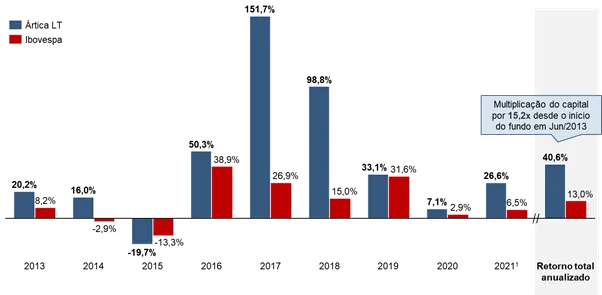
On June 27, Ártica LT FIA turned 8 years old. Since our inception in 2013, the fund has delivered a return of 15.2x the invested capital, equivalent to an annual return of 40.6% per year over the period! Over the same period, the Ibovespa rose 1.7x, or 13.0% per year.
What makes us even more excited is that, in our opinion, these levels of return were achieved without taking much risk. The fund has never used leverage and has always invested in stocks with a significant margin of safety (which we consider the best way to manage risk). A reflection of this is that, in the two crises we have been through (the 2015–16 crisis and Covid-19 in 2020), the fund outperformed the Ibovespa.
The chart below shows the fund’s annual return since inception:
Chart 1 – Ártica LT FIA annual return1
In this month’s letter, we present some factors that we consider important for our investors to know about and that were crucial to achieving this performance since our founding.
Alignment between managers and investors
As many of you know, Ártica LT FIA began as an investment club created to invest the own capital of Ártica’s partners and team. To this day, a significant share of the personal wealth of all partners and members of the investment team is invested in the fund (more than 70% of their wealth for several of us).
This level of personal exposure creates a strong alignment of interests between our investment team and the other investors in Ártica LT FIA. We remain fully focused on delivering excellent returns, and we think carefully about risks before making any investment decision. It may seem obvious, but without significant own capital invested in the fund, a manager might prefer to raise more money for the fund even if it meant lower returns, since this would increase management fees, or might take more risk than appropriate, since the manager would share more in the gains than in the losses. We manage Ártica LT thinking about how to preserve and grow our personal wealth invested in the fund. Exactly the same objective as our investors.
Focus on the best theses
An important part of our strategy is to always invest in between 5 and 15 companies, with positions ranging from 5% to 25% of the fund’s assets. This profile may seem concentrated to many investors, but it is what we consider ideal for achieving the best risk-return relationship for the fund.
From a return standpoint, it is intuitive to think that the 10 best ideas will always have a potential return far superior to the next 40. In other words, in a portfolio of 50 stocks, the 50th best stock has a much worse expected return than the best one, so adding it to the portfolio should reduce the potential return of the portfolio as a whole.
From a risk standpoint, a portfolio of 10 stocks already captures most of the risk reduction that diversification can provide and, with a limited number of companies, we are able to reach a greater level of depth and conviction in each thesis, which we believe is the best way to control portfolio risk.
For more details on this topic, it is worth reading the letter we wrote in Nov/20.
Atypical opportunities
As part of our strategy, we actively monitor atypical opportunities that few investors analyze. Such opportunities can arise in several ways, but the most common are: (a) discounts between share classes; (b) holding company discounts; (c) subscription warrants; and (d) M&A or delisting opportunities.
For example, an investment we have made that fits situation (a) above was the long-short2 with Itaú shares, which trade on the stock exchange through two share classes: common (ITUB3) and preferred (ITUB4). Both shares pay the same amount of dividends, but ITUB3 trades at a discount of around 10% to 15% relative to ITUB4.
At one point, the discount between ITUB3 and ITUB4 exceeded historical limits, so we built a long position in ITUB3 (long) and a short position in ITUB4 (short). What makes this investment interesting is that, in this case, we would make money not only when the discount returned to its historical level, but also if it remained constant.
The reason is that, for identical financial exposure on the long and shortlegs, the number of ITUB3 shares purchased was greater than the number of ITUB4 shares sold, which allowed for a positive exposure to Itaú shares without committing a single real of the fund’s capital (for example, for an exposure of R$1.0 million on each side, and assuming that ITUB3 trades at R$25.00 and ITUB4 at R$28.57, we would have to buy 40,000 ITUB3 shares and sell 35,000 ITUB4 shares, that is, a net positive exposure of 5,000 shares). As a result, whenever Itaú paid dividends, we would be rewarded for our positive exposure to the company, which would very likely exceed the cost of borrowing the shares we sold short.
The advantage of this type of strategy is that it delivers a differentiated return with a considerably reduced exposure to risk. It works as an important return complement for the portfolio, especially in rising markets, when it naturally becomes harder to find good investment opportunities.
Another example of this type of transaction that we have already discussed in a letter was the case of Bradespar and Vale. For more information, see our letter from Feb/20.
Technology to improve the quality of decisions
In recent years, we have invested more and more in technology to support the fund’s day-to-day management, both to speed up our analysis processes and to improve the quality of our decisions.
Some examples worth mentioning:
- Monitoring of special situations: As mentioned in the previous section, we actively seek atypical arbitrage opportunities that often go unnoticed by investors. To help with this process, we have developed robots that monitor equity markets 24 hours a day and alert us whenever potential opportunities are identified.
- Analysis of insider purchases: Companies listed on B3 publish the “CVM 358” report every month, which presents the purchase and sale transactions carried out by the company’s “insiders” (officers, board members and controlling shareholders). We have developed an algorithm that compiles all the published reports and shows us, fully automatically, all the purchase and sale transactions by “insiders” at every company listed on the exchange. Purchases by “insiders” (management, board, controlling shareholder) can be an important indicator of an investment opportunity.
- Data intelligence: To monitor the companies we invest in and follow, we routinely collect public data from the internet on a massive scale, using robots that scan websites and gather information in a structured way. Having this information allows for deeper analyses, or the ability to anticipate trends that benefit or harm certain companies.
Discipline and patience to invest
Finally, an important aspect of our management model, which has been in our DNA since the fund began: we are highly disciplined in maintaining rigor in choosing the assets that make up Ártica LT’s portfolio, and we only invest when we find excellent investment opportunities.
When investing, our goal is always to select the companies that have a strong chance of delivering good returns and to exclude those with a relevant risk of performing poorly. The problem is that this distinction is never known beforehand, and we are always subject to two types of error:
- Type 1 error: Rejecting a good investment
- Type 2 error: Approving a bad investment
As part of our philosophy, we believe that type 2 errors are more harmful to the fund’s results in the long run, and for that reason we seek to minimize them as much as possible, even at the cost of letting good opportunities pass.
Following this philosophy is harder than it seems, because excellent investment opportunities are rare and we can spend months (or years) analyzing many stocks without pulling the trigger on any thesis, until a good opportunity is found. Over time, this can become frustrating, and the temptation arises to relax our criteria in order to invest more often. To avoid falling into this trap, we are always careful to maintain the discipline and patience needed to invest only when we have real conviction in the thesis.
1 Ártica LT FIA began on June 27, 2013 as an “investment club” and, on September 27, 2019, it was converted into an “equity investment fund.” Returns shown from inception on June 27, 2013 through May 31, 2021
2 Long: investing in a stock (gains occur when the stock appreciates); Short: betting against a stock (gains occur when the stock depreciates). So-called long short are used for investments in which the thesis is the relative change in the value of the assets, rather than the absolute change.