
Investing in Brazil Is Still Worth It
Dear investors,
The letters we have published this year lay out our pessimistic expectations for the global and Brazilian economies in the coming years. Geopolitical tensions and the high level of public debt in several major nations should make growth harder for everyone. Even so, we are increasing the share of our personal wealth allocated to equities, while most of the market prefers fixed income.
We know our words and our actions look contradictory, and that popular wisdom has good reason to distrust equity fund managers who tell people to buy stocks. In this letter we share the reasoning behind our decision, so that each of you can judge its merits for yourself.
Returns don’t come from optimism
The market prices stocks based on the return expectations that exist at a given moment for each company. If this average of opinions were always right, the return on an investment in any company would equal the base interest rate plus a risk premium. We know that is not what happens in practice.
Returns vary widely around that theoretical benchmark. The first conclusion, then, is that market forecasts are often wrong. The second is that returns on equity investments don’t depend on whether a company’s results improve or worsen relative to its recent history, but on how the future unfolds compared with the earnings projections already implied in today’s share prices.
If the market turns more pessimistic on a company, its share price will fall to the level that offers the return investors require should that pessimistic future materialize. An investor who buys the stock will earn poor returns if the company’s results come in even worse than expected, and can earn excellent returns even if results are still negative, as long as they are less negative than expected.
What really matters is the gap between an investor’s expectations and the market’s average expectation. When we say a company is cheap, the more precise statement is that we believe its future will be better than what the market is projecting for it right now. We will earn good returns if we are right in that divergence of projections.
The right time to invest in a stock is not when we feel optimistic about the economy in general or about the prospects of the company under analysis. It is when there is a meaningful divergence between our expectations and the market consensus for that company’s results, and we judge that we have a high chance of being right. This is what we call price asymmetry. It is perfectly possible to earn poor returns in good times and good returns in times of crisis, depending purely on whether we are right in the divergence of views.
GDP and the stock market
If the theoretical argument doesn’t convince, just look at the historical series of Brazilian GDP growth and IBOV changes. There is no meaningful correlation between the two indicators. In several years, the stock market even moves in the opposite direction from the economy’s growth.
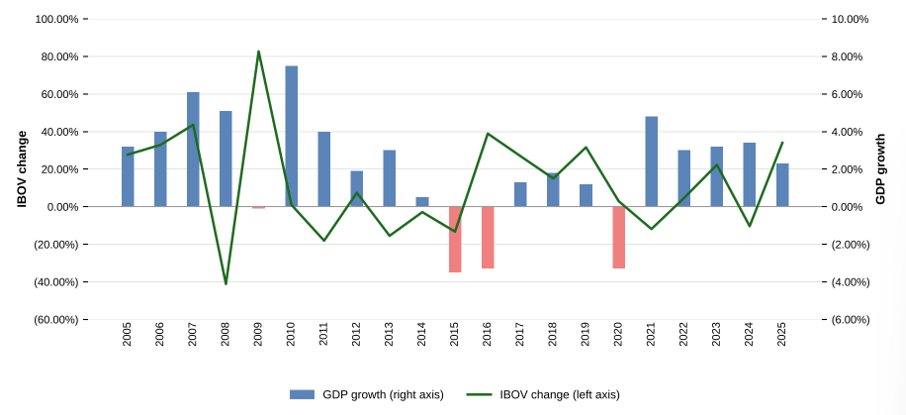
Source: IBGE and B3
One counterpoint would be that the stock market’s movement should signal what will happen to GDP in the following years, since the market always prices future expectations rather than what is happening at the same time as the IBOV’s change. At times this has held true, as with the IBOV’s rise in 2009 ahead of the GDP recovery in 2010, but at others it has not, as with the IBOV’s declines in 2021 and 2024, which were not followed by any meaningful change in GDP growth. In other words, the market is sometimes right and sometimes wrong. Nothing new under the sun.
A realistic view of Brazil
Our country is not easy. We agree that the problems commonly cited in public debate are real and hard to solve. The fiscal imbalance is serious, corruption and poor public management are chronic, and the tax system is terrible. We would add a few items to the list that we don’t see discussed as much. The political system is dysfunctional, populism is creating incentives that reduce labor productivity, and we have a deep education deficit (we wrote about this in the letter “Why doesn’t Brazil grow?” – Sep/2025). Why invest here, then?
Our country’s potential is enormous. We have vast territory, abundant natural resources, cheap energy (looking at production costs, before the taxes levied on it), a large population without major ethnic or religious conflict, and peaceful international relations. What limits Brazil is not the ground we stand on but what people have done with it. Comparing what we are with what we could be, it is hard not to vent our frustration and turn a little sour.
Our life experience leads us not to believe this potential will be put to good use any time soon, so our patriotic side is bound to stay frustrated. Perhaps permanently. Our investor side, however, has to set aside idealistic aspirations and stay purely pragmatic.
Brazil is not a terrible country. It is a middling one. Many nations in the world are more successful, but there are even more that are worse off. Our politics is confused and dysfunctional, but we don’t have major instability. The economy is not booming, but it is resilient. Historically, Brazil has managed to make the reforms needed to avoid economic catastrophe, although it acts late, only when it becomes clear there is no other way out.
The outlook always carries this nagging tone of mediocrity, but it is possible to invest and earn good returns in a stably mediocre environment. In a way, it is the backdrop we are used to. Ártica Long Term was created in 2013, and since then Brazil has not had a good run. Overall, it has moved sideways. Even so, we were able to find many interesting investment opportunities and earn excellent returns.
Why not invest only in better environments
Why not invest in a country with a better economy, such as the United States? Because everyone is aware of the quality gap between the two economies, and the market clearly reflects it in prices. Brazilian stocks trade at roughly half the price of US stocks, using valuation multiples as the basis for comparison. Today the discount is even wider, close to 60%.
Note that even the United States is not free of problems. Public debt and the fiscal deficit are at record levels there as well. There are also populist waves distorting what we would consider good public policy. They don’t have many of our problems, but they have some that we don’t share. For example, involvement in wars, both cold and hot. At equivalent prices, investing in the United States would be an obvious decision. At double the price, it is quite debatable.
Since 2024, we have been studying investment opportunities on foreign stock exchanges. Today, 12% of the Ártica Long Term portfolio is invested abroad, in three companies headquartered in the United Kingdom, Sweden and Japan. We keep most of the portfolio in Brazil because there are cheap stocks here, and we believe the price difference more than makes up for the quality gap relative to some international companies, at least in the specific cases of our holdings.
That last caveat matters. The real comparison is not between Brazil and other countries. It is between specific opportunities we have identified in Brazil and specific opportunities we have identified elsewhere. We are not investing in the IBOV or the S&P 500. We are hand-picking companies in which we believe there is enough quality and meaningful price asymmetry.
Micro factors matter more than the macro environment
There is a strong bias toward giving political and macroeconomic topics more attention than they deserve. In our own letters, they take up far more space than the influence they have on our investment decisions. We understand this happens mainly because they are subjects of common interest to most investors, while discussing specific companies is relevant to a much smaller group of people. In the case of our letters, there is also the fact that sharing details of our investment theses is generally not in our investors’ interest. We occasionally share what we judge will do no harm, but most of our analyses are kept as trade secrets.
In general, a company’s future depends far more on its microeconomic context than on the course of the national economy. The competitive dynamics of the sector, trends in the specific demand the business serves, movements in its supply chain and the financial condition of its direct customers are examples of factors with more impact than the evolution of the economic environment. The caveat applies only to extreme cases, such as hyperinflationary crises, sharp currency devaluations, changes of political regime and the like. Most of the time, the micro governs a business’s fate more than the macro does.
An analogy that helps clarify the point is judging a recent graduate’s odds of success in their career. The person’s level of competence and dedication matters much more than the current state of the job market. The gifted and hardworking will always find their place in the world, and the incompetent and negligent will always run into professional trouble. A better or worse job market shifts the cutoff line marginally and affects how many near-average professionals land good jobs, but most young people won’t see their fate changed much by the country’s unemployment rate.
We believe Brazil today is not close to the kind of economic catastrophe that would invalidate this general rule, and that a handful of companies listed on our stock exchange are good enough to invest in when the market price is attractive.
Sometimes the opportunity comes not from the company being phenomenal, but from its having a highly defensible competitive position. The fact that the Brazilian economy is not so dynamic ends up having a positive side for companies that already dominate their business segments. There is a major barrier for new entrants to finance their businesses and grow to the size at which they could really challenge the market leaders. Here it is much less common to hear stories of start-ups that raise billions in the market, become new giants and unseat the incumbents. That is not exactly good for the national economy, but it allows certain companies to stay dominant and profitable for long periods. Naturally, these are good candidates to invest in.
Why not fixed income
The biggest concerns about the Brazilian economy today come from the fiscal deficit and the level of public debt. Even with the problem out in the open, the government keeps spending more than it collects and covering the difference by taking on more debt. This path inevitably raises sovereign debt risk, keeps interest rates high and makes it even harder for the government to honor its debt as investors expect.
Since the debt is in local currency, we don’t expect the government to simply stop paying it. The most likely path is that the real value of the debt, and of the payments tied to it, is eroded by an expansion of the monetary base, which generates inflation, and by financial repression, which is a set of subterfuges to keep public debt interest rates lower than a free market would set them (we explore this logic at greater length in the letter “The Future of Indebted Countries” – May/2026).
In this possible scenario of inflation and financial repression, fixed-income securities are directly affected. It would be a flat contradiction to fear this possibility and try to protect ourselves from it by investing in fixed income. The asset classes that would offer the most protection are commodities and real estate. But they are not automatic solutions either. Commodities have the problem of high volatility, and real estate doesn’t usually offer such attractive returns.
Crises create opportunities
Equities are an always-controversial asset class. In aggregate, they also tend to suffer in unfavorable economic scenarios. However, there is a very wide dispersion of risks and potential returns among the individual stocks that make up this class. We have no appetite for investing in market indexes, but since we can choose businesses with a high chance of shielding themselves well from macroeconomic adversity, investing in stocks is an attractive option for us.
In short, we are reducing our personal investments in fixed income and buying more stocks because fixed income is becoming riskier and there are cheap stocks available in the market. Investing in real estate seems to us a valid strategy for those who prioritize only capital preservation, but it is not our personal choice. It is in moments of pessimism that the best opportunities to buy cheap stocks arise. Some of our best investments were made in 2014–2015, during the crisis surrounding Dilma Rousseff’s impeachment.
Today, we see a very attractive return potential in our portfolio, despite all of the country’s problems. We remain frustrated by how much Brazil is wasting its chance to prosper, but we don’t intend to waste the opportunities the market is offering us to contribute to the prosperity of our investors.