

The Problems with the Diversification Thesis
Dear investors,
In January 2020, we sent a letter discussing our portfolio management process and the strategy used to determine the percentage of assets allocated to each position.
One aspect of Arcádia’s strategy that we consider quite different from what is practiced in the Brazilian market concerns the degree of diversification. Although it is common practice in developed markets such as the United States, we have noticed that more concentrated investment strategies are rare in Brazil, and are often treated as “taboo.”
Throughout this letter, we present the main reasons underlying our strategy of holding between 5 and 15 companies in the portfolio, with positions ranging from 5% to 25% of the fund’s net assets.
Concentration allows for greater potential returns
Our philosophy is based on allocating significant portions of our capital to the theses in which we have the highest conviction. We differ from most investors with regard to diversification because we believe that excellent investment opportunities are rare, and our 10 best theses will always have a much greater return potential than our 50 best theses. In a portfolio of 50 stocks, the 50th stock has a worse expected return than the 1st stock, so adding it to the portfolio should reduce the potential return of the portfolio as a whole.
For this reason, we concentrate more on the few great investments we find, rather than also investing in opportunities of average potential merely for the sake of diversification.
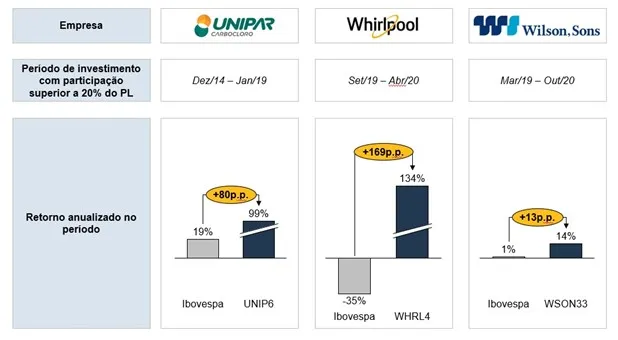
Throughout our history, we have had 3 investments that exceeded the threshold of 20% of the portfolio. In all of these situations, the returns obtained were far higher than those of the market in general over the respective periods and contributed significantly to Arcádia’s historical performance.
Chart 1 – Investments representing more than 20% of net assets
“In the field of common stocks, a little bit of a great many can never be more than a poor substitute for a few of the outstanding” – Phil Fisher
The natural question that arises after this explanation is the following: “Doesn’t this approach create more risk for the portfolio?”
In our view, it does not. The reasons are set out in the topics below.
Focus leads to greater depth of knowledge of the investee companies
A more concentrated portfolio forces us to be more careful in our decision-making, gaining a better understanding of the companies and of the risks involved in each investment. Even after a detailed analysis, an investment will only have a significant presence in the portfolio when we have a very high level of confidence in the thesis.
Achieving this level of confidence requires devoting considerable time to research and monitoring. This level of dedication is not possible in a highly diversified portfolio and, for this reason, we prefer to focus on a maximum of 15 investments at a time. In addition, between investee companies and those we monitor, each Arcádia analyst covers a maximum of 10 companies.
When concentration is accompanied by a deep knowledge of the assets and by the discipline and patience to invest only when there is a significant margin of safety, investment risk is reduced.
“Diversification is a protection against ignorance. It makes very little sense for those who know what they are doing” – Warren Buffett
A few stocks are enough to capture the benefits of diversification
Many investors seek diversification as a means of reducing portfolio volatility and risk (“not putting all your eggs in one basket”). Although this makes intuitive sense, the numbers show that the volatility-reduction benefit declines dramatically beyond about 5 investee companies.
The chart below illustrates this concept. It shows the expected volatility of a portfolio according to the number of companies held, and it is evident that the risk profile of a portfolio with 10, 20 or 30 assets is very similar.
Chart 2 – Diminishing benefits of diversification (portfolio volatility vs. number of assets held)1
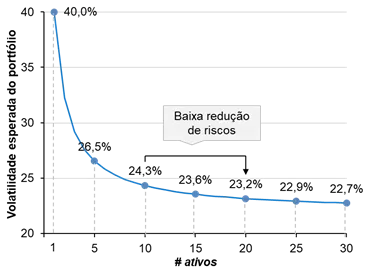
If a portfolio of 10 stocks has a risk profile similar to that of a portfolio of 30 and offers a superior return outlook, it does not seem to make sense to invest in the more diversified portfolio.
“The number of securities that should be owned to reduce portfolio risk is not great, as few as ten to fifteen holdings usually sufficiency” – Seth Klarman
Diversification does not protect against systemic risks
There are two types of risk to consider in portfolio construction: non-systemic risks and systemic risks.
Non-systemic risk is the risk that affects specific companies or sectors. Examples include regulatory changes affecting a particular industry, companies exposed to technological obsolescence, companies involved in accounting fraud, etc. This is the risk that diversification seeks to protect against but, as we saw in the previous section, a portfolio of 5 to 15 stocks already does a good job of providing such protection.
Systemic risk is the risk that affects the market as a whole. For example, an increase in interest rates in the economy reduces stock market prices as a whole, regardless of the company or the sector in which it operates. In this scenario, portfolio protection is not achieved through diversification, but rather through hedging mechanisms or allocation to other asset classes (e.g., increasing the portfolio’s cash position).
The Covid-19 crisis in March 2020 was an example of systemic risk, affecting the market as a whole. During the crisis, all stocks fell together, and diversification did not provide investors with greater protection precisely when they needed it most. Proof of this is that, during the Covid-19 crisis, Arcádia fell by as much as 34%, compared with a decline of up to 47% in the Ibovespa (an index with more than 60 assets) over the same period.
There are few listed companies in Brazil
The arguments in points 1 to 4 above are valid throughout the world. Even in the US stock market, with more than 5,000 listed companies, this range of 5 to 15 investments is sufficient.
In Brazil, the number of listed companies is much smaller. As of October 2020, there were 316 companies listed in Brazil, of which 96 have very low liquidity (less than R$250 thousand per day), leaving only 220 as legitimate investment opportunities. With a higher liquidity threshold (R$20 million per day), the number of remaining companies is only 126.
For comparison purposes, countries such as India, Canada and Australia, which have GDPs similar in size to Brazil’s, have 5 to 20 times as many listed companies. The charts below illustrate these figures:
Chart 3 – Number of listed companies in Brazil and comparison with other countries
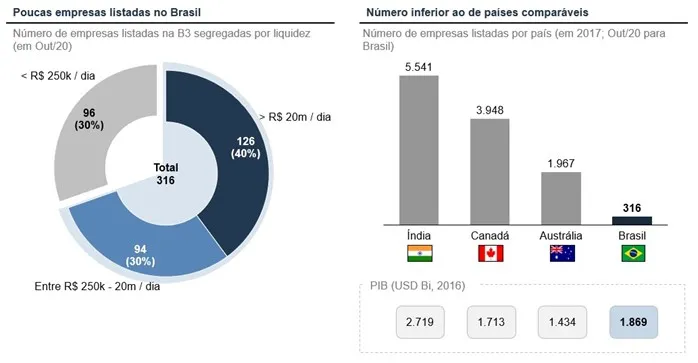
With only 220 companies with investment potential (126 under the liquidity threshold of many investors), it does not seem to make sense to us to build a highly diversified portfolio. A portfolio of 50 assets is betting that almost 25% of the companies on the stock exchange are good investments at that moment (good companies at the right price), which does not seem very likely to us.
In short, maintaining a portfolio of 5 to 15 companies allows us to concentrate our bets on the best investments, understand the investee companies well and maintain a comfortable level of diversification.
Our comfort with this level of diversification is reflected in the size of our personal investments in Arcádia – today, 58% of Arcádia’s net assets is capital from our team.
1 Assumptions: (a) standard deviation per asset of 40% (average standard deviation in Brazil); (b) correlation of 30% between assets (historical average for stocks); (c) assets held in equal weights