
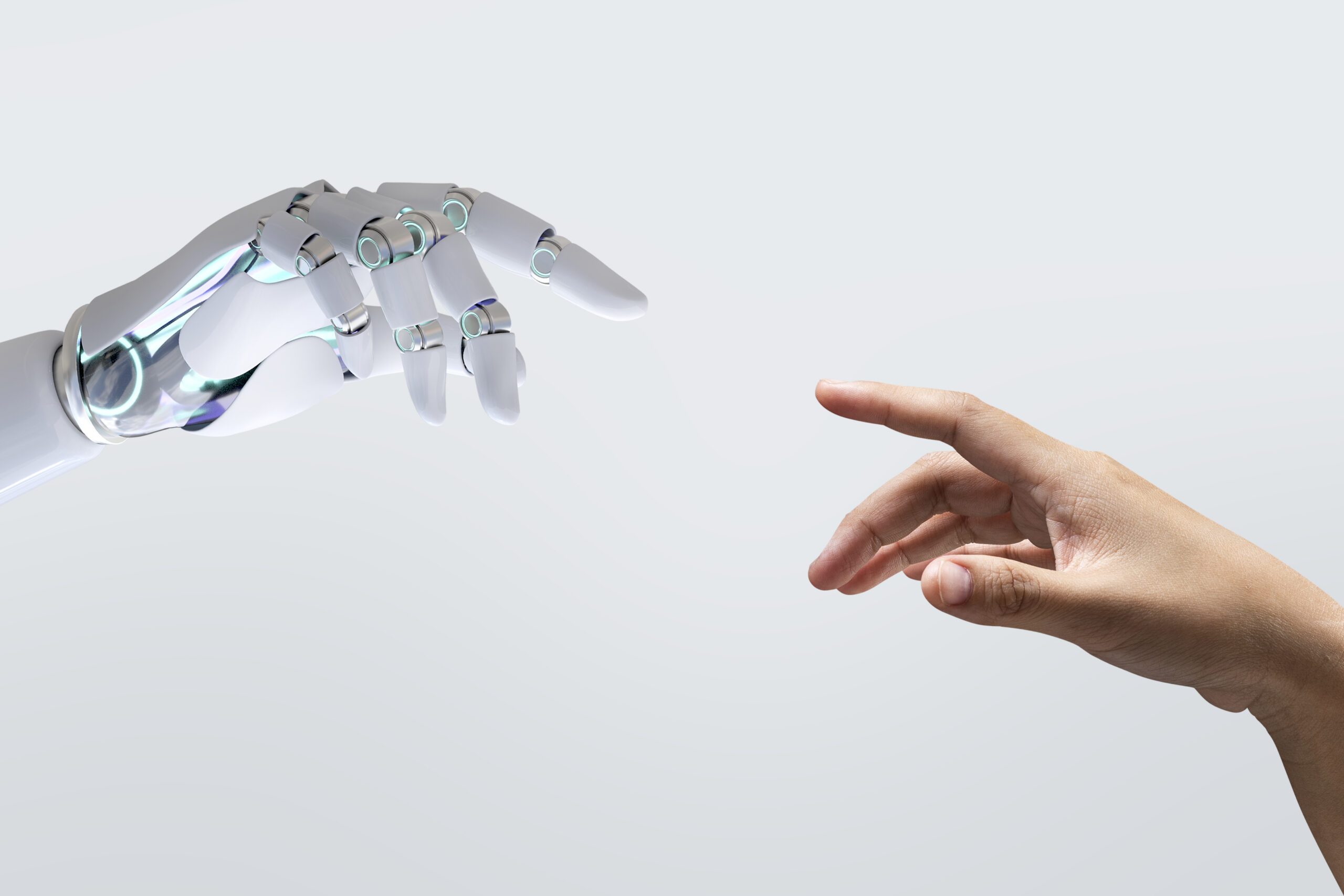
Our expectations for Artificial Intelligence
Dear investors,
ChatGPT was launched almost 4 years ago, in November 2022. Today, about 20% of the global population uses an artificial intelligence “(AI”) tool directly and half of humanity uses at least one service with embedded AI. It is the greatest technological revolution since the internet.
There has been much discussion regarding how far AI will go, but its current capabilities already seem sufficient to bring profound changes to the economy. Previous technological revolutions have destroyed companies that seemed to be unshakable and created new business giants. We believe this will happen again.
AI is the second cognitive revolution we have experienced. First, came the computer. We can review what happened during this first revolution to shed some light on what could happen with AI.
The impact of computers on employment
Computers were the first general-purpose technology that allowed us to automate what, until then, could only be done by human brains. Tasks that could be described step by step in logical and mathematical terms could then be programmed into software and quickly executed at very low cost. Productivity gains in these tasks were tremendous. Today, an RTX 5090, an NVIDIA consumer-grade video card, can run in a single second an amount of arithmetic operations equivalent to what a trained human would take about 3 million years of uninterrupted work to execute. This performance comes from decades of technological evolution, but the first computers were already thousands of times faster than humans in calculations.
Employing humans in tasks that computers could execute became pointless. All humans employed in tasks that a computer could perform lost their jobs, except for the best among them that migrated to the role of writing software for the computers that replaced them. However, right afterward, humans were still needed to find ways of using computers for specific purposes and to operate businesses offering computer-based solutions to the market.
Executing what humans did before was a very small fraction of the uses found for computers over the following decades. The very low cost and high execution speed enabled the use of massive computing power to several purposes, many of which unthinkable on the analogical era. The RTX 5090’s main purpose is to process sophisticated graphics for digital games. Decades ago, it would have sounded absurd to speak about using so much computing power for casual entertainment.
Computers made many jobs disappear but created a lot of new roles at the same time. The net effect on total jobs was positive, or at least neutral, because there was no secular increase in unemployment in developed countries.
General rule for technology and employment
Versatility is one of the human strengths. A person can perform a wider range of tasks than any technology has been able to perform to this day. As technological tools surpass human performance in specific tasks, jobs related to these tasks disappear and people move into other roles where human labor is still the better alternative.
Computers surpassed human capacity in arithmetic, but people continue to be required to develop the numerical methods used to coordinate the new massive computing power. Human computers disappeared, but mathematicians did not. Highly qualified humans are difficult to replace.
Replacing people also depends on whether it is economically efficient. Machines usually are better than humans in any repetitive mechanical process, but industrial robots are expensive. Automating every step of a production process is not always worthwhile. It is still common to see some tasks being done by humans in factories, just because human labor is still cheaper.
There are some activities where human presence is required. The number of elder caregivers is increasing as the population ages. Many specific tasks within this job description could be automated, but human empathy and the feeling of being with another person could hardly be provided by robots.
Considering these three general cases, the net effect on employment would be negative. What sustains the employment rate are the new jobs created after each technological revolution. It is not a logical requirement that enough jobs will be created to keep employment balanced, but we believe this will continue happening, because the range of possibilities for human action is infinite and society is interested in keeping its citizens employed. When there are time and resources available, we seek new ways to use them. In pre-industrial societies, it is estimated that 80% to 90% of the workforce was dedicated to agriculture. Today, only 1% to 3% of the workforce in developed economies works in this sector, while 70% to 80% of the employees are in the services sector, in jobs unthinkable centuries ago.
Impact of computers on the economy
Turning back to computers, we could expect that the extreme enhancement of computing power and the possibility of automating so many tasks at a low cost would give a great boost to labor productivity, but this did not happen. From 1948 to 1973, labor productivity growth in the U.S. was ~2.8% p.a. From 1973 to 1995, the period when computer adoption accelerated the most, productivity growth in America was ~1.4% p.a. It was as if computers had made no difference. This contradiction became known as Solow’s Paradox, in honor of the economist who observed, in 1987, “You can see the computer age everywhere but in the productivity statistics.” There are two main arguments that explain this paradox.
The first is that there is a delay between the creation of a general-purpose technology and the period of its most significant impact on labor productivity. Initially, the technology is used to optimize tasks inside the organizational framework in place, designed around the constraints that existed before the technological revolution. This productivity gain is quite limited. Afterwards, workflows are gradually reshaped to take advantage of the new technology. Only under this new organization will the greatest productivity gains take place.
There is an additional accounting consideration. The effort spent on reshaping operations will be recognized as an expense on the financial statements, and not as an investment on intangible assets. The benefits of this effort will materialize years later, without any new associated expenses. Therefore, profitability will be understated during the reorganization phase and overstated over the following years. A similar effect will take place on the aggregate national accounts. Productivity growth will be understated over the first years, when companies are adapting to the new technology, and overstated in the following period.
The delayed productivity gains from computers came during the period between 1995 and 2004, about two decades after the first commercially viable computers. Over this period, American productivity grew 2.8% p.a., but it went back to ~1.3% p.a. from 2005 to 2019, a period when computers and the internet materially advanced. This is where the second argument comes in.
Benefits from technological revolutions are not always fully captured in economic statistics. Productivity indicators try to capture cost reductions and quality improvements in products and services, but many new things, enabled by technology, do not have a previous price baseline and quality can be hard to compare to what existed before. Economic measures can be gross approximations. Most solutions that were created with computers would just be impossible to offer with human labor.
If a new product is created and offered to the market at a very affordable price, passing on most of the benefits coming from new technology to end consumers, productivity gains can be hard to measure and even contribution to GDP can be negligible. For example, Google Maps is a great service, and it is free. It certainly saves a lot of time people would otherwise waste getting lost on the streets, but this optimization is hard to capture in economic statistics. As it is free, it also does not directly contribute to GDP.
Microeconomic impact
When we shift our focus from the broad economy to individual businesses, the impact of computers is much clearer. Just as with employment, companies operating in obsolete segments disappear, resources must be reallocated and new businesses that were unimaginable before are created.
Among the companies that suffered are the manufacturers of writing machines (Olivetti), of photographic films (Kodak), encyclopedia publishers (Britannica), video rental chains (Blockbuster).
There were cases of adaptation, like IBM. Until 1950, its main technology was punched cards, used to store and process data without computers. It fell into obsolescence after computers were created. However, IBM turned around. It used its resources and market position to create the mainframes, corporate computers that made IBM the absolute leader in the computer industry for decades. Up to this day IBM is a relevant company, but far smaller than it was in the 1970s and the 1980s.
New giants were created to serve before non-existent demands. Intel as a microprocessor manufacturer, Oracle with database solutions, Microsoft with the operating system that dominated the computer arena and Apple with the expansion if personal computers.
There is no rule of thumb to identify who will be the winners and the losers after each new technology, but there are a few general principles that can help us to analyze each opportunity.
In the first place, identifying what a new technology will replace is not particularly difficult, but usually a great number of companies are created seeking to lead the movement and competition can be fierce. Warren Buffett illustrated this concept with the example of the automotive industry. When cars were created, it was easy to understand that they would replace horse-pulled carriages. However, 2,000 automakers opened for business between 1885 and 1930. In the 1930s, only 3 of them (Ford, General Motors and Chrysler) dominated the market. Most of the remaining companies were bankrupt. It was almost impossible to identify which 3 among the 2,000 would be victorious.
Another concept that is vital to investors is that there is no guarantee that technological revolutions will generate wealth for companies that offer solutions based on the new technology to the market. A good example is the case of airline operators. Airplanes were revolutionary for transportation but did not generate attractive returns for shareholders. Most of the big American airlines went through financial distress or bankruptcy.
Together, these two principles invalidate the instinctive strategy of searching for businesses that will be part of the technological revolutions and buying their shares to get good returns.
A business must have competitive advantages to offer something that is scarce on the market to be able to achieve high profitability and generate high returns for its shareholders. Who controls bottlenecks in supply chains captures the most value, in traditional or new industries. In the airplanes supply chain, turbine manufacturers were much more successful than airline operators.
Identifying which bottlenecks will disappear and which new ones will be created must be the focus of the search for new investment opportunities. If at first a company held an advantage because its team of human computers was the best, later the advantage shifted to those with the best electronic computers. A much weaker advantage, nonetheless, because a competitor could just buy the same computers to achieve the same capacity. The main bottleneck was not the computing power anymore, but the capacity to manufacture chips and software. Intel and Microsoft became giants because they controlled a big slice of the capacity to manufacture these products.
Parallels with artificial intelligence
Optimists foresee that in less than a decade AI will surpass human intelligence and cause massive unemployment but also eliminate the scarcity of goods and services that has been the underlying assumption of economics to this day. We are skeptical about this narrative. There were many similar expectations in the past and all of them have failed to materialize.
We believe AI will still get a lot better. This always happens in the maturation process of new technologies and a massive amount of resources are being dedicated to this goal. However, it is likely that the same patterns that could be observed in past revolutions will still be valid for AI.
Regarding employment, many people will have to change jobs, but not all of a sudden. Even jobs clearly exposed to the AI threat, such as programmers, are not quickly vanishing. The Federal Reserve published a report last March with statistics that show that the number of programming jobs in the U.S. is still growing, despite growing more slowly than before 2023. It is likely that corporations will slowly integrate AI over the next several years and the job market will have time to adapt and keep employment levels stable.
Many companies are adopting the “human-in-the-loop” model, in which a person participates in workflows together with AI, validating results and reviewing decisions. It is not so different from the usual model, in which a person operates a machine or tool. In the same way that there are industrial plants with greater or lesser levels of automation, there will be workflows with higher or lower AI automation.
Productivity gains and boosts to economic growth should also not be exponential. There is no doubt about the great benefits of AI. To allow every person to quickly get access to a broad range of knowledge by asking AI questions is already amazing. However, labor productivity statistics and GDP growth over the past few years are not outliers compared with what we observed in other periods before the rise of AI. It is likely that most productivity gains will come gradually, as processes are redesigned to get the most from AI, and that much of the created value can be passed on directly to end consumers, without being fully captured by economic indicators.
Which companies will be the great winners or losers in the AI revolution is one of the most important questions for investors but answering it is not enough. Every investment opportunity depends on price to be labeled good or bad. The most obvious cases have been quickly identified and are trading at valuations that imply greater optimism than we assume in our forecasts.
We have been evaluating the potential impact of AI in each of our portfolio companies and in each investment candidate. Our priority is to avoid the risk of loss. When we identify potential gains, we treat them as options. We are willing to pay a small price premium for them, but it is not our practice to assume that everything will go our way and embed every potential gain in our financial forecasts.
We are also searching for opportunities by asking the reverse question: what will not change? With AI capturing all the attention and against the backdrop of a massive migration of capital to this new sector, maybe other interesting businesses will be overlooked and become undervalued by the market. The greatest price asymmetries will hardly be in the spotlight.