
Contexto
Family-owned businesses are the backbone of much of the global economy. Estimates suggest that they account for between 70% and 90% of global GDP1.1Their importance in Brazil is no different: an estimated nine out of every ten Brazilian companies are family-owned2.
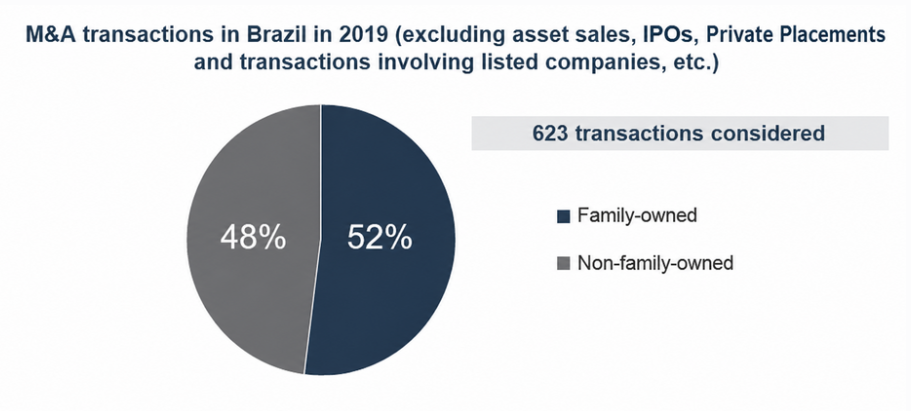
Given their weight in the economy, family-owned businesses also account for a significant share of M&A activity. In Brazil alone, 623 company sale transactions were identified in 2019, and 52% of them involved family-owned businesses.
Yet the implications of family ownership in an M&A transaction, particularly when the company is being sold, remain underexplored. The first technical publication on M&A dates back to 1921, but the first article addressing the distinctive features of M&A in family-owned businesses was published only 67 years later3. The first academic literature review on the subject did not appear until July 2017 4.
This white paper summarizes the available knowledge on M&A transactions involving family-owned businesses. Its purpose is to help shareholders make better-informed decisions when opportunities arise and to guide them through a complex process. Although the discussion is intended to cover family-owned businesses broadly, some topics are specific to medium-sized and large companies with annual revenue above R$50 million.
1 “Perspectives on Founder- and Family-Owned Businesses”, McKinsey & Company (2014).
2 “Family Business Governance: Evidence from Brazil”, PwC and IBGC (2019); Fundação Instituto de Administração (FIA).
3 Astrachan, J.H. (1988), “Family firm and community culture”, Family Business Review, Vol. 1 No. 2, pp. 165-189.
4 “Mergers and acquisitions in family businesses: current literature and future insights”, Maija Worek, Department of Strategic Management, University of Innsbruck, Innsbruck, Austria.
Distinctive Features of Family-Owned Businesses
Family-owned businesses differ from other companies in their governance structures, financial preferences, social priorities, and other non-financial objectives. These characteristics shape their strategic decisions, which means that conventional M&A theories and practices cannot always be applied to them without qualification.
Governance structures
In a family-owned business, ownership and management, in the sense of control over operating decisions, are held by one or more members of the family.
A survey conducted by IBGC with 279 privately held family-owned businesses in Brazil illustrates this clearly5:
- 64% have the founder working in the company;
- 82% have a member of the controlling family as CEO;
- In 71% of cases, at least one first-generation family member is involved in the company, whether in management, on the board, or as a shareholder; and
- In 42% of the companies, every executive officer is a family member.
Because there are often no shareholders from outside the family circle, governance structures tend to be less formal and less clearly defined. Decisions are frequently based on the practical experience of the founders or family members running the business. This can make strategic discussions among shareholders more complex, particularly when different generations and branches of the family are involved.
The business usually represents far more than a financial asset to the family. As a result, handing leadership to an executive who is neither a family member nor a shareholder can be difficult. Even when the family agrees to do so and begins searching for a candidate, compensation may become an obstacle. Family executives are also shareholders and receive dividends, so executive pay policies are not always aligned with market practice.
At the same time, succession planning for key positions is often postponed. This delays the debate over professional versus family management and avoids competition among heirs for executive roles.
Financial Preferences
Family-owned businesses tend to take a longer-term view. Their plans may be tied to targets, but they are not driven solely by annual budgets or quarterly reporting cycles. Instead, these companies often think in years or even generations, and the desire to leave a legacy may outweigh short- and medium-term financial goals.
They also tend to have greater flexibility. Unlike listed companies, they are not bound by the same operating structures, investor communication requirements, or financial disclosure obligations. Some are also willing to live with a certain level of contingencies or tax exposure.
Finally, family-owned businesses are typically more financially conservative. They rarely operate with high leverage and usually calibrate growth to their ability to generate cash internally and to the family’s dividend requirements.
5 Source: “Family Business Governance: Evidence from Brazil”, IBGC and PwC (2019).
Social priorities and other non-financial objectives
Every company has its own history, shaped by the challenges of running the business, its successes and lessons learned, and the difficulty of balancing professional and family life. Once a certain level of financial security has been reached, the controlling family may choose to use the business, or the dividends it generates, to strengthen its legacy and give back to society by supporting social, cultural, or environmental causes. In these cases, the conventional objective of maximizing shareholder value must coexist with the family’s broader priorities, influencing management decisions.
Why Families Decide to Sell
Why would a family decide to sell its business? Each of the three dimensions involved, family, ownership, and management, has its own interests, needs, expectations, rights, and obligations. A sale usually becomes more likely when misalignment among these dimensions persists over time.
Resolving or avoiding family conflicts, the leading reason according to IBGC research:
Resolving (or avoiding) family conflicts (the main reason, according to IBGC’s research): conflicts may arise within the business itself, for example when shareholders feel that management does not respect or listen to them. They may also originate elsewhere in the family and spill over into the company, damaging the business.
Professionalizing management, for example after the founder’s death: if there are no interested or qualified heirs and no succession plan is in place, a sale may be the fastest and least risky way to preserve the family’s wealth. A sale may also result from the company’s success when the scale and complexity of the business outgrow the family’s management capabilities.
The family becoming less involved in the business: shareholders may no longer participate in day-to-day operations, monitor management, or engage in ownership discussions. Alternatively, the family may identify another attractive opportunity that requires both capital and attention and decide to pursue it.
Completing the entrepreneurial cycle and realizing the value of the business: after investing much of their lives in the company, shareholders may want liquidity, better risk management, and greater diversification of family wealth.
Taking advantage of a favorable opportunity: recent performance may support a high valuation that the family does not believe is sustainable. In other cases, a buyer may simply make an attractive offer because it sees more value in the asset than the family does.
Financial difficulties, weak performance, or the risk of a sharper decline in value:economic, competitive, or industry-specific pressures may threaten the business, and failing to act could put the family’s remaining wealth at risk.
Finally, growth opportunities may require a partnership with another investor or strategic playerthat can provide expertise, capital, or both, as in a transaction with a private equity fund.
Critical Aspects of a Sale Process, and How to Prepare
Overlooking issues specific to family-owned businesses can jeopardize an M&A process, from reducing value during negotiations to preventing the transaction from closing. The main recommendations are set out below.
1. Align the family
Ideally, the family should reach consensus before deciding to sell. The more aligned the shareholders are, the stronger the negotiating environment. A lack of consensus weakens the family’s position, can slow negotiations, and may allow a buyer to exploit internal differences to obtain better terms. Even if disagreements continue behind the scenes, the family should present a united front at the negotiating table. If necessary, one person should be appointed to represent the family and ensure consistent communication throughout the process.
2. Prepare the company for sale
Investing in preparation can make a significant difference to the company’s value. This is true in any M&A transaction, but it is especially important for family-owned businesses because of their particular characteristics. Key steps include:
a. Produce reliable financial and management information: the more confidence a potential buyer has in the numbers, the more likely it is to submit an attractive offer. Before approaching buyers, the family should consider organizing the accounting records, auditing the financial statements, reconciling management reports with the accounts, and preparing a detailed business plan for the coming years.
b. Reduce informality, risk, and contingencies: every transaction involves an information and risk-perception gap between sellers and buyers. Practices that current owners have accepted for years may reduce value for a buyer or prove entirely unacceptable. Examples include operating without formal agreements with key customers or suppliers, paying employees informal performance bonuses, or taking aggressive positions on tax-planning opportunities. Sound advice helps shareholders identify these issues in advance and prepare negotiating alternatives, increasing the likelihood of a successful transaction.
c. Professionalize key management positions: buyers often worry that critical business knowledge will leave with the family, including customer, employee, and supplier relationships. Even if family members remain after the sale, a buyer may assume that their motivation will decline once they are no longer shareholders. One solution is to implement succession plans for key positions held by family members and reduce the company’s dependence on the family. Because these changes take time, preparation should begin well before a sale process.
d. Consider a pre-transaction corporate restructuring: this can unlock additional value for sellers. Typical benefits include (i) removing non-operating assets, such as real estate, from the company being sold so that they remain with the family; and (ii) improving the sellers’ tax position. By way of illustration, selling a company through a family holding company may result in up to 130% more income tax on the capital gain than completing the transaction directly at the individual shareholder level.
3. Do not rush
Families frequently underestimate how long and demanding a sale process can be. A typical M&A transaction involving a family-owned business can easily take more than a year.
Discipline and patience are essential to securing the best terms. The buyer is often a strategic company whose executives have many competing day-to-day priorities. What seems like a short delay of a few days to an executive may feel far longer to a family waiting for a response on a critical negotiating point.
A clear timetable helps manage expectations. If the family feels pressure to close because of necessity or emotional fatigue, it may concede points simply to accelerate the process, without actually bringing the closing date forward.
4. Do not negotiate alone
It can be a serious mistake for an owner to act as the lead negotiator in the sale of the company, particularly when he or she must report back to other members of the same or another family. The risk is greater when the owner also runs the business: the time required by the transaction can distract management, affect performance and business continuity, and ultimately reduce the company’s attractiveness.
There are several reasons for this. First, the owner may have limited experience negotiating an M&A transaction, and a sale and purchase agreement often contains hundreds of issues beyond price. Second, keeping the ultimate decision-makers away from the negotiating table creates useful distance, allows alternatives to be considered more calmly, and reduces pressure to accept a point in the heat of the discussion. Finally, it helps avoid conflicts of interest and misalignment with the rest of the family.
5. Run a structured sale process
In Brazil, business owners often say they are “open to a sale”: they are willing to discuss a transaction if approached by a potential buyer, but are reluctant to “put the company up for sale” because they fear this may disrupt the business or be misinterpreted by third parties, or, worse, by the family itself.
Understanding buyers’ motivations and decision-making processes in advance makes it possible to plan how discussions should be conducted. Failing to plan this stage sharply reduces the likelihood of a transaction because most potential buyers are not actively looking for opportunities. It also makes it harder to maximize price. A buyer that approaches the owner directly will generally want to avoid a competitive process and, as a result, pay a lower multiple.
With appropriate safeguards, it is possible to run a broader process while preserving confidentiality around outreach and negotiations, thereby improving the chances of achieving a higher value. After all, how often has a business owner read about a transaction in the press without having suspected that it was under way?
6. Plan for life after the sale
Before negotiations begin, the family should consider what life will look like after the transaction. If preserving the company’s legacy matters, this should be defined in advance and included among the criteria used to select a buyer:
- Will the company’s brand, values, and culture be preserved?
- Should family members remain in management after the transaction? If they do not wish to stay, how long would they be willing to support a transition?
A liquidity event also raises important questions about the management of the family’s wealth:
- How should the proceeds be invested? How can the capital be preserved to support future generations?
- How should liquidity be managed for family members who may not be able to do so effectively on their own?
There are many possible solutions. Waiting until after the transaction to consider them can lead to poor decisions and a loss of capital.