
Negotiation in M&A Transactions
Introduction
The Temple of Karnak is the largest temple in Egypt. Built by several pharaohs between 2,200 and 360 BC, it contains a number of structures, the most prominent being the great temple of Amun. On one of this temple's walls, hieroglyphs describe the Treaty of Kadesh, also known as the Eternal Treaty.
Celebrated 3,500 years ago, the Treaty is a “ceasefire” between the Hittites and the Egyptians. After 20 years of a costly, bloody war marked by threats from other neighbors, Pharaoh Ramesses II (Egyptian) and King Hattusili III (Hittite) brought the conflict to an end.
The document has the hallmarks of a modern agreement, including clauses declaring the end of the war, the repatriation of refugees, prisoner exchange, and mutual assistance in the event of an attack by a third party.
This is the only document from the ancient Middle East that has survived in two versions. In addition to the Egyptian version, a Hittite version was also found, written in cuneiform script. The content of the two documents is very similar, as would be expected, but there is one crucial difference: the Hittite document says it was the Pharaoh who surrendered and asked for peace, while the Egyptian document says the opposite.
As illustrated by the Treaty of Kadesh, humanity learned long ago that for a negotiation to succeed, it is important for the other side to feel that it “won.”
Although knowledge about negotiation is not new, the start of the systematic study of modern negotiation techniques is attributed to the founding of the “Harvard Negotiation Project” in 1979. The project was created with the mission of improving the theory and practice of conflict resolution and negotiation, working on real-world conflict intervention, theory building, education, training, and the dissemination of new ideas. This initiative gave rise to the book “Getting to Yes,” published in 1981, which became a classic on the subject of negotiation.
The book advocates a collaborative negotiation style, in contrast to the combative style that most novice negotiators tend to adopt. It also discusses a technical and rational approach to analyzing negotiations, with useful concepts that are still widely used today. However, this purely rational approach has practical limitations. It cannot explain, for example, the results obtained in what is known as the ultimatum game, which works as follows:
The house awards a prize to one person, the leader, who must split it with a second person, the receiver. Once the leader's split proposal is made, the receiver has only two options:
(i) accept the proposed split;
(ii) or reject it, in which case neither party receives anything.
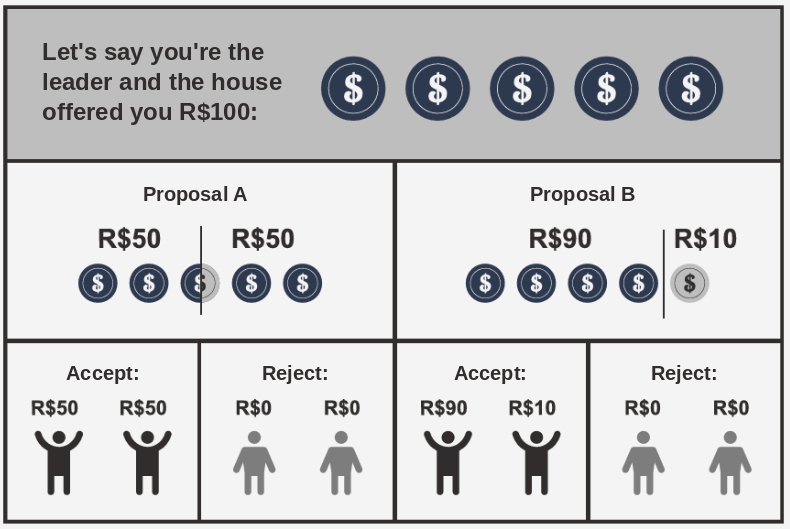
What proposal would you make?
Theoretically, assuming complete rationality, if you offer a split of R$99 for you and R$1 for the receiver, the receiver should accept, because the alternative is that both of you end up with nothing. However, experiments conducted around the world show that the practical outcome is quite different:
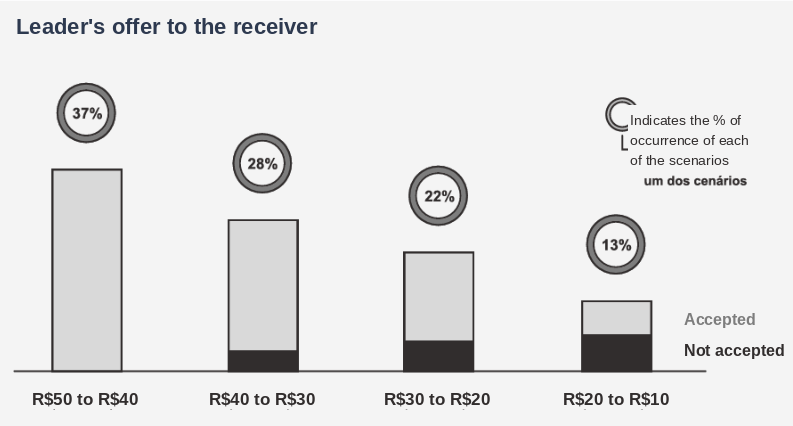
In other words, the more “unfair” the leader's proposal seems, the greater the chance the receiver will reject it. This decision is clearly irrational, since it is better to receive between R$10 and R$20 than to receive nothing.
Since then, much more has been developed and published on negotiations.
These contributions range from scientific discoveries in the field of judgment psychology, decision-making, and behavioral economics, led by Amos Tversky and Daniel Kahneman, to the practical lessons distilled by Christopher Voss, who spent more than two decades working in the FBI's Crisis Negotiation Unit and rose to become the Agency's lead international hostage and kidnapping negotiator.
This article seeks to combine what has been developed over the last 40 years of knowledge in the science of negotiation with practical situations and demands of an M&A transaction.
The importance of negotiation in M&A and its challenges
The most common analogy made for an M&A financial advisor is that of a business broker, whose function is to find a counterparty interested in a specific opportunity. Although the importance of finding an interested party cannot be denied, the greatest value in an M&A transaction is created during the negotiation process. The countless issues involved make it possible to explore designs, solutions, and synergies that leave both buyer and seller in a much better position once the deal closes.
On the difficulty of finding an interested party
In most transactions involving medium and large companies, experienced advisors know where to look for potential interested parties. Depending on the profile of the transaction, we look for companies operating in the same segment or related segments, domestic or foreign, as well as suppliers, potential customers, or large investors with enough scale to execute the intended transaction. Private equity funds (there are now more than 100 in the Brazilian market) and large family offices are also commonly approached.
Often, what is most needed is discipline, time, and resilience. Few buyers and/or investors are ready to analyze and act quickly on a specific opportunity, whether due to issues of strategic alignment, financial capacity, or any other reason. When it is the buyer who proactively seeks out opportunities, sellers may not be at the right moment to discuss a sale. So, some seemingly obvious transactions sometimes take years to materialize.
On the value added by negotiators
Negotiation outcomes can vary greatly depending on the skills and effort of the parties involved.
Academic studies show that experienced negotiators with a stronger technical toolkit have a greater chance of concluding the process on terms favorable to both sides. Research conducted by the University of Washington1 showed that the outcome obtained by those involved increased by up to 20% after successive rounds of negotiation, demonstrating a direct relationship between experience and performance. A second study2 concluded that experience gained in previous situations, combined with support tools, further improves negotiation outcomes.
1 THOMPSON, Leigh. An examination of naive and experienced negotiators. Journal of Personality and Social Psychology, 1990.
2 STEINEL, Wolfgang; ABELE, Andrea; DREU, Carsten. Effects of Experience and Advice on Process and Performance in Negotiations. Group Processes and Intergroup Relations, 2007.
Looking at it from a practical standpoint as well, former FBI chief hostage negotiator Christopher Voss reports that trained negotiators are able to anticipate information about the counterparty that is not yet evident. This makes it possible to develop strategies to guard against surprising facts coming from the other side of the table, putting the side with good, prepared negotiators in a more favorable position.
In an M&A operation, this is no different. When we deal with clients or counterparties who are not used to carrying out M&A transactions, they often raise issues that become obstacles to the progress of the deal, or that harm their own negotiating position. A common topic on which inexperienced parties usually leave “money on the table” is the negotiation of price adjustment clauses tied to working capital position and minimum cash at closing.
On the other hand, when we negotiate with experienced parties, the value generated can be enormous. We once structured a transaction in which a healthcare services provider gave up a minority stake in its capital to one of the largest hospital groups in Brazil, in exchange for a long-term supply contract with the network's hospitals. For our client, it was the opportunity to multiply their return more than tenfold in a short period of time. For the hospital group, the stake required no cash outlay or cost increase, only a change of suppliers, and resulted in an equity stake worth hundreds of millions of reais.
The challenge of aligning interests between the principal and their agents
There are countless issues that need to be discussed in an M&A transaction:
- financial (in addition to the obvious ones, such as price and payment terms, post-closing price adjustments, potential future contingent payments, etc.);
- labor governance;
- environmental;
- regulatory;
- etc.
Due to this complexity, the main interested party (buyer or seller) hires a team to support them (which may include lawyers, investment bankers, consultants, advisors, etc.), who become their agents. Typically, the principal delegates the conduct of the negotiation process to their agents. In the case of corporations, companies without a defined controlling shareholder, the issue becomes even more diffuse, since shareholders delegate to the CEO, who in turn hires the advisory team.
As already documented in the literature, the problem in these situations arises when agents' incentives diverge too much from the principal's interests. Some examples: in an M&A negotiation, financial advisors are often only paid if the deal closes. One can imagine that, after many intense months of work, it becomes very difficult for the advisor to recommend that the client walk away from the deal. On the other hand, advisors paid based on hours worked (consultants, lawyers) may invest more time than necessary on minor issues, losing focus on what really matters for the transaction.
In another situation, business owners negotiating the sale of their business to a large corporation may find their advisors being overly cautious about not upsetting the counterparty, a potential client of theirs in the future.
For the rest of the paper, we will discuss negotiations in general, without distinguishing between situations in which the principal or their agent is present at the table.
However, we must keep in mind that, to ensure a successful negotiation, it is necessary to minimize the misalignment between the principal and their agents; otherwise, there is no negotiation technique that can guarantee a positive outcome for the principal.
Preparing for the Negotiation
Negotiation is an information game. Those who know how to obtain good information perform better than those who simply stick to what they already know before the process begins. That is why preparation is a key success factor: it is crucial to set aside time to identify the parties involved in the negotiation and their respective interests, anticipate areas of potential conflict, map out possible clarifications that may be needed, find common ground, and design possible outcomes.
1. Reflect on your assumptions about how the negotiation will unfold
Before starting a negotiation, you have likely made several assumptions about the negotiation itself, and many of these come with biases that can hinder a more creative solution. For example, if you assume the counterparty will be tough and inflexible during the negotiation, you may send signals that you will behave the same way, without having any real evidence about the counterparty, harming the whole negotiating dynamic. If the business owner assumes the sale negotiation will be quick and highly likely to succeed, they may decide not to make certain important investments in their business in order to keep more cash on hand and thus increase the amount they will receive. If the transaction is not completed, this will have negatively impacted their company.
The solution is to carry out a careful analysis of the main assumptions you are making (why am I making this assumption? what facts or evidence support it? what are the implications if it turns out to be wrong?) and not be afraid to revisit or even discard them if you do not feel confident they are properly grounded.
2. Define your objectives and be clear about your reasons
Beyond the minimum price (in the case of a sale) or maximum price (in the case of a purchase), you need to be clear about your definition of success. For example, when a business owner is bringing in a Private Equity fund as a partner, the profile of the partner, alignment with their values, and the structure of the proposed transaction tend to be more important than the proposed valuation3 for the future of the business after the transaction.
On the buyer's side, in addition to acquiring the company at a price that generates value, an important objective is to ensure that the business continues along the future prospects that were assumed in valuing it. For example, it is necessary to consider the probability of retaining contracts, the customer base, the management team, etc. What really matters? If the CEO of the acquired company asks to leave the next day, does the acquisition still make sense? How do you carry out a good transition and capture synergies?
In practice, having clarity about your objectives before starting the negotiation process, with full awareness of the reasons behind each of them, helps you look for creative solutions that may initially seem out of the question. It is also useful for avoiding wanting to gain much more than necessary and ending up snapping the rope.
3 Study “Companies invested in by Private Equity funds in Brazil,” conducted by Ártica Investimentos, Endeavor Brasil, and Insper.
3. What is your best alternative to the current negotiation? What is your walk-away point?
Clearly defining what your alternative is before entering the whirlwind of emotions that a negotiation can involve prevents you from being led to accept undesirable terms out of fatigue, when it would be better not to close the deal. For example, if a seller understands, at the start of the process, that below a certain amount it makes no sense to sell their company, they should not change their position after a
In addition, having a plan B for the ongoing negotiation, besides being an alternative and serving as a reference for the minimum value of the deal, increases emotional comfort during the most difficult moments.
4. What is the other party's perspective?
The best negotiators are those who listen to and understand their counterparty. This is an important point in M&A deals, where the negotiation is not distributive (in which one party's gain is the other's loss, as in dividing a cake), but rather integrative. In other words, the multidimensional nature of the environment allows both sides of the negotiation to come out better than they went in. To do this, it is necessary to understand what matters to the other side.
The case of the healthcare services provider described in the previous chapter is a good example. Initially, the hospital network said it had no interest in the transaction.
Investigating the reason for this initial refusal, we understood that the potential for value creation was quite clear to them, but they had two major concerns:
(i) becoming dependent on a single supplier of a service considered critical to hospital operations, and (ii) the risk that some failure in service delivery could cause reputational damage to the group.
Aware of these issues, we were able to address them through a combination of additional clarifications and contractual mechanisms.
5. How much trust exists between the parties?
If the parties are not willing to share and discuss their interests at some point, reaching a win-win solution is impossible. And when there is no trust in the relationship, people hesitate to share their interests and concerns, because they worry the information will be used against them.
Hence the importance of being careful with attitudes that could break a trust relationship: not honoring what was agreed or promised; behaving in ways that could be perceived as unethical; not listening to the other side; lying or exaggerating; withholding information that could harm the other party; not showing empathy or a genuine desire to understand the other side.
Remember that it takes years to build trust, and only seconds to destroy it.
6. Don't ask what, ask why
Once, on the eve of signing a purchase and sale agreement, one of the shareholders called us and said she refused to sign the contract. She and her husband together held about 50% of the company, but the husband held 30% and she held 20%. She said she would not harm her children, that the original stake should have been 25% for her and 25% for her husband, that this had been agreed years earlier, and that she was not going to give that up now.
It turned out that this call happened on a Friday night, and the contract with the buyer, a foreign multinational whose representatives had spent a week in Brazil negotiating the final terms, was to be signed over the weekend. There was no time to adjust the company's articles of incorporation, let alone to explain this last-minute change to the buyer.
The first solution proposed by one of the sellers' agents was to draft a contract between husband and wife, so that the husband would donate part of the value to the wife, with a negative tax impact. There was also speculation as to why she wanted this: did she (or he) have a child outside the marriage? Did she have plans to separate after the sale of the company?
The wife insisted on postponing the signing until the situation was resolved. At this point, we asked: why was she demanding this? What exactly was the concern about the children?
For some reason, she had understood that the disproportionate stake between her and her husband could affect the children's inheritance (all of whom, incidentally, were from the same marriage). That same night, we arranged a conversation between her and a family law specialist, who understood the family situation and the marital property regime, and clarified all her doubts.
In the end, the concerns were unfounded and the signing went ahead as planned.
We have a natural tendency to state what we want, rather than why we want it. In other words, we want to propose a solution to a problem or demand we have, but we usually do this with limited information, without knowing all the possible alternatives, and the result is far from optimal.
The negotiator should be concerned with better understanding the negotiating situation at all times, both on their own side and the counterparty's. Some questions they should ask are: What are each stakeholder's real objectives? What are their priorities in the negotiation? What alternatives does the counterparty have?
When a counterparty makes a demand, even if in an aggressive manner, the negotiator should try to understand what is behind it. This is especially true when it happens in the middle of a negotiation and represents a shift from what was previously being discussed. They should understand the real interests that led to this demand, in order to find the best solution.
Likewise, the negotiator should be clear and structured when presenting their own demands, explaining their reason or discomfort. This will help the counterparty structure a mutually beneficial solution.
7. Find common ground with unlikely allies
Although there is a shared desire to reach the best possible deal, at a negotiating table there is a myriad of additional interests involved, which are not necessarily fully aligned. Knowing how to separate and understand individual objectives can help in gathering information and designing a better negotiation.
Senior executives of a company being sold will likely be present at some points during an M&A process. If they are interested in staying with the company after the transaction, and the buyer is also interested in having them stay, a closer relationship and exchange of information can be established between them, in order to bring new alternatives to negotiating points and create a more constructive environment for freely testing ideas.
8. Organize the negotiation process
An M&A transaction usually takes several months, sometimes even years, to close. In other words, the negotiation is never resolved in a single meeting. That is why it is important to maintain organization of the process as a whole, and the discipline of preparing and planning each interaction.
If a buyer proactively goes after a company it would like to buy, the first meeting will likely have an exploratory dimension, to understand whether there is a possible deal and perhaps align a timeline for the negotiations. A second meeting could be aimed at deepening the understanding of each party's interests and perhaps a preliminary collection of information for a minimal understanding of the business. In a third interaction, potential transaction structures can be tested and possible dealbreakers understood, and so on.
The principles of an effective meeting should not be forgotten for each interaction. Some questions should be asked:
- What outcome is expected? What do we want to achieve in this meeting?
- What level of authority does your counterparty have? Are they the decision maker?
- How should messages be conveyed to the counterparty? How will they receive your messages?
- What would we like to understand about the counterparty?
Opening the Negotiation
The start of a negotiation calls for caution and attention in order to build a trusting relationship, in an environment where the parties feel comfortable exchanging information about objectives and alternatives, thus increasing the chances of a mutually beneficial transaction. To do this, it is essential to avoid a tit-for-tat dynamic, the mindset in which one party only wins if the other loses. Instead, the ideal is to seek a situation in which the parties work together to reach a potential agreement that benefits everyone.
1. Build a trusting relationship
Even before meeting with counterparties, it is worth trying to establish mutual references through a shared network of relationships and assessing whether there is any connection that can be made. Even if there is none, it is possible to build a closer relationship by having informal conversations and taking the initiative to share information. In other words, open up before asking the other side to do the same.
Another way to build a trusting relationship is to listen to and try to understand the other side. The more negotiators feel they have been treated fairly, the more likely they are to trust and cooperate with one another. Avoid boasting about negotiating points you have won and praise your counterparty's contributions.
Trying to be as transparent as possible will also help build trust.
Our overall satisfaction with a negotiation can be more affected by our perceptions of the fairness of the negotiation process than by the results achieved. In other words, remember that if your counterparty feels they were treated well throughout the process, they will be satisfied with the negotiation even if they did not achieve their main objectives.
2. Hold in-person meetings
Since the pandemic, videoconference meetings have become very common. Without a doubt, this greatly facilitates logistics and optimizes our time, but there is a non-negligible loss in communication quality. A large part of our communication is non-verbal, and this portion is impaired in videoconferences.
A study published in Nature4 in April 2022, involving nearly 1,500 engineers across 5 countries, showed that in-person brainstorming meetings generated 17% more ideas than meetings held by video. In addition, the ideas raised in in-person meetings were judged to be more creative by a panel of experts.
Especially at critical moments in negotiations, in-person meetings are useful for bringing the two sides closer together and producing solutions for the most sensitive points in a discussion.
3. Align basic understandings, goals, and objectives
Each individual enters a negotiating situation with some preconceived idea of how the process should unfold and what each party's objectives would be. These concepts are not necessarily close to one another, and the lack of prior alignment can be a source of great stress or even make an M&A transaction unfeasible.
If a large company's M&A team approaches the owner of a business it would like to buy, they need to understand how much the owner knows about the process in order to avoid possible frustrations.
4 BRUCKS, Melanie; LEVAV, Jonathan. Virtual communication curbs creative idea generation. Nature, 2022.
A common need is to educate the prospective seller about a typical transaction timeline, and manage expectations regarding deadlines, indicating that the process can take months; that there are different bodies that approve the deal at different stages; and explaining what level of information is required at each stage of the process: in the first phase, to validate the buyer's interest; in the second, to submit a non-binding proposal; and in the third phase, to carry out due diligence. Even among experienced negotiators, the importance of aligning understanding of the process step by step should not be underestimated.
An explanation we consider relevant at the start of a sale process is the structure of the transaction documents: regardless of what is found and discussed during due diligence, the purchase and sale agreement holds the seller liable for false statements about the company. In Brazil, typically in privately held companies, the seller is liable for any contingencies arising from events before the transaction closes. Therefore, there is no point in trying to hide problems during due diligence, because if they are found later, it could be worse: what will count are the compliance representations made in the contract, subject to penalties and corrective measures that may be more costly than if the seller had sought to address them on their own.
4. Make the opening offer whenever possible
In an M&A negotiation, who should put the first number on the table? It is quite common for a sale process in which the seller's advisors set a specific date for potential buyers to submit a proposal. Is this the best strategy?
The answer begins with an experiment conducted almost fifty years ago, developed by two psychologists.
First, the experimenter spun a wheel that, hypothetically, landed on the number 10. He then asked some volunteers whether the percentage of African countries that are members of the UN was greater or less than 10%. Most people thought the estimate was too low: 25% was the average of the responses.
The experimenter spun the wheel a second time and, this time, it landed on 65. He then asked a second group whether the percentage of African countries making up the UN was greater or less than 65%. On average, participants agreed that this number was too high, and estimated the correct value at 45%.
The difference in the two groups' estimates was linked solely to the initial number they received, even though it had no relation to the question whatsoever (it came from a spinning wheel). The psychologists responsible for the study, Amos Tversky and Daniel Kahneman, described the error as caused by a phenomenon known as anchoring: when you don't know the answer to something, your starting point plays a powerful role in determining what you think the right answer is.
Over the years, further studies have corroborated the anchoring effect in negotiating situations. In one of them5, real estate agents who were given a lower initial price for the cost of a house concluded that the house was worth less than those given a higher initial figure.
In another6, the researcher asked shoppers, before they entered a store, how much money they had in their wallets or how much they had in their bank accounts.
Those who were reminded of the larger amount in their bank balances spent, on average, more than those who were reminded of the smaller amount in their wallets.
5 NORTHCRAFT, Gregory; NEALE, Margaret. Experts, Amateurs, and Real Estate: An Anchoring-and-Adjustment Perspective on Property Pricing Decisions. University of Arizona, 1987.
6 Psychologist Nicholas Epley, University of Chicago
In other words, whenever possible, try to anchor your demand as extreme as possible so that you can justify your price without affecting the degree of trust between the parties.
Using a range of values, rather than a single figure, allows you to be aggressive in your ask while at the same time demonstrating cooperation to make the deal viable. So, instead of the advisors stating that the asking price in an M&A negotiation is, say, R$300 million, they can suggest a value between R$300 million and R$365 million.
However, it is necessary to be careful with overly aggressive initial offers. We were recently advising on the sale of a U.S. company. A potential Brazilian buyer, used to making initially low purchase offers, followed this strategy and ended up eliminated without a chance to make a new offer, which had been their original plan.
Another lesson from this episode is that you should not always be the one to put the first offer on the table. If you do not have enough knowledge to assess the situation, or if your assumptions may be mistaken, it may be better to gather more information before making your value judgment, or even let the other side make the proposal first. You may give up the chance to anchor the negotiation, but you also avoid the disadvantage of positioning yourself insecurely or overly aggressively at the start of the process.
5. Manage timelines and deadlines well
In 1998, players in the NBA (National Basketball Association), the American basketball league, and team owners disagreed over a new collective salary agreement. At midnight on June 30, the owners declared a lockout, halting the start of the 1998-99 NBA season for lack of a contract. With the delay, teams lost revenue (broadcasting, ticket sales, jersey sales, etc.) and players went without pay. For six months, players and owners negotiated without success. It is estimated that during this period the two sides collectively lost hundreds of millions of dollars.
In the end, it was a deadline that resolved the conflict. The team owners declared that if they did not reach an agreement with the players by January 7, 1999, they would cancel the rest of the season. The owners set a final, arbitrary deadline to end their participation in the negotiations; the chosen date had little meaning for either side. Through public statements, they made the decision known to everyone. This created a sense of pressure on the players, and in the early hours of the morning of January 6, the two sides signed a contract that greatly favored the team owners.
The use of deadlines is a very powerful tool. Deadlines tend to make us believe that closing a deal now is more important than closing a good deal. Because of them, people say and do things that go against their own best interest. And why does this happen? Fear of losing the deal!
In fact, in M&A negotiations deadlines tend to be arbitrary and flexible, and the consequences of missing them smaller than we imagine. The exception is regulated processes, such as privatizations, where missing a deadline can take you out of the running entirely.
Hiding a deadline can also put the negotiator in a bad position. Your time pressure forces you to speed up your concessions. Meanwhile, believing there is still plenty of time to talk, your counterparty will be content to hold out and wait for you to make concessions first. In this situation, the chances increase that you will fail to reach an agreement before time runs out, or that you will end up with a highly disadvantageous deal.
When negotiators inform their counterparties about a deadline, they get better deals.
Why? First, because both sides are more likely to work to reach an agreement before the deadline expires, meaning you reduce the risk of walking away with nothing. Second, when the other side knows about your deadline, they will make concessions much more quickly. The NBA owners' January 7 deadline would have been useless had they kept it secret; the players' union would have kept negotiating past that deadline.
6. Don't reveal your weakness
During the Covid-19 crisis, we were in the final stage of selling the company TargetCo. Talks had begun before the pandemic, and after a brief pause due to the initial impact of all the uncertainty generated, discussions resumed with the seller needing to close the deal as quickly as possible.
To complete the sale, TargetCo needed to seek authorization from the shareholder of another company it had purchased in the past: a significant portion of the purchase price was still owed in installments over the following years, and in that company's purchase and sale agreement, the shareholder had negotiated a clause requiring express authorization from them for any change of control. To complicate matters, TargetCo's relationship with this shareholder was not the best.
Since it was a confidential negotiation, the shareholder was unaware of TargetCo's sale. The question was how to proceed. We needed their formal authorization, but at the same time, they had no obligation to agree and might want to negotiate additional demands. One alternative would be to borrow money and pay off the amount owed in cash, but credit for this type of deal simply evaporated during the pandemic. Another alternative would be to propose an additional payment for them to quickly sign off on the change of control.
After days of thinking about how to proceed, and with the deadline for resolving this running out, we decided on the following: TargetCo's CEO called the shareholder and informed them that, due to the whole crisis generated by the pandemic, the company would have great difficulty honoring the payments as previously agreed. That was true at the time. He also said that we were working on an alternative, which would be selling the business, and that for this we would need them to agree to the transaction should the negotiation move forward. Relieved, the shareholder signed the document that very day.
Many people in a position of negotiating weakness quickly accept that it is useless to try to get something better and end up settling for the easiest solution. The literature shows, however, that negotiators who think carefully and systematically about such situations are often able to achieve extraordinary results in the face of seemingly impossible odds.
Not revealing your weaknesses is the first step toward having time to build a positive negotiating solution.
7. Know how to position yourself in a competitive process
From the seller's perspective, the ideal is to structure a competitive process for selling the company. There is ample literature published over the last four decades demonstrating the existence of the “winner's curse” in auction situations (whether for art, oil fields, real estate, etc.). This “curse” is defined as the tendency for the winning bid in an auction to exceed the intrinsic or true value of an item. In M&A, this also holds true: a recent study7 analyzed 462 transactions from 1994 to 2020 and confirmed the hypothesis that the winner of a competitive sale process tends to overpay for the asset.
The greater the number of interested parties, the greater the likelihood that the final buyer will offer a price higher than the intrinsic value of the business8.
Many business owners confuse managing conversations with a few potential parties who proactively approached them with a competitive process. It goes far beyond that: it involves going after potential buyers, not limiting oneself to those who approached the company; it requires timeline management to ensure maximum engagement from potential interested parties; it takes into account buyers' ability to actually close a transaction, based on their financial availability, M&A track record, and strategic alignment; and it relies on a procedural dynamic that encourages competition among interested parties, extracting the best offer from each of them.
7 LIU, Tingting; SHU, Tao; WANG, Jasmine. Winner's Curse in Takeovers? Evidence from Investment Bank Valuation Disagreement. SSRN, 2021.
8 PEETERS, Ronald; TENEV, Anastas. Number of bidders and the winner's curse. University of Otago, 2018.
In Brazil, it is common for a business owner to “be open to a sale,” that is, to consider discussing a transaction if a potential buyer approaches them, but be reluctant to “put the company up for sale,” because they understand this may harm their business or be misinterpreted by third parties (competitors, suppliers, or customers).
With due care, it is possible to run a broader process while preserving confidentiality around prospecting and any negotiations, potentially achieving a higher value for the deal. After all, how many times has a business owner been caught off guard by a transaction reported in the press without having had any inkling it was underway?
Buyers, obviously, benefit from a lack of competitiveness in the process. The most experienced either avoid competitive sale situations entirely or try to reduce competition as much as possible; the most common practices used by this type of investor are:
- Proactively approaching target companies, avoiding a structured process.
- Developing a portfolio of potential acquisitions, putting forward several acquisition proposals in parallel in order to have negotiating alternatives.
- Proposing to quickly sign some type of memorandum of understanding with the seller, promising a fast due diligence process and a closing without major concerns.
- Demanding exclusivity, and threatening not to take part in the process if this is not granted (and being prepared to follow through on it).
- Requesting differentiated treatment in the due diligence process or in the submission of final proposals (for example, a right to match the best offer received).
- Having the discipline to stick to the value initially estimated for the asset being sold, avoiding revising it upward during the negotiation process.
- If you expect to obtain benefits that other buyers cannot (for example, unique synergies, or at a level higher than other potential buyers), you don't need to worry as much about the winner's curse. In this case, ask yourself whether you would make a given offer even knowing that all other potential buyers value the asset less than you do. If the answer is yes, proceed with your offer. If not, reduce it to an amount you feel comfortable answering the above question positively about.
Finally, one way to escape competition in a situation with multiple bidders is to develop a proposal with several elements that make a direct comparison with the others more difficult. For example, a Private Equity fund seeking to become a partner in a company could suggest including, as negotiating currency, a portfolio of potential acquisitions it is negotiating that complements the company's growth strategy.
The Middle of the Negotiation
M&A negotiation is multidimensional, involving dozens of variables across different aspects of the deal, such as: commercial terms (price, payment terms, payment guarantee structure, etc.), process and conditions precedent for closing, representations about the company, stakeholders impacted by the deal, etc. Effective negotiators create value for both sides by exploring tradeoffs between various different negotiating points. This requires not only that you be clear about your own negotiating priorities, but also that you manage to learn about the priorities of the other side.
We once began an M&A project with one partner wanting to buy out the other's stake. Once the situation and objectives of each side became clear, the negotiation evolved with the potential entry of a Private Equity fund as an investor to facilitate the negotiation between partners and inject capital for growth. During talks with the fund, a new alternative was identified, and the transaction ended up also including a share-swap operation with a strategic player in the sector. Although this considerably increased the complexity of the transaction, the value generated for our client was something unimaginable two years earlier, when we began the first negotiation.
Negotiation tools also help maintain rationality in the negotiation, reducing the impact of emotions and anxieties on the design of solutions and alternatives.
1. Manage your concessions
a. Allow yourself room to make concessions: Concessions are an important part of M&A negotiations. That is why it is important to have already planned the various objectives, positions, and underlying interests (needs/priorities) you are preparing to negotiate for concessions of equal value from your counterparty. It may make sense to include less relevant issues early on, to have more freedom for future concessions during the negotiation process.
b. Develop a rationale for each concession: When making concessions, label them clearly so people know what they are getting in exchange for giving something up. Due to our reciprocity bias, people are naturally inclined to respond in kind when they receive something. However, people are also motivated to underestimate or ignore others' concessions, in order to escape the feeling of obligation. Make sure concessions are reciprocal, that is, make it clear what you are getting in return for giving something up.
c. Signal information through the size of your concessions: Concessions should also decrease over time, as this shows that the negotiations are reaching their limits. In an M&A process, this would be like starting with an acquisition proposal of, say, R$200 million. Following with a second one of R$220 million, a third of R$224 million, and a final accepted offer of R$224.5 million.
An experienced negotiator will use this technique to try to close the deal below the maximum amount they would be willing to pay, say R$235 million.
d. Use “broken” numbers: Round numbers, without a clear justification, give the impression of being arbitrary and are an invitation to be debated. A study conducted by Harvard Business School9 analyzed transactions involving publicly traded companies in the U.S. and concluded that initial offers with round numbers had a lower chance of resulting in deals compared to proposals with broken numbers.
Instead of the buyer in a transaction proposing an escrow holdback of R$100 million, for example, to serve as security against potential contingencies, they can propose the amount of R$98 million, which is the average value of the risks identified weighted by their probability assessment.
e. Keep a record of how proposals evolve: Negotiating priorities can change until the very last minute. So always make sure to record and keep them updated before discussing a new proposal. Where there is complexity, it is necessary to park certain points and return to them later, after reviewing some of the other items on the negotiating agenda. Keeping a history of proposals not only helps keep what matters to you in perspective, but also provides a factual and objective view of how the negotiation has evolved.
2. Negotiation tools
a. Explore preference differences between the parties: Build trust by openly communicating and sharing information about your priorities on different issues. If your counterparty cooperates, this will make it possible to identify all the issues that could potentially be relevant for creating maximum value.
Obviously, you don't need to make clear which issues you don't care about, since you can use them for concessions.
After creating the conditions for maximizing value, you can focus on capturing as much of that value for yourself as you see fit, taking into account your relationship with the other party and your desire to be fair.
Remember that preference differences can take many forms, not only between different issues, but also among alternatives within the same point. The parties will certainly have different preferences regarding risks or probabilities of future events; time preferences; etc. For example, for an individual seller of a company, what often matters most is the total nominal value of the deal, in order to feel they got a good deal. For the buyer, if the seller accepts installment payments, minimizing the initial cash outlay is often what matters most. So instead of a R$100 million cash transaction, it may be more advantageous for both sides to structure a R$120 million transaction, with 40% paid in cash and the remainder in installments over 5 years, with future installments adjusted for inflation.
9 HUKKANEN, Petri; KELOHARJU, Matti. Initial Offer Precisions and M&A Outcomes. Harvard Business School, 2016.
b. Negotiate several issues simultaneously: Although negotiators usually find it more natural (and easier) to negotiate one issue at a time, a much better strategy is to negotiate several issues simultaneously. Why? Because negotiating one issue at a time eliminates the possibility of exploring the difference in how the parties perceive value. A study10 involving negotiations over due diligence adjustments between auditors and clients showed that negotiating several items simultaneously generates more concessions from the counterparty, in addition to clients' final perception of the auditors being more positive at the end of the process.
10 PERREAULT, Stephen; KIDA, Thomas; PIERCEY, David. The Relative Effectiveness of Simultaneous versus Sequential Negotiation Strategies in Auditor-Client Negotiations. SSRN Electronic Journal, 2013.
c. Make multiple offers: This technique consists of presenting several alternatives that, in theory, work equally well for you. For example, in the case of selling a company, indicating that you would be willing to do the deal at a valuation of R$100 million, keeping 80% of the business with some governance rules, or selling 100% for R$120 million. As benefits, it allows you to provide information about your relative priorities and see how the other side reacts to them, allows you to anchor the negotiation while being ambitious in your proposal without appearing aggressive and signaling cooperation, and also tests what the other side is saying (in our example, that there is a possibility of buying 80%, not just 100%, of the business).
On the other hand, there are some disadvantages that need to be considered: first, it can reveal more information than desired. The other side may want to cherry-pick the alternatives, choosing what it prefers from each one. And, depending on the counterparty's negotiating experience, they may believe these are the only possible alternatives and treat it as a limiter on the solution space.
d. Contingent offers (earnouts): Earnout mechanisms are widely used in M&A transactions. They avoid discussion about the probability of some future event (for example, will the company hit its budget next year?) and instead allow the parties to wait and see what actually happens.
It also serves as an incentive for the party to perform at (or above) the level contractually agreed. For example, when the selling business owner has an executive role in the company and will continue to be responsible for operations after the sale, an additional payment based on the company's post-transaction performance can be quite motivating.
However, care must be taken regarding the situations in which the earnout mechanism is used. It is not uncommon to have a negotiation process in which the other party starts talking about an earnout before any value proposal has even been put on the table. It is tempting because it postpones difficult discussions, which could often be dealbreakers in a deal.
It turns out that when the future arrives, what was a point of disagreement in the past resurfaces. Calculating the metric may not be easy to agree on; unforeseen external events may lead one of the parties to claim “force majeure” to avoid fulfilling the agreement: imagine having to calculate EBITDA for earnout purposes during the Covid pandemic period? As a consequence, there are countless disputes arising from poorly structured mechanisms of this type, often ending up at the judicial or arbitration level.
The first recommendation would be to use this mechanism with great caution: only complicate things when the simple approach doesn't work.
Second, try to structure mechanisms whose calculation is as simple as possible: for example, if the occurrence of a certain event exceeds a certain gross sales figure, etc. The use of EBITDA as a metric, in particular, should be avoided whenever possible: there are so many exceptions and adjustments required to arrive at a value both parties agree on that it ends up becoming a new negotiation, only in a much worse and uncomfortable situation: the parties have already completed the deal.
Third, try not to defer the calculation of the contingent value mechanism for very long periods. The more time passes, the greater the chance that the situation will be very different from what was originally envisioned, and with that, the greater the risk of disagreements.
3. Don't Lie
Numerous studies have already shown that the more confidence your counterparty has in your honesty, integrity, and reliability, the easier it will be to negotiate. Intuitively, we know we should not lie. However, sometimes it ends up being the most instinctive way we have of responding to certain situations.
Some ways to guard against this bias:
1. Be prepared to answer difficult questions. It is highly advisable to rehearse with the managers and shareholders of the company being sold, who will interact with potential buyers, so they practice answering the toughest questions they might receive. Being prepared helps avoid a hasty response.
2. Avoid negotiating or having to answer something under time pressure. Understand that it is natural to respond: “I'll have to think about what you asked and get back to you later.” To be able to do this, also avoid putting yourself in situations that don't allow for this kind of way out.
3. If necessary, refuse to answer certain questions. For example, in a sale process, when a buyer asks whether there are other interested parties at the table, even if there aren't, the seller can respond that, in order to preserve the confidentiality of the process, they cannot disclose that information.
4. Offer answers to a different question as an alternative: Most of the time the other side is satisfied with an answer to a question close to the one it asked, without noticing that you did not exactly address the request: Are there other interested parties at the table? This can be answered with: we have signed more than 10 Non-Disclosure Agreements so far (even knowing that the other 9 have already dropped out of the process).
5. Work to change your negotiating position: let's go back to the same situation of having only one interested party at the table. To avoid answering that there is no one else at the table, we can contact new potential interested parties throughout the process, even if we assume the chance of gaining traction with them is low. At the very least, at any point we can say that we are talking to other interested parties too! Even if it is at a very preliminary level.
Persuasion Strategies in Negotiation
The main purpose of using influence strategies is not to work on the attractiveness of the proposal itself, but to make use of the cognitive biases we are all subject to in order to increase the likelihood that it will be accepted without the need for improvement or concessions.
1. Break up gains and bundle losses
No one likes to deliver bad news, or cause disappointment to another person. In an M&A negotiation, this tendency leads us to present our demands cautiously, or to gradually turn down the other side's requests that we do not want to grant.
However, this bias can get in the way of achieving the best negotiating results.
Consider two scenarios:
- One day, you are walking down the street and find a 200-real bill.
- You are walking down the street and find a 100-real bill. The next day, walking down the same street, you find another 100-real bill.
In both situations, you end up with 200 reais in your wallet. Which situation do you prefer? In general, people feel better about scenario B.
Now consider two other scenarios:
- One day, you open your wallet and realize you have lost 200 reais.
- One day, you open your wallet and realize you have lost 100 reais. The next day, you discover you have lost another 100 reais.
Again, the outcome in both scenarios is equivalent, but people tend to prefer scenario A.
Research shows that we tend to prefer gaining little by little, but losing all at once. As an implication of this bias, try to break up the gains you offer the other party, for example, by spacing out your concessions, and bundle the losses, for example, by making broad demands or delivering several pieces of “bad news” at once.
2. Use the power of justification
“Because” is a magic word when you want to influence people to do something. A study conducted at Harvard in 1978 demonstrated this:
A researcher asked volunteers to try to cut in line ahead of people waiting to use a photocopier that was heavily used on a university campus. Remember that this was in the 1970s. People did not have computers or printers. A lot of photocopying was done back then, so there were often lines to use a copier. The researcher instructed the volunteers to use three different, specifically worded requests to cut in line.
Did the way the request was phrased affect the chances of them cutting in line? Here are the results:
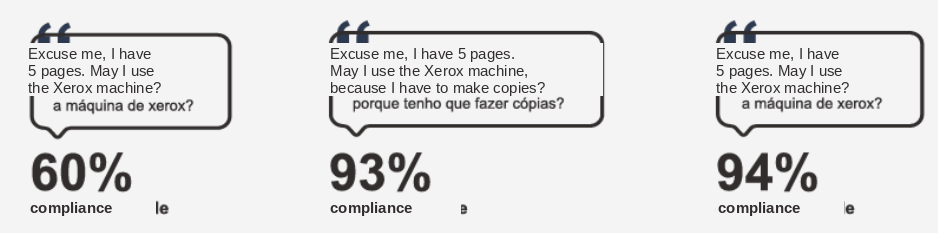
In other words, there was an increase of more than 50% in acceptance of the request to cut in line simply because a justification was included with the request. Even when the justification merely stated the blatantly obvious!
Always explain the reason for your requests. The more impactful the point in the negotiation, the more important the quality of the justification. But even for smaller requests, it is worth explaining the reason behind them, since, due to our cognitive biases, this tends to increase the chance that they will be accepted.
3. Leverage social pressure
Social pressure bias stems from the (generally correct) belief that a group of people knows more than an individual, and that the best way to make a decision is to base it on the group's behavior regarding that decision. A study conducted in Beijing used a restaurant menu as a vehicle to analyze this bias. When the menu listed certain items as the restaurant's most popular, those items were ordered 13% more often than before, on average.
In a negotiation, we can use this lever in several ways. For example, when selling a company, by making it apparent that there is a certain number of interested parties in the asset, showing how desirable it is. If there is some negotiating issue, say, a risk inherent to the business being sold or to its industry, argue along the lines that “other potential buyers are not seeing this as a risk” or “other deals have already been done in this industry and this issue was never raised.” A practical example: in a recent transaction in the education sector, the buyer raised a question about a tax benefit specific to the sector, which in theory was set to expire soon. The argument used was: all publicly listed education companies are valued assuming the perpetuation of the benefit, as you can see from these analyst reports.
4. Reinforce loss over potential gain
We are risk-averse to preserve gains, and willing to take risks to avoid losses. Consider the study below, carried out in two distinct scenarios:
Scenario 1: Imagine that the U.S. is preparing for the outbreak of a new disease, expected to kill 600 people. Two alternative programs to combat the disease have been proposed. The estimated consequences of the programs are:
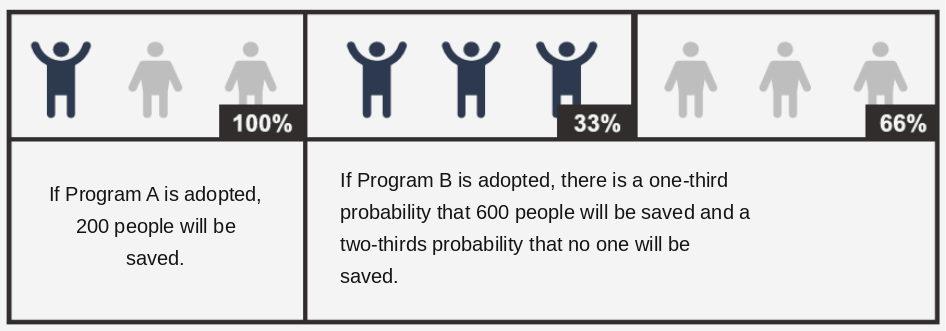
Which alternative would you choose? In this scenario, 72% of respondents chose Program A and 28% chose Program B, even though the expected outcome11 for both programs is the same!
11 1/3600 + 2/30 = 200 under Program B.
Scenario 2: Imagine that the U.S. is preparing for the outbreak of a new disease, expected to kill 600 people. Two alternative programs to combat the disease have been proposed. The estimated consequences of them are:
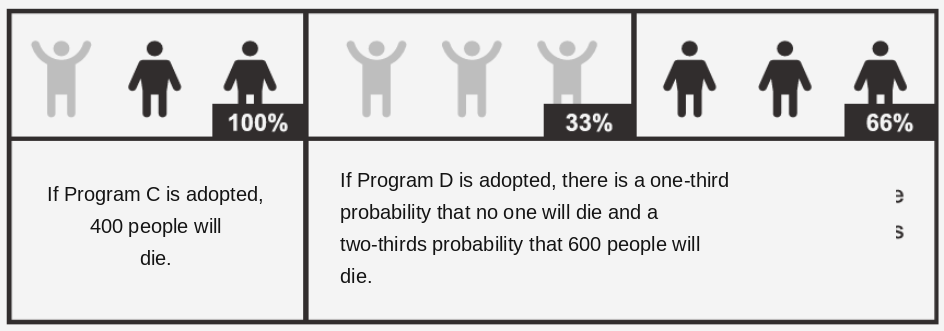
In this scenario, 22% of respondents chose Program C and 78% chose Program D.
In addition to the expected outcome being the same in both scenarios, the most striking thing is that Programs C and D are Programs A and B reframed, swapping loss for gain and vice versa!!
In other words, the way we frame a situation affects the likelihood of people's responses.
So, when possible, use loss framing against your counterparty, for example: “You will lose the opportunity to have the best asset on the market if you don't raise your offer.”
5. The door-in-the-face technique
In a classic study conducted in 1975, researchers from the University of Arizona posed as employees of a juvenile detention center. They randomly stopped people on university campus sidewalks and asked if they would consider accompanying a group of juvenile delinquents on an unpaid day trip to the zoo.
Only 17% of those approached said they would.
The researchers then approached different people with an even bolder request: would they be interested in being considered to serve as unpaid counselors at the juvenile detention center? They were told that this volunteer position would require two hours of their time each week, for a minimum period of two years.
Not surprisingly, everyone asked said no. But the researchers did not simply let them leave; they then asked whether they would be willing to consider accompanying a group of juvenile delinquents on an unpaid day trip to the zoo.
In that situation, 50% of respondents said yes.
Why were people so willing to agree to a fairly demanding request after refusing a much larger one? According to the researchers, when we back down from an extreme request we made and then ask for something smaller, the other party sees this as a concession on our part, and feels compelled to reciprocate. Many cultures have a reciprocity bias that leads us to try to repay in kind whatever someone has “given” us, whether a favor, an invitation, or even a concession in a negotiation.
In short, the technique known as “door in the face” consists of making an extreme request that you expect to be rejected, so that your counterparty accepts a moderate demand that you make right afterward.
6. Make symbolic unilateral concessions
When we make concessions in a negotiation, we tend to assume that a concession must actually be costly to us (financially or otherwise) for the other side to notice and give us what we want. But, in fact, we can often move a negotiation forward by making a symbolic unilateral concession (one that costs us little), write Harvard Business School professors Deepak Malhotra and Max H. Bazerman in their book Negotiation Genius (Bantam, 2007).
In the book, the authors tell the story of a trade association that wanted to conduct a mail survey of its members. Due to low prior engagement with this type of survey, the association decided to offer financial incentives to test whether the response rate would increase.
The association sent the questionnaire without any financial incentive to a randomly chosen subgroup of members. Of this group, 20.7% returned a completed questionnaire. The association then promised to pay a second group of members US$50 if they completed and returned the questionnaire. This time, 23.3% of members responded, only slightly more than the first group. Finally, the association sent a third group of members a single US$1 bill (a symbolic concession) along with the questionnaire (and no other incentive). This time, 40.7% of members in this group returned completed questionnaires, a much higher response rate.
Why did so many members of the third group fill out and return their questionnaires? Their behavior violates the predictions of traditional economic theories. Not only was the US$1 incentive considerably smaller than the US$50 offered to the second group, it was not even an incentive: it was a guaranteed payment, regardless of whether the member fulfilled the request. It seems they felt compelled to cooperate because the dollar was not an incentive, but rather a symbolic unilateral concession, a gift.
For the best effect, it is important to keep the following in mind:
- Understand what the other side wants and offer something they value or appreciate;
- Make your concession without expecting anything directly in return; and
- Ideally, make it clear that you are making the concession in a spirit of being constructive and collaborative for the negotiation.
Persuasion techniques are no guarantee of winning every negotiating point. In fact, overused, they can irritate the counterparty and get in the way of the negotiation. An April 202212 study showed that, in situations of repeated negotiations between the same counterparties, negotiators who detected that their counterparty had used the “door in the face” technique in the first negotiation, compared to those who had not, made more demanding opening offers in the second negotiation and achieved better results. They also saw their counterparty as less trustworthy and were more likely to choose a new partner for the collaborative project.
Overall, the study's results seem to suggest that using persuasion techniques can often backfire, if your counterparty feels you tried to manipulate them. The suggestion is to use them sparingly and to keep in mind that they are just some of the many tools we have for concluding a successful negotiation.
12 STAFF, Pon. The Door in the Face Technique: Will It Backfire? Harvard Law School, 2022.
Closing the Negotiation
Although it is important to take the time to seek the best negotiating terms, M&A processes that drag on too long can harm the outcome of the deal after the transaction13. Once the alternatives and arguments of the parties are clear to everyone, and some of the main negotiating points are conceptually agreed upon, it is time to conclude the negotiation.
To successfully conclude a negotiation, it is necessary to keep in view the perspective of the main parties involved, not just their advisors. Thus, it is not enough to agree on terms or sign a contract; you need an agreement that can be implemented and that allows all the value expected by both sides to actually be captured.
The following recommendations do not apply only to the conclusion of final contracts, but also to the settling of intermediate agreements, such as termsheets and Memoranda of Understanding, indicative and non-binding offers that are usually negotiated and used throughout M&A processes.
Note, also, that excessively long timeframes for closing a transaction are harmful to both sides, since negotiations take place based on the parties' reality at that specific moment, and the more time passes, the greater the risk that the more recent reality will render the negotiated terms obsolete, leading to the need for renegotiation or even abandonment of the deal. To illustrate an extreme case, imagine the situation of someone who signed an M&A transaction at the end of 2019, whose completion was supposed to occur in 2020, after the emergence of the Covid-19 pandemic.
13 Ártica/Insper study with business owners who had been partners of Private Equity funds. Negotiations that took more than 12 months to conclude had much worse results than negotiations that were concluded more quickly. Hypotheses to explain this include: loss of focus on the day-to-day of the business; postponement of necessary investments; negotiating wear and tear that harms the interaction between management teams after the transaction.
Focus on consolidating the agreement
1. Hold closing meetings: By making it clear that the agenda of the meeting is to leave with an agreed-upon document, we secure the commitment of the parties involved to act: everyone should come prepared, with alternatives for the negotiating points, so as to leave the meeting with a consolidated document. At these moments, it is not uncommon for negotiating teams to keep decision-makers from each side on standby to be consulted in real time on issues beyond their authority, in the spirit of concluding the negotiation as quickly as possible. This signals the commitment to make the negotiation work and tends to increase the degree of trust between the parties, who are then able to share ideas and information more openly. If possible, do it in person.
That said, the negotiator must not forget their negotiating principles and must not get carried away by the heat of the moment. They must be clear about their objectives and must not accept a bad deal. Not reaching an agreement is better than closing a terrible one.
The closing meeting does not need to be a single meeting; it can involve several interactions, especially when the parties need to evaluate new proposals and scenarios presented.
2. Tie up loose ends. This is the moment to resolve disagreements. To do this, it is worth being proactive and trying to offer alternatives that would work for your side, shifting to the counterparty the responsibility for further delaying the transaction if it does not accept one of the alternatives. For example, if the issue is the company's price, two conditions can be offered: (i) a lower amount, 100% in cash, or (ii) a somewhat higher amount, in installments. For small differences, it may be more appropriate to simply propose something in between, on the grounds of not wasting time on minor issues.
3. Use sweeteners to overcome final resistance. Sometimes small additional concessions make the other side feel satisfied by the number of points gained, not necessarily by the magnitude of those gains. For example, in a transaction we advised on, the sellers accepted the final terms when we added, to the commercial terms, one year of post-transaction salary so they could act as consultants to the company and help with post-transaction integration. Proportionally, this was an amount that increased the deal price by less than 0.1%, but it had a positive emotional impact on the sellers. Care must obviously be taken not to give up too much without managing to close the deal.
Ratification
Using other decision-making bodies is a good negotiating practice. While the negotiating team is caught up in the heat of the discussions, the other body (board of directors, shareholders) can take a cooler, more detached look at the negotiating situation as a whole. This mechanism is especially useful when a final approval of the negotiated terms is needed. It ends up being an opportunity to eventually revisit points that had already been agreed by the negotiating team, although this may cause some frustration for them. It also allows for some course correction or adjustment of more favorable terms, without damaging the degree of trust that was established by the parties at the negotiating table.
For this reason, it is recommended that in most situations the final decision maker not be at the negotiating table. When this happens on only one side, that side can end up in a more delicate position if it commits to some negotiating point, since this reduces the chance of being able to revisit or even reflect more deeply on the issue. In these cases, the alternative is not to commit to deciding at that moment, asking for time to think about the matter at hand.
Let the counterparty “win”
As illustrated in the introduction to this article, a negotiation has little chance of ending well when it turns into a war of egos. Right up until the last moment, issues are being discussed and negotiated. Creating and maintaining an environment in which the other side feels it succeeded (or is succeeding) is very important. Highlighting the concessions you made, reinforcing that the other side is achieving its negotiating goal, and showing that the negotiation is progressing are important attitudes for the final issues to be resolved.
Try to obtain small final concessions and avoid giving in
Note that your negotiation should not end when the agreement is signed: it should end when you feel you have exhausted every option for creating value. In the final stretch, when the mood is one of closing the deal, there may be room for additional requests to be granted without new concessions from the other side. Due to the fatigue caused by the negotiation and the anxiety to close the deal, the counterparty may accept some last-minute requests: “a new issue has come up, and I'll need this additional flexibility from you to close.”
In a recent sale transaction, after almost everything had been settled, the seller initially asked for a monthly fee to continue as a consultant for another 36 months. The buyer, already tired of the whole process, accepted, without asking for anything in return. Next, the seller asked to extend the benefit to other family members. Despite protests, the buyer went along with that too. This is the kind of demand that, if made at earlier stages of the negotiation, would probably have required some concession from the seller.
Final Considerations
Cross-border negotiation
Although the basic language of finance and contracts is similar around the world, the particularities of each culture and market need to be taken into account for a successful international negotiation. In a transaction to sell a Brazilian company to a large Japanese group, talks had already dragged on for 18 months without any progress: the Brazilian shareholder was waiting for a position from the Japanese side, which in turn was not making its intentions clear. They only progressed when the seller put the asking price and the deal structure on the table. The requested value was never questioned, but it took countless meetings, with the same agenda, involving several people within the organization, before they decided to formalize a proposal. In fact, in addition to several representatives coming to Brazil, the selling shareholder had to spend a week in Japan visiting the organization and meeting with different decision makers.
It is necessary to be careful, however, not to fall into clichés about cultural differences, holding a stereotyped view based on just one or two dimensions, which fails to capture all the nuances of how each society behaves.
Within our own culture, we tend to know which behaviors are consistent with social norms and which are not. Understanding our own culture also tells us when and how it is appropriate to negotiate. Unfortunately, we often violate these norms in other cultures.
The more we understand and study the cultural context, the greater our chances of achieving a good international negotiation. However, how can we know the best way to negotiate in a given culture?
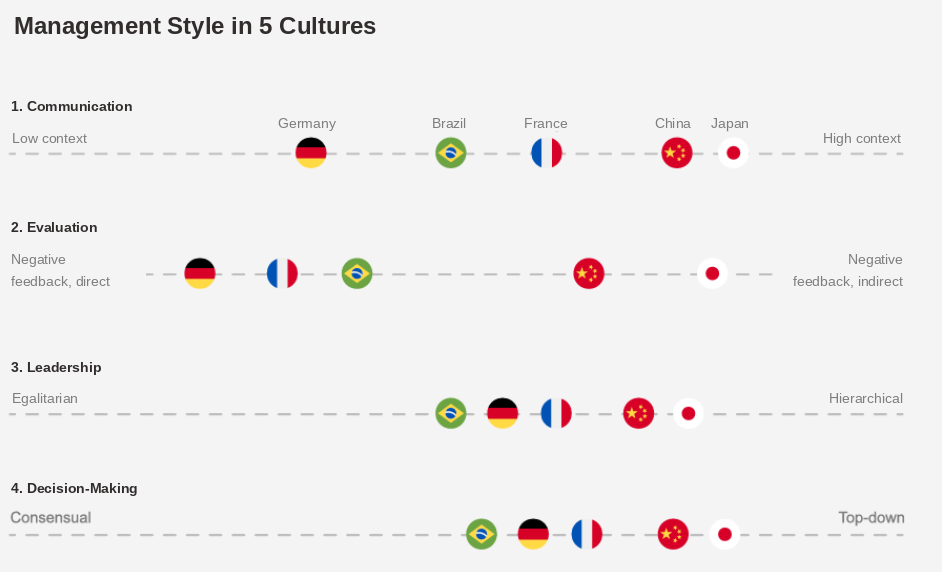
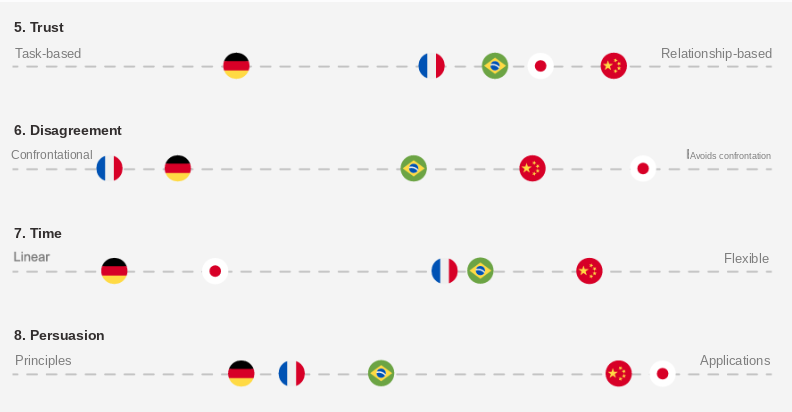
The first step in answering these questions is always to prepare. A very interesting tool for use in an M&A context was proposed by Insead professor Erin Meyer in her book “The Culture Map.” Based on decades of research and interviews, the map describes, across 8 dimensions, the value system of a society in general: communication, evaluation, leadership, decision-making, trust, disagreement, time, and persuasion.
For example, take the time dimension: businesses around the world operate according to schedules and hours, but in some cultures people strictly follow the timetable, while in others they treat it as a suggestion. This scale assesses how much value is placed on operating in a structured, linear way versus being flexible and reactive.
Even if you have no one to ask, you can ask your counterparty to educate you about the norms. We were once negotiating the sale of a Brazilian company to a European group, whose M&A director was French. We were going to have a meeting in Brazil for them to present their purchase proposal. Before the meeting, he called and asked: typically, how much bargaining do Brazilians expect? How much of a price increase do they expect to get above the initial offer to feel satisfied? Based on this, he calibrated his initial proposal.
Caution also applies to the design of solutions, since the legal context differs from country to country, impacting various aspects of M&A, whether tax, governance, or even contractual structures. You should not assume that the regulatory framework of other jurisdictions is similar to Brazil's.
When not to negotiate
There are situations in which trying to negotiate can worsen the outcome for a party. Some of these are:
When your alternative is bad and everyone knows it: for example, a company in very poor financial condition, whose alternative to a sale is to “go under,” and which has only one offer on the table. As painful as it may be, the arguments for trying to negotiate better terms may be very weak, and besides the wear and tear that can occur in this situation, there is a risk of losing the deal. In this case, the best thing to do is to recognize that there is no room to negotiate and (i) either accept the offer on the table or (ii) make a request for improvement, framing it as a request, acknowledging there are no alternatives and that even if the request is not accepted, the deal will go ahead.
When negotiating sends the wrong message: it can signal (i) a lack of confidence; (ii) that you are more concerned with winning for yourself than investing in the relationship with the counterparty; or (iii) questioning the validity of the initial offer. For example, if the CEO of a company being acquired expects to continue with the business, before the transaction may not be the moment to try to improve their compensation package too aggressively. The buyer may even accept their requests, since they need to retain them, at least for the time being, but may feel held hostage, jeopardizing the post-transaction working relationship.
Conclusion
Negotiating is, at the same time, a science, based on theories, concepts, and methods, and an art, since it requires sensitivity to cultural differences, an ability to engage in dialogue, some psychological skill, and resilience. To negotiate well, practice and experience are necessary, but they are not enough. Knowing what has already been developed on the subject makes a big difference. Finally, every negotiation is unique. Without dedication and preparation, even the most experienced negotiators are unable to achieve the best results.