

The Market Pendulum
Dear investors,
In a memo written in 1991 by Howard Marks, the renowned value investor who leads Oaktree Capital Management, the movement of a pendulum is used as an analogy to describe the dynamics of market swings. This idea of pendular movement would be revisited by him on several occasions, in other memos and in his books “The Most Important Thing” and “Mastering the Market Cycle”, and identified as one of the most fundamental concepts for understanding market behavior.
At the negative extreme, when the prevailing sentiment is pessimism and prices reach historic lows, it is as though the pendulum were at the 9 o’clock position on a clock. At the opposite extreme, when the mood is one of generalized optimism and it seems as though nothing can go wrong, it is as though the pendulum were at the 3 o’clock position. The lowest point, at 6 o’clock, is where price levels should remain if markets were always rational and measured. Yet, just like a pendulum, the market spends less time at 6 o’clock than in the lateral zones where prices are either above or below what more measured valuations would suggest.
It may seem counterintuitive to say that a market made up of intelligent and qualified investors spends most of its time with distorted notions of the true value of assets, but rationality in markets is like the force of gravity acting on a pendulum. It always acts in the direction of bringing things back to the equilibrium point at 6 o’clock. However, under the influence of an external force, that static equilibrium becomes dynamic: the pendulum oscillates around its equilibrium point but never comes to rest there. In the market, the external force that disturbs the static equilibrium and creates this pendular dynamic is the nature of human psychology.
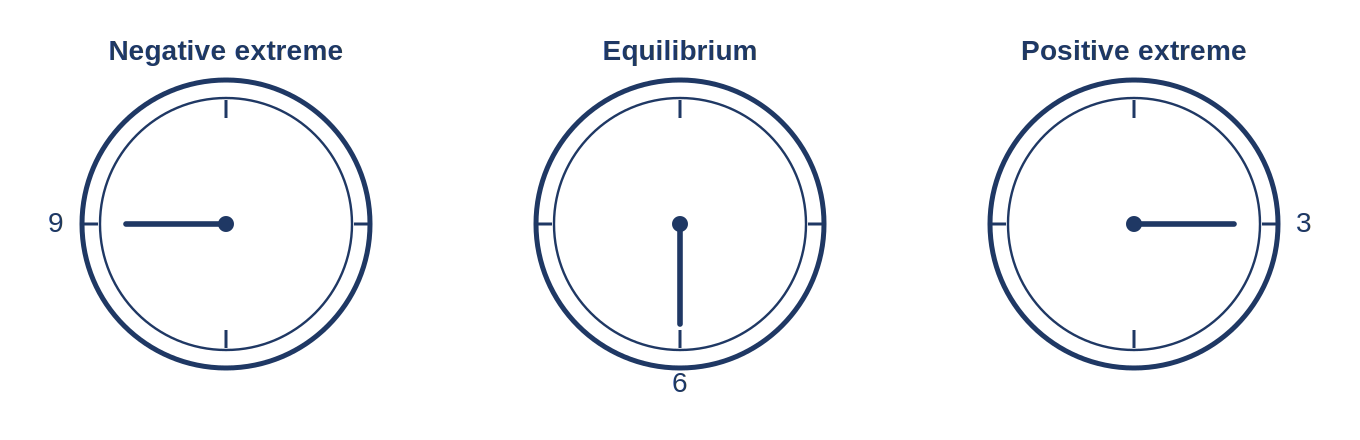
Application of the pendulum analogy
Imperfect as analogies tend to be, this one carries several important differences. The first is that the pendular movement of the market is not regular and predictable like that of a physical pendulum. It is not possible to know how far the market will go or when it will reverse course. The second is that the market does not move in the same direction until it reaches its extreme points. There is a series of short-term reversals, with no consistent method for distinguishing brief counter-moves from those that will prove to be inflection points marking the beginning of a long-term trend change. A more precise analogy would be a pendulum made of a styrofoam ball, exposed to winds blowing first in one direction and then another, with no predictable pattern.
Although this random component frustrates investors’ eternal desire to forecast future market prices, there are two practically useful conclusions we can draw from this analogy. The first is the awareness that, sooner or later, the market will reverse the direction of its movement and pass through its equilibrium point again. The second is that, by recognizing the symptoms that become visible at the extremes of the market’s pendular movement, it is possible to estimate, with reasonable confidence, whether the pendulum is to the left or the right of 6 o’clock. Even if this information is imprecise, since it is not possible to know whether the pendulum is at 3 o’clock or 4 o’clock, it is useful because it indicates which direction the market is most likely to move over the long term. If it is closer to the 9 o’clock side, the greater probability is that it will rise again; if it is closer to 3 o’clock, it is more likely to fall.
Since the cause of the pendular movement is human psychology, and it is useful to identify the symptoms that indicate which zone the pendulum currently occupies, the next step is to map how the psychology of a typical investor evolves across the phases of that movement.
From the negative extreme to the equilibrium point
The hallmarks of this phase are a predominance of fear of losing money, skepticism toward good news and credulity toward bad news, leading to an aversion to any investment that carries risk. As a result, stock prices plunge and pessimistic narratives dominate public discourse. Each additional decline reinforces the notion that the pessimists are right, and anyone who remains invested is labeled naive for failing to see the obvious negative trend.
The psychological factor at play in this phase is not only the fear of losses, but also the fear of going against what “everyone can see,” of being wrong alone, and of enduring the torment of having made such an “obvious” mistake. Most people prefer to follow the prevailing trend, under the psychological comfort of knowing that being wrong alongside the rest of the market is an “honest mistake”, one that can always be justified by something so unforeseeable that no one could have predicted it, whereas being wrong alone would be foolish, an unacceptable failure that no one else committed.
This tide of pessimism is only reversed when prices reach levels so low that the asymmetry between potential return and risk begins to attract attention and inject confidence into the more rational investors. The fear of being wrong alone is replaced by the hope of being right alone, which would carry not only the credit of having seen what no one else could, but also substantial profits. Some of these investors then enter the public conversation as challengers to the pessimistic theses, arguing that the market has gone too far and the trend will reverse.
Since overstated theses in any direction tend not to materialize, when market sentiment is at an extreme, the passage of time favors those who go against the prevailing opinion. As the catastrophes prophesied by the most enthusiastic pessimists fail to materialize, and the economy delivers better-than-expected results, sometimes simply due to the effect of mean reversion, more investors begin to change their minds and return to equities, causing prices to rise again.
Starting from the undervalued prices of the 9 o’clock position, rational analysis has room to justify an upward trend for some time, until the equilibrium point at 6 o’clock is reached. During this movement, optimists gain prominence in the media and become the new opinion leaders, endowed with credibility by the recent upward price trend.
From the equilibrium point to the positive extreme
Just as a physical pendulum reaches its maximum speed as it passes through 6 o’clock, the market arrives at that point with full momentum and passes it with ease. Even though it was rationality that caused the reversal of the downward trend, few investors who are long equities will remain faithful to it and reverse their optimistic outlook once their stocks surpass the fair values they calculated back at the negative extreme. Their financial interest lies in prices continuing to rise, and that is the direction their public statements will point.
Even for those who might want to warn the market that the equilibrium point has been exceeded, the rational argument is still too weak to interrupt the upward trend. Valuing variable-income assets is an imprecise science, in which margins of error of around 20% are common. Declaring that markets are slightly overvalued is therefore interpreted as a mere opinion rooted in unjustified skepticism, at a time when the economic environment is favorable and market sentiment is positive.
During the pendular movement toward 3 o’clock, investors who are already long equities are encouraged to remain optimistic by the greed of continuing to make money, while investors who are still on the sidelines are subject to two mutually reinforcing sentiments: envy of those who invested earlier (and made more money) and fear of staying out and missing out on the gains being made by the majority of the market. Once again, it is the fear of being wrong alone and failing to seize the “obvious” opportunity that everyone else is taking and thereby exposing oneself to ridicule.
As investors who were on the sidelines yield to these sentiments and decide to buy, they create additional demand that encourages the continuation of the upward trend. Even though it is no longer so obvious, from a rational standpoint, that equities are undervalued, they need to keep rising for the new buyers to make money, so they too begin arguing that there is still plenty of room for further price appreciation. Gradually, concern about the risks to which businesses are naturally exposed begins to fade.
At the positive extreme, at 3 o’clock, risks are downplayed and the return required to accept them becomes unreasonably low. Long-term earnings projections begin to assume scenarios in which no negative events ever occur. Multiple competing companies project aggressive growth rates that could only be realized by taking market share from one another, yet they still enjoy the backing of confident shareholders willing to pay elevated valuations for their shares, underestimating the difficulty of competition. This is how numerous “unicorns” are born, some of them reaching billion-dollar valuations without ever having generated a profit in their existence, sustained purely by the optimism and faith of their investors.
The new level of prices is destined to be unsustainable. Over time, overly optimistic theses are gradually exposed, as company results disappoint market expectations and investors who took on excessive risk, who tend to be in the spotlight while the upward trend lasts, suffer large losses. As a result, more and more investors migrate to the skeptical camp and sell their shares, initiating a new downward trend.
Fund managers, advisors, and individual investors
The psychological trajectory described above applies to a solitary investor who looks only at their own portfolio, tracks economic data, and operates directly in the market. In the real world, however, there is an additional layer of complexity. A small fraction of individual investors buy and sell stocks directly in the market. The majority are served by brokers or wealth management advisors, who select fund managers that, in turn, operate directly on the exchange.
These financial market professionals operate under somewhat different conditions compared to individual investors. While the latter can operate in private and absorb the bitterness of occasional losses on their own, professional fund managers and advisors have their opinions and portfolios open to public scrutiny and depend on their reputations to maintain successful careers. The fear of going against the consensus and being wrong alone is therefore particularly acute for them, since it exposes them to the risks of being ridiculed by peers, attacked by competitors, and losing clients who begin to doubt their competence. Getting the timing of a trend reversal right is also a more delicate matter for professionals. If they act too early and swim against the current for too long, they may lose their clients before time proves them right, and winning those clients back is far from easy. This further increases the probability that the market will drift far from its equilibrium point, since many professional investors will hesitate before taking the lead in reversing the trend.
What Individual Investors Can Do
Individual investors are the owners of the money and therefore have the final say over where their capital is allocated. Even if they do not operate directly in the market, they decide whether they want their capital invested in equities by choosing between equity funds and other types of funds. Investors who hire wealth managers theoretically delegate this task of selecting asset classes and funds to their advisors, but not all of them grant full discretion. When a client expresses a view on what should be done, the advisor must choose between the boldness of contradicting them, at the risk of losing the client if the recommendation proves wrong, or simply following the client’s stated preference, under the protection of being able to justify that they merely did what the client requested. With incentives structured this way, it is difficult to judge those who opt for the safer path for their own careers.
Ultimately, the individual investor remains responsible for important decisions. One alternative is to select people they trust and truly allow them to design their investment strategies freely, an approach that will require the temperament to tolerate mistakes from time to time, since no investor will be infallible. Another possibility is to remain engaged with advisors and continue participating in decisions, while being careful not to pressure them into a corner, at the risk of suffering the same fate as the boss who favors employees who always agree with their own views and ends up surrounded by sycophants with no initiative whatsoever.
Another important consideration is tracing the origins of one’s own market views. The theses that gain the widest popularity tend to be quite elegant, and as a result it is easy to mistake them for genuine market insights. But an insight only has value before it becomes widely known, as the old saying reinforces: “what wise men do in the beginning, fools do in the end.” If your view was formed based on news covered in the mainstream media, and most of the people you speak with agree with it, you are aligned with the prevailing market trend, and that view is not an insight.
It is worth noting that going against the prevailing trend is not always the right course of action. This depends on the position the pendulum currently occupies. Between 9 o’clock and 6 o’clock, while an upward move is the rational direction the market should be heading, following the trend is the best strategy. The risk-return relationship becomes unfavorable in the zone between 6 o’clock and 3 o’clock, where continuing to follow the upward trend carries the risk of being long when the movement reverses and suffering the losses that come with it.
Where We Stand Today
Eliminating the wrong alternatives is always a good method for reaching a diagnosis more easily. Today, it is clear that we are not at the positive extreme of the equity market. The fashionable themes are fixed income and international investments, the latter driven largely by an aggressive commercial push from several brokerages that recently launched the option for Brazilian investors to open accounts to invest in the United States. The market’s direction is also clearly moving from 3 o’clock toward 9 o’clock (i.e., declining); the only question is whether we are before or after 6 o’clock, the equilibrium point at which valuations would be close to fair value.
The best approach to answering this question is a technical one: evaluating various companies and comparing our own fair value estimates with market prices. However, this approach is impractical for individual investors given the extent of the work involved in those assessments. The same concept could be applied by comparing current valuation multiples with their historical averages, but conclusions drawn from this simplified method should be treated with considerable caution, as multiples can shift sharply under certain conditions.
A second approach for gathering evidence of where we stand is to assess the psychological state of the majority of investors. Over the past two months, what we have observed is a strong aversion to equities. We have heard from numerous investors, including professional advisors, that it is not worth spending time evaluating equity investment opportunities at this moment, since current fixed income returns are already sufficient. There is a priori pessimism toward equities, without assessing the merits of specific opportunities, is characteristic of the negative extremes of the pendular movement.
The technical approach points to the same conclusion. Several of the companies we have analyzed are trading at market prices substantially below what we estimate to be their fair value. Unfortunately, it is not possible to know whether the pendulum is already very close to 9 o’clock or still passing through 8 o’clock, but it seems safe to say that we have already passed 6 o’clock.
“Buy to the sound of cannons, sell to the sound of trumpets.” - Nathan Rotschild