Artificial Intelligence: The Next Technological Revolution
Dear investors,
The invention of the steam engine in the late 18th century initiated a period of great economic productivity growth that became known as the First Industrial Revolution. At the time, this rapid progress was interpreted in two completely opposite ways simultaneously: on one side, a utopian hope that the productivity gains would be so great that people could work less and have more free time to enjoy their lives; on the other, the fear that machines would replace workers and consign them to unemployment and inevitable poverty. This second interpretation even gave rise to Luddism, a workers’ movement whose members invaded factories and destroyed machines in an attempt to halt the technological advance that, they believed, would bring about their ruin.
Fast-forward two centuries, and today there is a debate with certain similarities about the impact that artificial intelligence (AI) will have on the world. Enthusiasts see the potential for a new era of accelerated productivity growth and the consequent generation of material wealth for humanity’s benefit, while others perceive a grave threat — going as far as predicting an apocalyptic future in which machines controlled by superintelligent AIs conclude that the world would be better off without the human race and decide to eliminate it.
We are not experts on the subject, but it is obvious that the impact of this technology will be substantial, so it seems pertinent to follow it closely — both to seek out investments that could benefit from AI’s advancement, and to remain alert to the potential risk that the transformation ahead may pose to certain business segments.
We will share our current view — certainly incomplete and imperfect — on the possible impacts of AI, aiming to be as pragmatic and realistic as we are currently able to be. Any criticism, disagreement, or additions are welcome.
What is Artificial Intelligence today?
Today’s AI tools are based on machine learning, a branch of computational statistics focused on developing algorithms capable of self-adjusting their parameters — through a large number of iterations — to create statistical models able to make predictions without relying on a pre-programmed formula. In practice, these algorithms analyze millions of pairs of data points (e.g., a text describing an image and the image itself) and adjust their parameters to best fit that enormous dataset. After this calibration, the algorithm is able to analyze just one element of a similar data pair and, from it, predict the other element (e.g., from a text describing an image, generate an image that matches the description).
Without delving into the philosophical debate of whether this mechanism of prediction from statistical models is equivalent to human intelligence, the fact is that these models perform tasks — previously impossible for software — quickly, cheaply, and better than most humans would. For example, an AI called DALL-E generated the following images from the description: “a diverse group of economists and computer scientists, accompanied by a brown and white dog, trying to learn about AI next to a river.”

Note that the images are not photographs. They are entirely created by AI and carry certain imperfections that a skilled human artist would not make (see the people’s hands), but they are produced very quickly, at low cost, and by a recently launched technology that certainly still has a great deal of room to improve.
Another notable example is ChatGPT, the chatbot launched in November 2022 that possesses an “almost human” ability to converse (in multiple languages) and a decidedly superhuman capacity to answer questions on an enormous range of topics, drawing its “knowledge” from the vast amount of written content available on the internet. The tool still has some limitations — it sometimes produces false information, and the quality of its written outputs, while quite reasonable, does not strike us as surpassing human ability (when compared to well-read individuals). Even so, it is an undeniably impressive technology, especially considering it has only been in mass use for a few months.
An interesting footnote is that the ideas behind these algorithms are not new. They emerged around the 1960s and went through several cycles of enthusiasm and disillusionment within the scientific community. What caused these new solutions to gain popularity and recognition was the advance in computational processing power, which allowed AI algorithms to use datasets large enough to achieve accuracy rates good enough to become genuinely useful.
Potential uses of Artificial Intelligence
There are software tools designed to fully automate tasks that could be performed by people, and others designed entirely to amplify human productivity in certain tasks (the Microsoft Office suite, for example). Artificial Intelligence is a new class of software, also used both for task automation and for amplifying human capability. There is, however, an important difference relative to traditional software.
Software without AI can only execute activities whose steps can be formally described and programmed in logical expressions. Identifying whether there is a dog in a photo, for example, is a task that is impossible for traditional software, due to the difficulty of describing what a dog is in logical and mathematical language. By contrast, an AI tool can be trained to recognize dogs when shown millions of examples of photographs of dogs. After this calibration, it will be able to recognize dogs in new, unseen photos as well as a human, and far more quickly.
This ability to recognize patterns in images is, on its own, already enormously valuable. For example, it is very likely that the physicians who today issue reports on diagnostic imaging exams (X-rays, ultrasounds, MRIs, etc.) will be replaced by AI software that will produce reports more quickly, with higher accuracy, and at a fraction of the current cost. On one hand, this can be seen as a threat to the role of radiologists, but it is something that will greatly enhance the work of other physicians, who will almost instantly receive the reports they need to determine how to treat their patients.
Another very probable use is that AIs will replace people employed in customer service. Today, chatbots are already widely used in customer support (you have certainly interacted with one), but most are so limited that in the majority of cases the customer is still transferred to a human agent. Before long, AI tools will reach a level sufficient to offer service that is better than what a human can provide, with complete knowledge of all information related to the products and services offered by a given company, and infinite patience to courteously attend to any customer.
The threat of mass unemployment
Current AI technology enables the creation of tools designed for a specific purpose, that is, tools that can become extremely efficient at performing a particular task, but are not capable of learning tasks of a different nature. The great fear of those who argue against AI is that this technology will evolve into Artificial General Intelligence (AGI), a software capable of learning anything that, once created, could evolve beyond human capacity and replace people in any cognitive function. If AGI were actually created, we would be facing something entirely different from any technological advance seen to date, potentially bringing a profound change in economic organization and in the need for human labor across many of today’s jobs. However, nothing close to AGI exists yet, and there is considerable debate about whether humanity will ever be capable of developing something like it.
In the absence of an all-powerful AGI, it seems more likely that the impact of AI will resemble that of other disruptive technologies that have emerged throughout history. For example, before computers existed, every form of mathematical calculation was performed manually by people. Engineering activities and scientific research employed large numbers of staff to carry out computations and review calculations, roles seen as low value-added. The emergence of computers completely eliminated that professional category, but enormously amplified the productivity of people who depended on calculations in their professions, and in no way diminished the importance of mathematical knowledge.
This same dynamic can be applied to countless cases of technological advance, even across completely different fields. Today there are agricultural machines that make a single farmer as productive as hundreds of people working an unmechanized field. In every case, the amplification of productivity, through the reduction of human effort required for a task, is obviously a good thing.
Another obvious observation is that technology, which since the 18th century has prompted in some people the fear of rendering humans obsolete, has still not contributed much to reducing the workload demanded of humanity. People still spend most of their days working to sustain themselves, because the average standard of living has risen greatly over time and maintaining that standard requires more human effort.
For example, no one in the last century imagined that internet access would come to be considered a “basic necessity,” but ensuring that today requires vast fiber-optic networks, a range of data storage and transmission equipment operating without interruption, and billions of personal electronic devices. All of the tasks involved in widespread internet access were completely unimaginable a century ago. As more and more products and services are incorporated into our daily lives, new jobs emerge and demand for human labor continues to exist.
The Hype Cycle
Gartner, a major technology consulting firm, created a schematic representation of how expectations related to a new technology evolve over time. In the first phase, the technology gains attention amid speculation about its potential, but there is little clarity about its use cases or commercial viability. In a second step, experiments begin to succeed and enormous expectations are created around the transformative potential the new technology will bring to the world. Then, expectations prove not quite as realistic or harder to achieve than initially imagined and widespread excitement gives way to collective frustration over unfulfilled promises. However, problems are gradually overcome and better ways of using the new tools are discovered, until the technology matures and enters a phase of productivity and realistic expectations. The chart below represents this cycle.he graph below represents this cycle.
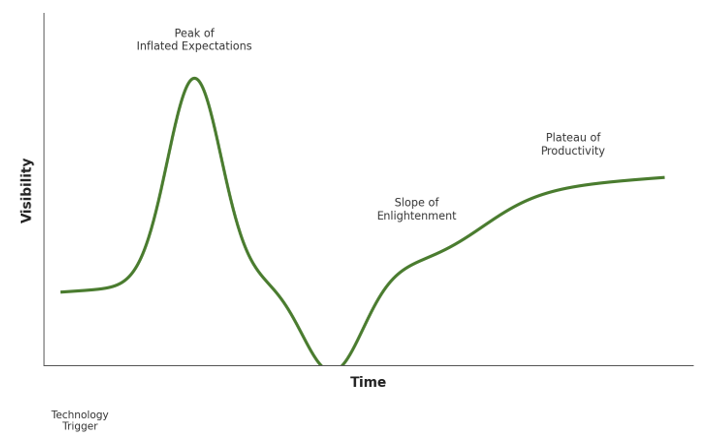
Today, it seems to us that AI is in its peak-of-inflated-expectations (hype) phase. Everyone perceives an enormous potential in the abstract, but we do not yet know how far this technology will evolve, how rapid that evolution will be, or which applications will prove economically efficient enough to become widely adopted. It is therefore likely that much of what is currently said about AI contains a measure of exaggeration and speculation. New technologies generally take several years to mature and reach the plateau of productivity, so the future of AI is still difficult to predict in concrete and detailed terms.
The impact of AI on investments
Finally, what always interests us most: how might this topic affect investment decisions?
Investing in AI companies is probably a bad idea at this moment, because during hype periods the valuations of companies at the industry’s vanguard tend to become hyper-inflated, and it is very difficult to predict which company will ultimately become the definitive leader in its segment. A great illustration of this is the story of Yahoo and Google. Yahoo was founded in 1994 and was the dominant search engine until the early 2000s, reaching a peak valuation of more than USD 125 billion, more valuable than Ford, Chrysler, and GM combined at the time. Even so, Google, founded in 1998, defeated Yahoo and became the undisputed leader among search engines. Today, OpenAI is one of the most prominent companies in the sector, owing to the success of ChatGPT, but it is very difficult to predict whether its future will mirror Yahoo’s or Google’s.
Potentially more interesting investment theses might be found by seeking opportunities among companies that supply the AI sector, following the adage that “in a gold rush, the ones who make the most money are those selling picks and shovels.” This is also not an easy task: while it does not take much effort to conclude that AI depends on robust data centers to store and process massive volumes of data, it is necessary to analyze each supplier segment to judge whether it is subject to intense competition and risks of technological disruption.
Another possibility is to look at the sectors that should benefit from the use of AI. For example, the music industry benefited enormously from the technologies that made it possible to record audio and distribute albums on records, tapes, CDs, and now through streaming. Some record labels became multi-billion-dollar companies thanks to the scalability that technology brought to their businesses. In the same way, AI will certainly enable some businesses to become more efficient, scalable, and profitable for their shareholders.
Just as important as identifying the companies that will benefit is understanding which businesses AI represents a risk for. New technologies can destroy companies, a fact well illustrated by the story of Kodak, which was founded in 1888 and for more than a century was one of the most important names in the camera and filmmaking market. When digital camera technology emerged in the 2000s, Kodak was slower than its competitors in developing new products and ultimately fell behind. In 2012, the company filed for bankruptcy.
Today, we are still more focused on detecting risks related to AI — especially for the companies in our portfolio, than on developing investment theses based on this technology’s progress, given the still very significant uncertainty surrounding the subject. However, we believe AI has the potential to become as revolutionary as the advent of computers, the internet, and smartphones, and for that reason it is a topic we intend to continue following closely.