
David and Goliath in the financial market
Dear investors,
How the financial market operates in Brazil is still poorly understood by most individual investors. For example, have you ever wondered how major brokerages make money, even while offering free services to retail clients, and what the implications of this business model are for investors?
One of the main revenue sources for brokerages is charging commercial commissions from the investment funds available on their platforms, which commonly amount to 50% of all fees paid by investors to fund managers, throughout the entire investment period.
This business model has two significant implications. The first is that brokerage advisors, who serve clients for free, have an incentive to recommend the products that pay the highest commissions, not necessarily the ones that are best for each client. The second implication is that the compensation of fund managers, who do the actual work of improving investment returns, is cut in half. The remainder goes to the brokerages, which provide the convenience of a good app and the ability to centralize investments in a single account, but contribute nothing to improving the return on invested capital. It is as if the packaging cost the same as the product inside.
As a consequence of this structure, managers seek to offset the reduction in fees by growing the fund’s assets under management. This, however, creates a burden for their investors: the larger the fund, the harder it is to achieve excellent returns. This will be our topic today.
Smaller funds, higher returns
The fact that small funds tend to generate higher average returns than large funds is well known in the financial industry. Although the topic is rarely discussed openly, several studies and articles substantiate the point.¹
Aurum, a funds of funds manager (funds specialized in selecting and investing in shares of other funds), analyzed the returns of hedge funds between 2010 and 2018. At the start of the period, there were approximately 1,700 funds managing USD 1.7 trillion; by the end, 3,800 funds with USD 3.2 trillion. They found a clear correlation between fund size and performance: while “micro” funds (less than USD 50 million in AUM) averaged 7.7% per year, “mega” funds (more than USD 5 billion) averaged 5.1% per year. USD 100,000 invested in “mega” funds would have grown to USD 156,000 over 9 years, while the same in “micro” funds would have reached USD 195,000, a final value 25% higher.
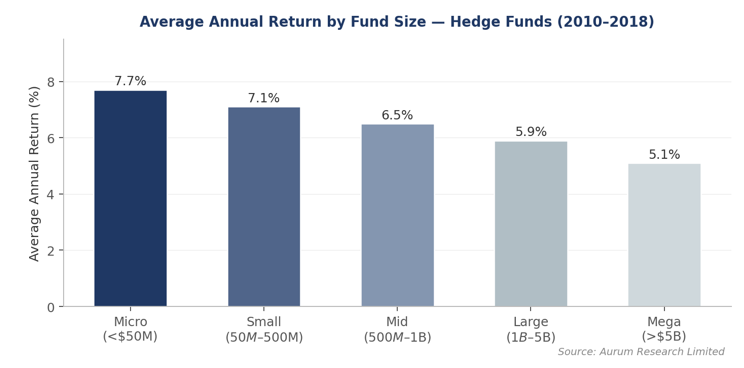
Source: Aurum Research Limited
The same result holds in Brazil
To verify whether this return differential also applied to equity funds operating in the Brazilian market, we gathered data on 1,049 investment funds registered with the CVM with net assets of at least BRL 50 million for the period from 2012 to 2021, and compared average returns across different size brackets. There is no return erosion below BRL 750 million, but average returns begin to decline beyond that point. While funds below BRL 750 million averaged 10.61%, those above BRL 5 billion averaged just 0.66%. BRL 100,000 invested in the larger funds would have grown to BRL 107,000 over those 10 years, while the same in smaller funds would have reached BRL 274,000, a final value 157% higher.
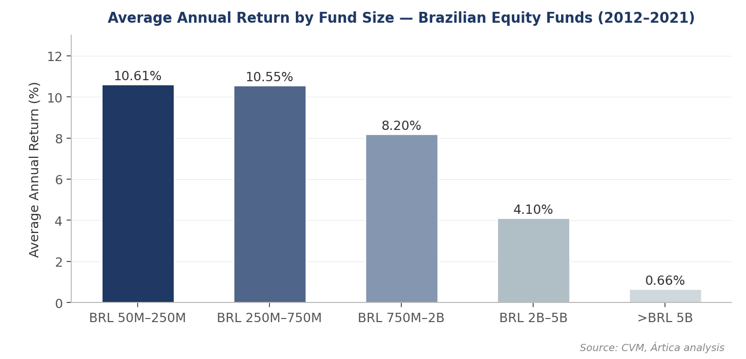
Source: CVM, Arctic analysis
Why does this happen?
Truly gigantic businesses are quite rare. In Brazil, there are 366 companies listed on the exchange,* of which 253 are worth less than BRL 5 billion, 95 between BRL 5B and BRL 50B, and only 18 above BRL 50B. Similarly, there are fewer opportunities capable of absorbing billions of reais than there are for deploying tens or a few hundred millions.
At the same time, fund managers typically only invest time analyzing opportunities that allow them to deploy a minimum amount of capital. The larger the fund, the higher this threshold, a fund investing only in stocks above BRL 5B market cap would analyze just 113 out of 366 stocks, ignoring 69% of possible opportunities.
As a result, large funds compete with one another for a restricted set of investment opportunities, making it harder for significant price-value asymmetries to emerge. By contrast, there is far less competition for smaller opportunities, making it easier to find undervalued small caps, which also tend to generate higher long-term returns due to greater growth potential and more agile management structures.
Consequently, the chance of these funds having very high returns ends up being lower.
In contrast, there's far less competition for small opportunities, and in some cases, the competition comes from non-professional investors, who are more likely to make mistakes and misprice the stock they're analyzing. Thus, it's easier to find small caps (stocks with low liquidity, usually from smaller companies) that are undervalued in the market and, in addition, small caps tend to have higher returns than large caps in the long term³, as they tend to have greater growth potential and more agile and efficient management structures. Funds that can invest in these types of companies have an advantage in seeking higher returns.
Our plans
We are quite realistic about the fact that our investment strategy would not deliver the same results if we had billions under management. The size limit at which we have a good chance of continuing to meet our return target is not precise, but we know it lies somewhere between R$ 500 million and R$ 1 billion. Given this, we have made two decisions.
The first is that, when we begin to experience difficulty finding good investments due to the fund's size, we intend to close it to new investors. Beyond investing the majority of our personal wealth in Ártica Long Term FIA, the fund also holds meaningful capital from a number of friends and family members. As such, both out of professional ethics and personal relationships, we have a deep commitment to generating the best possible returns on this capital.
The second decision was not to distribute Ártica Long Term FIA through platforms. We prefer to raise capital directly and avoid the "packaging cost," thereby ensuring that the fees paid by our investors go toward the management structure — which is what actually generates returns. The impact of this is quite significant: we are able to sustain the same structure with half the assets under management that would be required if we were paying distribution commissions.
We also value knowing our investors and maintaining close contact with them. Raising capital directly carries the added benefit of allowing us to continue this practice. We have been working to become increasingly transparent about our investment philosophy and market outlook: we began hosting lives on the topics covered in our monthly letters (every first Wednesday of the month at 7:00 PM) and also quarterly results presentations in online meetings held exclusively for our investors.
If you have any suggestions for what else we could do to improve our communication with you, please send us an email at investimentos@articainvest.com.br We would be delighted to hear new ideas!
¹ Gao, Chao; Haight, Tim and Yin, Chengdong, Size, Age, and the Performance Life Cycle of Hedge Funds (September 2018); Chen, Joseph S. and Hong, Harrison G. and Huang, Ming and Kubik, Jeffrey D., Does Fund Size Erode Mutual Fund Performance? The Role of Liquidity and Organization (May 1, 2004)
² B3 data as of July 30, 2022, excluding listed companies that do not have traded shares.
³ We published a letter about investments in small caps in September 2021, which is available at the link https://artica.capital/cartas/investimento-em-small-caps/