
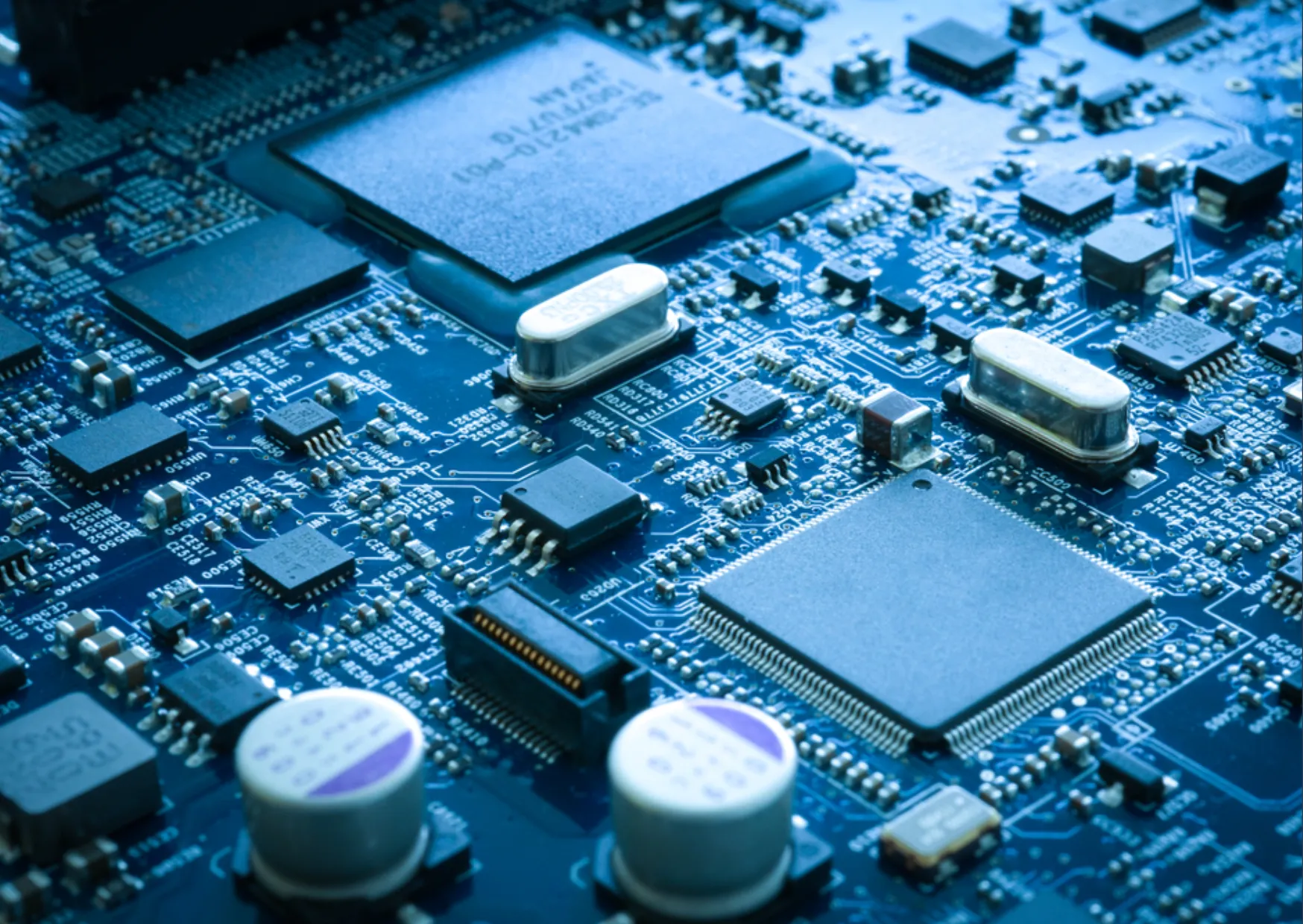
Chips: the brain of the digital economy
Dear investors,
In April 1965, an article titled “Cramming More Components Onto Electronic Circuits” appeared in Electronics Magazine. This publication, whose title can be fully appreciated only by engineering enthusiasts, went on to become one of the most influential contributions in history.
The article had been written by Gordon Moore, an electrical engineer who was then head of R&D at Fairchild Semiconductor, one of the future co-founders of Intel. In his article, Moore predicted that the number of transistors on an integrated circuit would double, on average, every two years. This prediction eventually became known as Moore’s Law.
The prediction was originally made for the following 10 years, but it has proven true to this day, nearly 60 years later. It is thanks to this law that the number of transistors fitting on a single chip grew from 4 to more than 16 billion today¹, enabling this technology to become ever more prevalent in our lives. At the heart of the digital universe, chips — or microprocessors — are the brains behind computers, smartphones, tablets, and a vast array of electronic devices that form the foundation of the digital economy. Without them, many of the advances we see in fields such as artificial intelligence, Big Data, the Internet of Things (IoT), and cloud computing would not be possible.
Demand for chips is growing across a wide range of sectors, from automotive to healthcare, agriculture, and even space exploration. Chip shortages can have dramatic effects on production and the economy as a whole — an effect that became starkly evident during the pandemic, when chip scarcity had a significant impact on the automotive industry. A modern vehicle contains, on average, 1,500 chips. Without them, many vehicles could not be produced, which is estimated to have cost the industry up to ~USD 200 billion in lost sales in recent years. This impact is equally notable in the sharp rise in car prices witnessed over the same period.
Given that the technology in this industry is held by very few companies — each specialized in a single stage of the production chain — new bottlenecks are not unthinkable and could be far more severe than those experienced during the pandemic. This is especially true considering that the company responsible for producing nearly 90% of the world’s most advanced chips² (TSMC) is located in Taiwan.
In the following paragraphs, we briefly explain the industry’s history, how it is structured today, its role in the global geopolitical landscape, and the implications for our investments. For those interested in a deeper dive into the subject, we recommend reading the book “Chip War” by Chris Miller.
What exactly is a chip
To understand how a chip works, it is useful to start with the concept of a semiconductor.
Semiconductors are materials with electrical properties that fall between those of conductors (such as copper, which conducts electricity very well) and insulators (such as rubber, which does not). Silicon is the most commonly used semiconductor in chip manufacturing — it is from this element that the American region known as Silicon Valley takes its name.
Inside chips, small components called transistors are created from this semiconductor. Think of a transistor as a tiny switch that can turn electricity on and off. This ability to control electricity is crucial to the chip’s operation, as it is how binary language (the code of 1s and 0s) is represented. When the transistor is “on,” a “1” is recorded; when it is “off,” a “0” is recorded. This series of 1s and 0s is the fundamental language that computers use to process information.
Brief history of the chip industry
The semiconductor industry has its roots in the 20th century, when the invention of the transistor at Bell Labs in 1947 changed the course of technology. This small device, capable of amplifying and switching electrical signals, eventually replaced the vacuum tube, which was larger, consumed more power, and was less reliable. In 1958, Jack Kilby of Texas Instruments and Robert Noyce of Fairchild Semiconductor independently created the first integrated circuit (or chip), combining multiple transistors into a single device. This invention marked the beginning of the silicon era and the birth of the chip industry.
In the early years, these products had no commercial demand and found use in military applications. The fact that the United States was falling behind in the space race provided the necessary incentive for computing demand. Fairchild Semiconductor received a major order from NASA for the Apollo mission (the mission that put humans on the moon in 1969). Meanwhile, Texas Instruments received a large order from the U.S. Air Force for a missile guidance system.
In the 1970s, companies such as Intel and AMD emerged as major players in the sector, with Intel introducing the first commercially available microprocessor, the Intel 4004, in 1971. The invention of the microprocessor led to significant advances in computing and other technologies, fueling the rise of personal computers in the 1980s.
From the 1980s onward and continuing into the 21st century, the semiconductor industry expanded beyond computers to encompass an ever-growing range of applications, including mobile phones, Internet of Things (IoT) devices, and artificial intelligence systems. In addition, a global division of labor emerged, with some companies — such as Intel — designing and manufacturing their own chips, while others — such as Apple and Qualcomm — design chips but outsource fabrication to companies like TSMC.
Current industry landscape
Given the importance of this industry, it is almost surprising how concentrated it is.
Companies like Apple, Nvidia, and AMD play important roles, but are responsible only for designing chips. To develop those designs, these companies rely on software whose technology is dominated by just 4 firms (3 American and 1 German) that together hold 90% of the global market: Synopsys, Cadence, Ansys, and Siemens.
Once the design is complete, it is sent to one of the chip manufacturers. Depending on the complexity of the product, there are only 2 or 3 companies in the world capable of producing them: TSMC (Taiwan), Samsung (South Korea), and Intel (USA)³. For chips with less advanced technology, other companies enter the picture, such as the American Global Foundries (a former AMD spin-off), the Taiwanese UMC, and the Chinese SMIC.
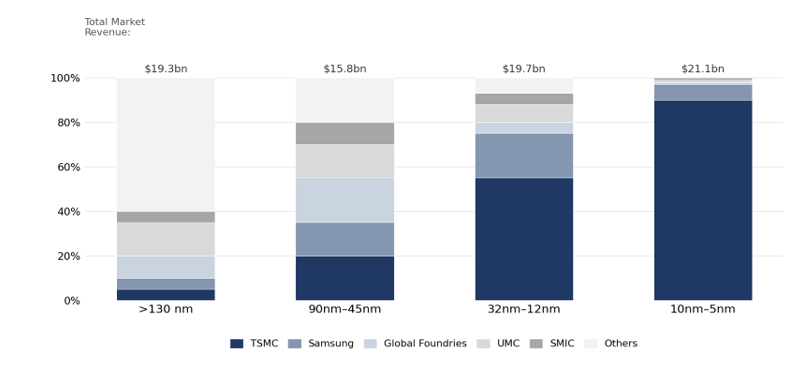
What stands out is the dominance that TSMC exercises in this market — for the most advanced chips, with nodes below 10 nm, it holds a 90% market share. And even for less advanced nodes, the company maintains a dominant position with a market share above 50%. Details in the chart below.
Chart 1 – Market share of non-integrated chip manufacturers by node, 2020 data
Source: Bain/IC Insights/Gartner
In the chart, the bars on the right represent the most advanced chips (with the smallest distance between elements)
Companies like Apple and Nvidia have become more widely known — the former for being the most valuable company in the world, and the latter for being best positioned to ride the AI wave (which caused its shares to surge an incredible 175% in 2023) — but both are extremely dependent on TSMC. 100% of both companies’ chips are manufactured by the Taiwanese firm.
TSMC is able to translate its clients’ designs into silicon using some of the most precise machines in the world, which etch, deposit, and measure layers of materials at the nanometer scale (20,000 times smaller than a human hair). These machines are produced primarily by 5 companies: one Dutch (ASML), one Japanese (Tokyo Electron), and three American (Applied Materials, Lam Research, and KLA), each focused on a specific stage of the process.
ASML in particular (the Netherlands’ largest company by market cap) is the sole holder of EUV⁴4lithography technology, which is essential for transferring chip designs onto silicon layers. Each of these machines has an average cost of USD 150 million (very few companies are capable of making such an investment — only TSMC, Samsung, Intel, and memory chip manufacturers such as SK Hynix and Micron), and is the product of three decades of investment by ASML. Today, the company reaps the rewards, as this technology is essential for producing the most advanced chips and has no substitutes — it is said that ASML will remain free from competition in this technology for decades to come.
And how did we end up in this situation — where such a critical industry is dominated by so few companies?
Across the chip industry, the past few decades tell a story of consolidation. There are two main reasons for this: first, several parts of the chip manufacturing process are brutally capital-intensive, with extremely expensive machinery. This discourages competition, as a new entrant must invest billions of dollars before knowing whether its product will even work.
The second reason is that the level of expertise required to build this equipment is highly specific and demands hands-on experience — it cannot be taught theoretically in universities. This means that the companies holding the relevant technologies employ the vast majority of people in the world with the necessary knowledge, making it extremely difficult for new entrants to emerge.
The geopolitical dilemma
The importance of chips extends beyond economic considerations — they have also played a fundamental role in military applications, contributing to technological advances in areas such as communications, surveillance, intelligence, and weaponry. During the Cold War, for example, the United States’ pioneering use of this technology was a decisive factor in their victory over the Soviet Union.
In today’s world, chips play an even more critical role, particularly given that military and intelligence systems will increasingly depend on artificial intelligence. AI systems are trained in data centers filled with sophisticated chips. If a country does not hold the technology to manufacture such chips, it will not be able to train AI systems — and this is precisely where the United States is placing its bets in its conflict with China.
In this context, the U.S. has taken steps to restrict China’s access to advanced semiconductor technologies. For example, several Chinese companies have been placed on a Commerce Department list that restricts their ability to purchase U.S. semiconductor technology. At the same time, American and allied-country companies (such as ASML, Tokyo Electron, Applied Materials, Lam Research, KLA, and even TSMC) face a series of restrictions preventing them from selling their most advanced products to China.
In response, China has been investing heavily in developing its own semiconductor manufacturing capabilities, although there is still a long way to go before it reaches the technology level of the leading chip manufacturers.
There is also the question of Taiwan. China has claimed Taiwan as part of its territory, which has been a persistent source of tension between China, Taiwan, and the United States — a key supporter of Taiwan. Any conflict in Taiwan, or any attempt by China to exert more direct control over the region, would have significant implications for TSMC and, consequently, for the global semiconductor supply chain.
To protect itself against a potential escalation of the conflict in Taiwan, the U.S. passed the CHIPS Act in 2022. The law allocates USD 280 billion for investments in chip research and manufacturing on U.S. soil, with the goal of reducing American dependence on chips manufactured in East Asia — particularly the most advanced ones. The passage of the law has already attracted investment commitments from companies including Intel, GlobalFoundries, Samsung, and even TSMC — all of which plan to build factories in the United States in the coming years. Despite the substantial sum, there are many skeptics regarding the actual impact these investments will have on reshaping the global production structure, given that each factory is incredibly expensive (a cutting-edge fabrication plant costs between USD 20–25 billion to build, and retains leading-edge technology for only a few years) and the fact that production in the United States is naturally more expensive than in Taiwan — especially due to higher costs in key areas such as labor, land, water, and electricity, stricter environmental regulation, and a more burdensome tax regime.
How all of this plays out is something to be closely monitored in the years ahead.
Impact on Investments
From an investment standpoint, there are two ways to think about how to act.
The first is to identify potential opportunities within the industry itself, which certainly has very attractive characteristics: it is an essential product for the global economy, with clear growth trends and populated by dominant companies in their respective segments. Given these characteristics, we have been analyzing the companies and monitoring share prices, with a view to potentially investing when prices are appropriate.
One company that stands out in particular is TSMC. As we have seen, it holds a dominant competitive position, and analyzing its growth and profitability track record (it has grown at a rate of 22% per year over the past 30 years, with a consistently strong ROE of 20–30%), one would expect it to trade at high multiples. Nevertheless, it is currently valued at USD 465 billion5 and trades at a multiple of 14x trailing twelve-month earnings — low given the quality of the company. However, its presence in Taiwan places it in a vulnerable position given the constant threat of a Chinese invasion, which may represent a risk to an investment in TSMC. The legendary investor Warren Buffett had invested in the company but sold his shares in early 2023. When asked about his reasoning, Buffett said he considers TSMC one of the best-managed companies in the world, but that he dislikes the company’s location.
The second approach is to think about second-order effects — particularly how the evolving dynamics of this industry might impact the global economy. A major concern is a potential war or naval blockade around Taiwan, which could have near-catastrophic consequences for the global economy. If the chip shortage seen during the pandemic is any indication, we would likely go one or two years without being able to buy new cars, and a similar level of disruption would be felt across numerous other industries such as mobile phones, computers, and household appliances.
In addition to seeking new investment opportunities in this industry, we are also attentive to the impacts that changes in the semiconductor supply chain could have on the companies in our portfolio. Given the topic’s importance to the global economy, we will continue monitoring it closely in the years ahead.
1 Number of transistors in Apple A16, microprocessor in iPhone 14 Pro
2 2020 data shows that TSMC has a market share of 90% in chips with nodes smaller than 10nm
3 Intel is the only company that still designs and manufactures its own chips. Given its dual focus, it ended up losing the race to pure-play manufacturers (especially TSMC), and managed to launch its most advanced technology products only several years after its competitors
4 Extreme ultraviolet lithography
5 Based on closing prices as of June 2, 2023