
Annual Letter 2020
Dear investors,
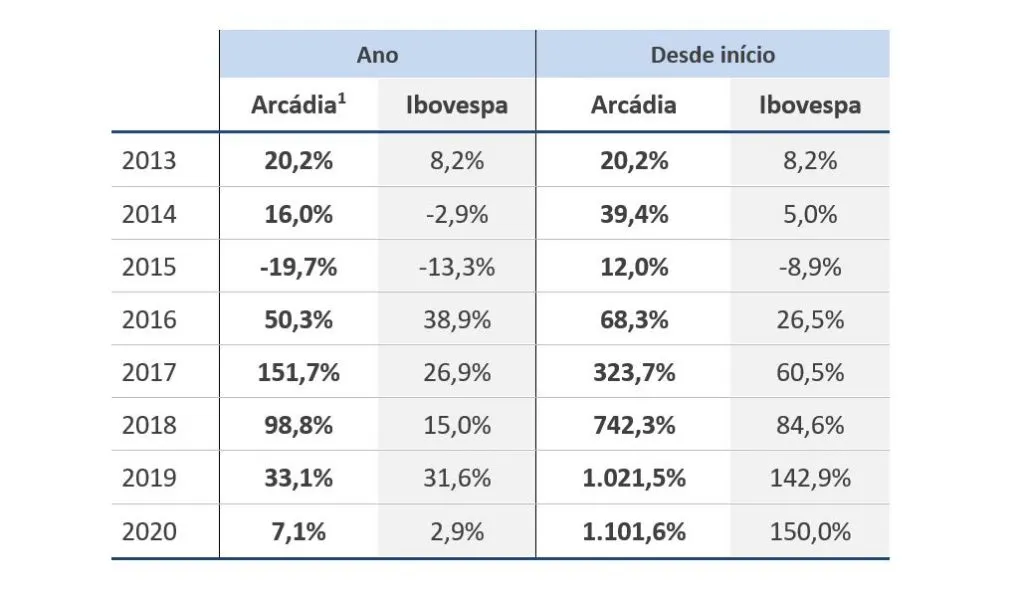
We closed 2020 with an annual return of 7.1%, above the Ibovespa and the CDI, which returned 2.9% and 2.8%, respectively, over the period. The cumulative return since the Fund’s inception, around seven and a half years ago, is 1,102%, which represents an annualized return of 39.2%:
2020 in review
2020 was a very challenging year for everyone. It was a year marked by the Covid-19 crisis which, in addition to its terrible humanitarian consequences, brought enormous volatility to financial markets.
With the Ibovespa surprisingly ending 2020 in positive territory and close to its all-time highs, the days of extreme uncertainty we experienced at the beginning of the year seem distant. It is worth remembering that the Ibovespa’s circuit breaker1 was triggered six times during the year (record high, tied with 2008) and, in March 2020 alone, the index accumulated losses of 30%, the worst month since August 1998 and the fourth worst in history. Between January and March 2020, the Ibovespa posted a cumulative decline of as much as 47%, losing almost half of its value in just two months.
This enormous volatility taught investors important lessons:
The first and most important is portfolio risk management. As we published in our October 2020 monthly letter, we believe that the best way to manage portfolio risk is not by diversifying investments across dozens of theses, but rather through in-depth analysis of each investment opportunity, carefully choosing companies with great return potential, the resilience to weather a variety of economic scenarios and a robust capital structure. We have always kept our portfolio concentrated in our best theses, which for many is synonymous with greater risk, and we have managed to come through not only this Covid-19 crisis well, but also all the others that have occurred since our founding in 2013.
Another important lesson was the importance of a long-term focus. During the crisis, investors with a long-term perspective had the composure to analyze and understand that the crisis was temporary and that, over time, the economy and good companies would recover. The fall in share prices would be a short-term phenomenon and could present an excellent buying opportunity.
That is exactly what we told our investors on March 20, 2020:
“We believe this may be one of those opportunities that arise only a few times in a lifetime to make a good investment in the stock market. This is a severe but temporary crisis. Some companies may fall by the wayside, especially the most leveraged ones and those exposed to the hardest-hit sectors, but those that survive should not have their long-term results affected. We are highly convinced that all the companies in which we invest and would like to invest belong to the second group. In the few weeks since the beginning of the crisis, new contributions to our fund already represent 110% of all the capital contributed in 2019. And, of these contributions, 75% was money from our team (or from family members, on our recommendation). Many investors ask us to tell them when it is a good time to invest. We believe this is a good time.”
Case CEB
In this letter, we will share a recent and little-known case from the fund: the investment in Companhia Energética de Brasília (CEB).
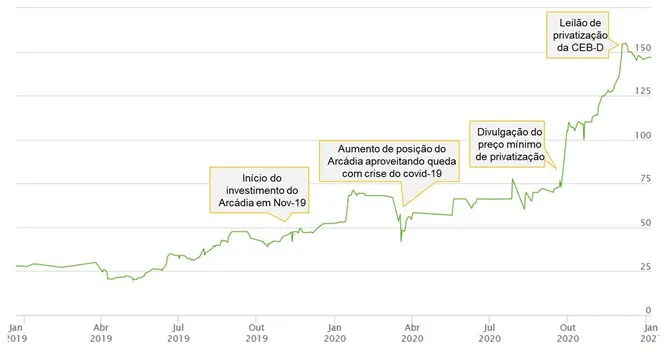
CEB gained prominence at the end of 2020 with the successful privatization of CEB-D (its power distribution subsidiary), which was sold to Neoenergia for R$2.515 billion, and its shares appreciated 180% in 2020, more than any stock in the Ibovespa index.
The privatization took place in December 2020, but our investment in the company began back in 2019. Below, we detail our investment process in CEB and comment on its current prospects, given that it still represents an important position for the fund.
Chart 1 – CEB (CEBR6) share price and main milestones
Background and initial investment
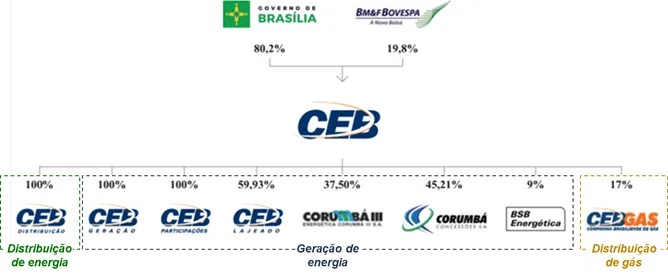
CEB is a state-owned company controlled by the government of the Federal District, which holds an 80% stake. The remaining 20% is traded on B3. Its most liquid share classes (ON: CEBR3 and PNB: CEBR6) are thinly traded on the exchange (daily liquidity of around R$500 thousand/day) and, as a result, the company was (and still is) overlooked by many investors. This lack of coverage created an enormous investment opportunity for us in 2020.
The company operates in power distribution, generation and trading through 8 subsidiaries. The figure below shows CEB’s corporate structure:
Chart 2 – CEB’s corporate structure
CEB’s main asset is CEB Distribuição S.A. (CEB-D), which holds the concession to operate power distribution in the Federal District.
CEB-D is a loss-making company in a difficult financial situation, the result of high personnel costs and an inflexible cost structure (as a state-owned company). Because of electricity sector regulations, which require companies to maintain minimum levels of financial health, CEB-D was at risk of losing its concession.
To address this problem, the solution found by the company was to privatize CEB-D, a plan that gained momentum with the election of a district government with a more liberal bias. In June 2019, the privatization of the company was approved by its shareholders and BNDES was hired to advise on the transaction.
CEB-D also had some characteristics that caught our attention and could make it a highly coveted target for private companies in the sector:
- Operations in one of the wealthiest regions of the country, with low default rates;
- High density of customers per km of power distribution line, which reduces the need for investment per customer and increases the profitability of the operation; and
- Low rates of network failures and interruptions compared with other state-owned companies, indicating good-quality infrastructure with no need for major upgrade investments after an eventual acquisition.
Given the sector’s successful track record in privatizations of state-owned companies (companies such as Equatorial and Energisa managed to generate enormous value for their shareholders by acquiring state-owned companies and making them more efficient), the news of CEB-D’s privatization immediately caught our attention and led us to study the case.
In addition to power distribution, the company also has a significant presence in generation, where it owns good assets with very stable cash generation. Among them, four hydroelectric plants stand out (UHE Lajeado, UHE Corumbá III, UHE Corumbá IV and UHE Corumbá Queimado), which together have an installed capacity of 200 MW2 and concessions expiring between 2032 and 2037.
The results of these generation companies caught our attention because of the earnings growth observed over the last five years, as shown in the chart below.
Chart 3 – Net income from CEB’s generation operations (in R$ million)
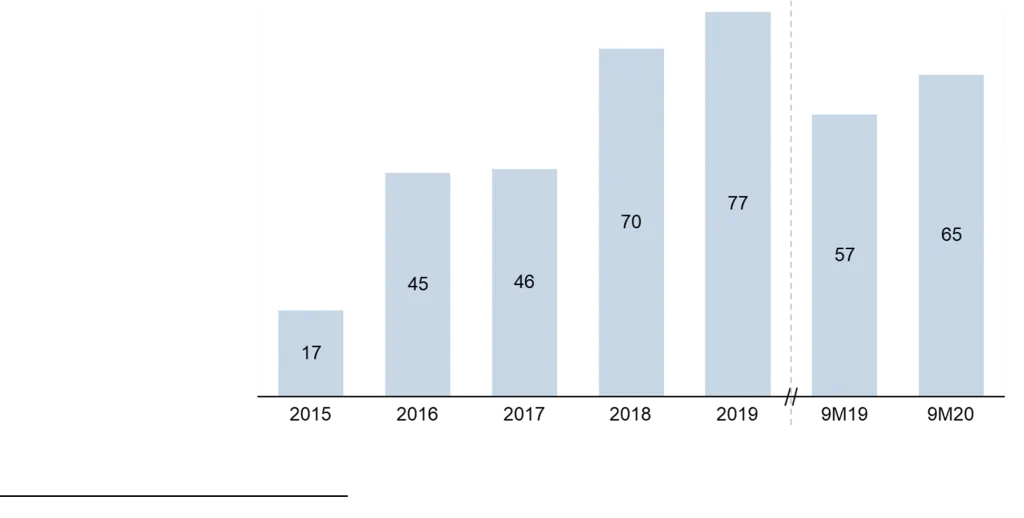
The main reason behind this growth is the deleveraging of one of the concessions (Corumbá IV), which still had high debt resulting from the investments required to build the plant. With the cash generated in recent years, the company was able to pay down a large part of this debt and considerably reduced its financial expenses. With a lower level of debt, we expect results to be even better in the coming years.
Despite these good results, the cash generated by the generation companies was largely used to cover CEB-D’s losses. Thus, after the privatization, the positive and consistent results of these companies should become more evident in the company’s financial statements.
Estimated valuation and portfolio risk management
With the background explained, let us move on to our analysis of the company’s potential value. Considering that CEB was a holding company with several subsidiaries engaged in different activities, it makes sense to calculate the company’s value using a “sum-of-the-parts” methodology.
To do so, the first step was to estimate the value of the generation companies. Considering their cash generation profile and the duration of their concessions, we conservatively estimated that these companies had a combined value of R$600-700 million, which represented multiples of 6.0x EV/EBITDA and R$4.0-4.5 million/MW of EV/installed capacity, both below the sector averages.
The next step was to estimate the value of CEB-D. In this case, given the privatization context, we worked with two scenarios:
Scenario 1 assumed a successful privatization process. In this case, based on the sector’s privatization track record, we estimated that the company could be valued at more than R$1.0 billion and, given CEB-D’s particular characteristics (mentioned above), there was room for positive surprises if several bidders took part in the auction.
Scenario 2 assumed no privatization. In this case, considering that the company was unable to meet Aneel’s financial targets, the concession would probably be declared forfeited and CEB-D would cease to exist. Considering the company’s liabilities and the costs of shutting down the operation, we estimated that, in this scenario, CEB-D would have a negative value of R$300 million.
There was also the possibility of the company continuing to operate the concession, which would be more advantageous (even though CEB-D was loss-making), but we considered this scenario unlikely and disregarded it for the purpose of estimating the company’s value.
Considering that the holding company’s costs and the value of CEB-Gás (a small subsidiary) were negligible, the company’s value lay mainly in the sum of CEB-D and the power generation companies, which we estimated at R$1.7-1.8 billion in scenario 1 and R$300-400 million in scenario 2.
These amounts compared with a market value of R$700 million at the time; that is, in scenario 1 (privatization) there was a potential gain of 140-160%, and in scenario 2 (remaining state-owned) there was a potential loss of 40-60%. Clearly, the success of the company’s privatization was essential for the investment to succeed. We then set out to analyze the probability of CEB-D’s privatization.
Estimates of this nature are always uncertain in Brazil, given the many participants and political leanings involved in such processes, but a few factors gave us confidence that the chances of CEB-D’s privatization were high:
There was a successful track record of 7 recent privatizations of regional distribution companies like CEB; in other words, we were not treading an unknown path.
The government of the Federal District and CEB itself were very interested in the privatization, both because CEB-D was at risk of losing its concession and because of the more liberal bias of the company’s management, which is working to make it more efficient. Proof of this were the steps the company had already taken toward privatization.
Aneel, the sector’s regulatory agency, also viewed the process favorably, as it was a way to improve the quality of power distribution in the region.
The main opponents of the process were the company’s own employees, organized in unions, and politicians who supported those unions. We therefore looked at the history of other privatizations to understand what kinds of threats such opposition could pose, but none of those processes had been blocked by union opposition.
In addition, at the time of the analysis, the STF (Brazil’s Supreme Court) had recently ruled that the privatization of subsidiaries of state-owned companies did not require approval from legislative bodies. The decision had been made in the context of the privatizations of Petrobras and Eletrobras subsidiaries, but it was also applicable to CEB.
Finally, private companies’ interest in the asset was high. There were at least 6 private companies in Brazil with an appetite for acquiring state-owned power distribution companies and, considering the quality of the asset, there was no reason why many of these companies would not be interested in CEB-D.
By our estimates, the probability of privatization would have to be greater than 25% for the investment to have a positive expected value and, considering the points above, it seemed to us that the chances were far higher than that 25%. We then decided to make the investment.
Given that the position carried a significant potential loss (40-60%), we sought to control the risk through position sizing. We started with a small investment and, as the privatization process advanced and the chance of success increased, we increased the initial position until it reached 10% of the fund invested in CEB.
In short: with a 10% position and considering our scenarios, we could lose 6% or gain 16% of the fund’s total value, with the positive scenario being more likely than the negative one. It was this asymmetry in the risk-return relationship that led us to the decision to make this investment.
Current scenario
Even after the privatization of CEB-D (which is expected to be completed by March 2021), we still believe that CEB remains an excellent investment opportunity, and we are keeping it in Arcádia’s portfolio.
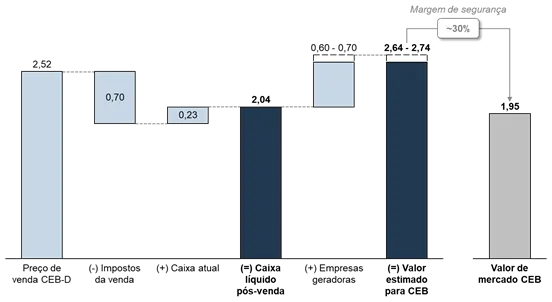
With CEB-D privatized for R$2.515 billion, we estimate that the company will pay around R$700 million in taxes and, added to its existing cash of R$225 million, the company will have a net cash position of R$2.04 billion, while its market value is R$1.95 billion3 – in other words, the company’s cash alone is worth more than its current value on the stock exchange!
In this calculation, we are not even taking into account the generation companies which, as we have seen, have an excellent cash generation profile. With the valuation of R$600-700 million mentioned above, we arrive at a fair value for the company of around R$2.7 billion. Compared with the market price, there is a margin of safety of close to 30% in the investment, which is quite high given that a large part of the valuation consists of cash and, by all indications, a large part of it will be distributed as dividends. The company still seems cheap to us.
Chart 4 – Estimated composition of CEB’s value (in R$ billion)
CEB is an atypical company in the portfolio. Normally, we like to invest in companies of excellent quality that are leaders in their sectors and have high profitability ratios. CEB, by the very fact of being a state-owned company, does not meet all the qualitative characteristics we look for.
That has not stopped it from being a great investment. In the stock market, it is possible to achieve excellent returns in average companies and large losses in excellent companies. It all depends on the price paid for the asset. For us, buying cheap is a great method of risk management.
“Investment success doesn’t come from buying good things, but rather from buying things well.” – Howard Marks
News from Ártica Asset
We have some news for 2021. The first is that Ivan Barboza, one of Ártica’s founding partners, has left the M&A practice to dedicate himself exclusively to the firm’s asset management business. In addition to his arrival, we have strengthened our research team, and we now have a team of 5 people on the investment team. Another change is that, to facilitate our communication, we have decided to unify our company’s identity around a single brand: Ártica. As a result, our fund Arcádia FIA will be renamed Ártica Long Term FIA, uniting our Ártica brand with our investment philosophy.
1 A circuit breaker is a mechanism used to halt trading when the market experiences a sharp decline
2 The concessions for these plants are held by companies in which CEB has varying stakes. The 200 MW figure presented represents only CEB’s proportional stake in each of these plants
3 As of 12/31/2020