
Why doesn't Brazil grow?
Dear investors,
In our last letter, we walked through ten crises Brazil has faced since the Plano Real and how the stock market behaved through each one. That review echoed something we've learned over 12 years of investing here: Brazil is a good place to make money in equities not because of the strength of the national economy, but because stock price volatility runs well ahead of economic volatility — and that gap generates excellent investment opportunities.
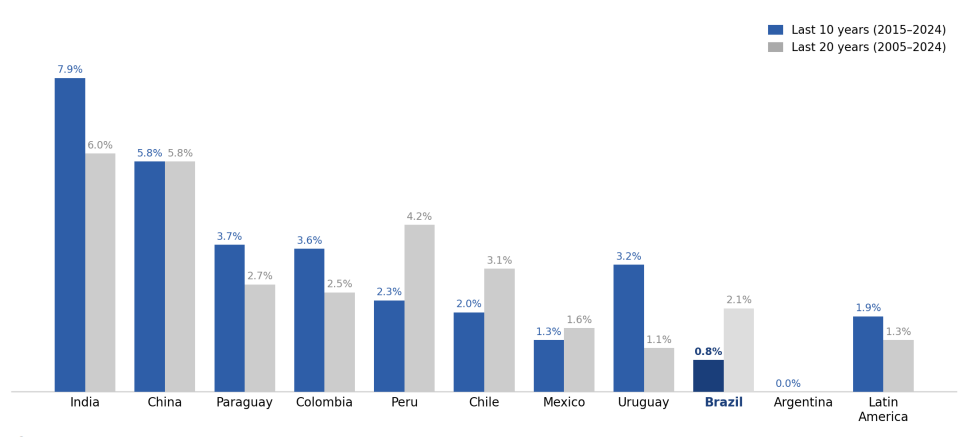
We can't complain about the returns we've made in that context, but we still share the frustration most Brazilians feel: a nagging sense of wasted potential. Why does a continent-sized country, rich in natural resources and free of major geopolitical headaches, still fail to develop? Stack us up against other emerging markets and it's clear how far behind we've fallen, especially over the last decade.
Average GDP growth
Source: World Data Bank
The direct causes are well known. We have a deep education problem. Brazilian productivity has stagnated for decades. We live through near-constant political crises. But what's really driving these ailments? Why have other countries managed to solve them while we haven't? We don't claim to have definitive answers, but here's our take.
The educational problem
The most superficial takes on Brazilian education blame a lack of resources. More sophisticated ones point to teaching methods, institutional governance, and international best practices. You rarely hear anything beyond that, but we think there's a third layer — closer to the heart of the matter, and rooted in Brazilian culture.
Antoine de Saint-Exupéry put it well: “If you want to build a ship, you don't begin by gathering wood, cutting boards, and distributing tasks. Rather, you awaken within people a desire for the sea.” Human performance depends first on motivation, then on method. An operation with well-designed rules and processes, but disengaged people, will rarely be more than an inefficient bureaucracy. The first step toward quality education is genuinely valuing and wanting knowledge. That sounds obvious, but it's not what we see in Brazil.
The average Brazilian wants the diploma because it's a hiring requirement, and cares less about the actual knowledge it's supposed to represent. One well-known fact backs this up: most Brazilian students cheat on exams — the infamous “cola” — and it's so common it barely carries any moral stigma anymore. The blame doesn't rest with students alone. Part of it comes from how little many curricula connect to real life: students don't see how their classes help them get ahead, write the material off as a waste of time, and end up with a general distaste for studying. Part of it comes from a world where a 15-year-old influencer can suddenly blow up on social media and start out-earning a doctor, lawyer, or engineer with decades of experience — making a traditional career path look like a failure of imagination. There's no easy fix, but at least two cultural shifts could help.
The first is dropping the immature obsession with easy, fast success that seems to have become the modern default. Sure, some 15-year-old influencers make it big — but the average earnings across everyone chasing that path are almost certainly far below what a doctor, lawyer, or engineer makes. Playing the lottery every week is a bad way to get rich, and building a career plan around the extreme exception is no different. Mature ambition looks more like the “American Dream”: the belief that anyone can succeed through determination, hard work, and initiative. Studying and training until you're genuinely skilled at something useful is still a sound plan.
The second is remembering that knowledge is immensely valuable precisely because it's useful. Humanity doesn't pursue knowledge out of bureaucratic duty or academic vanity — it pursues knowledge chasing problems and ambitions of epic scale. The people behind humanity's great intellectual leaps are its real heroes. Everyone's heard of Aristotle, Isaac Newton, and Albert Einstein. Aristotle died roughly 2,400 years ago. Today's biggest celebrity, however much more popular right now, is unlikely to be remembered the same way 24 years from now. Intellectual achievement is one of the highest ambitions available to any human being.
How to change this is the real question. There don't seem to be any tricks or shortcuts. A nation's culture spreads from the top down — from its public figures and power brokers. China's Jack Ma, founder of Alibaba, works hard to cultivate a teacherly image, and is known as Ma Laoshi (“Teacher Ma”). The contrast captures the cultural gap between China and Brazil well, and we think it's part of what separates their economic trajectories. If our own elites put more effort into cultivating erudition, the rest of the population tends to follow suit.
The efficiency problem
Stagnant productivity is a different beast. Businesses are always chasing greater efficiency, so lack of motivation isn't the issue here. Most signs point to a big chunk of the problem coming from dysfunctional rules across Brazilian society: the tax system, the judiciary, and constant government intervention in the economy. The theoretical fixes for these problems are fairly well known — the OECD, the international body focused on improving economic and social well-being worldwide, has run dozens of studies and published detailed reports full of public-management best practices. Even so, most of it never gets implemented here. The reason seems to be a prisoner's dilemma, playing out at national scale.
In the classic version, two accomplices get arrested and pressured to confess. If both stay silent, they each get 1 year. If one confesses and the other doesn't, the one who talked walks free and the other gets 10 years. If both confess, they each get 5. The best outcome, in theory, is for both to stay silent and take the 1-year sentence. But fear of being the one left holding the bag drives both to confess, and both end up doing 5 years instead. Brazilian society's rules get shaped by a similar dynamic.
Take Brazil's fiscal problem as an example. The obvious way out is to cut spending — exactly what any household or business does when income falls short of expenses. The government clearly knows this, and understands the alternative just fine. It doesn't take that path because society doesn't actually demand it. In speeches, most people might even claim to support spending cuts. In practice, most people pressure the government for benefits that directly translate into more spending. The average citizen wants welfare and income-tax breaks. The business owner wants a special tax rate for their sector and a pile of subsidies. Together, these competing interest groups inflate spending, distort the rules, and create a dysfunctional mess. The result: capital gets misallocated across the country.
The free-market principle holds that the economic system is too complex for central control, and that letting prices float freely — set by the balance of supply and demand — generates the incentives needed to optimize how economic activity runs overall. Companies that efficiently deliver what society values, relative to their competitors, turn a profit and grow. Inefficient ones are doomed to fail. That dynamic is supposed to guide the best use of a country's resources, producing the most of what society actually wants. Once the government starts legislating different rules for each sector, that self-regulating principle stops applying. With subsidized financing and special tax rates in play, inefficient companies can survive and outgrow efficient ones that get no government favors — and there goes any hope of the productivity gains everyone claims to want.
Private industry won't solve this on its own: nobody wants to be the first to stop lobbying, there's no coordination mechanism for every party to agree to equal rules at the same time, and any path to implementation runs through Congress anyway. Government has to lead these reforms, and the private sector's job is to evaluate proposals fairly and push for a level playing field — not special treatment.
The recent tax reform was a real chance to make major progress, but it ended up a more timid step than intended — and as far as we can tell, not because of the politicians. The original proposal was excellent, but got deformed by pressure from multiple interest groups, and the law that passed came loaded with special regimes and differentiated conditions. The prisoner's-dilemma parallel is obvious: by each acting in its own narrow interest, every sector ends up stuck with worse rules, with long-term growth held back by the national economy's weak overall performance. Getting out of this requires real collective will, from both the public and private sectors.
The political problem
Brazilians elect both the president and members of Congress — tied to one of 29 parties — by direct vote. This setup, known as presidentialism with fragmented multipartyism, is rarer than people assume. Countries with similar systems cluster in Latin America and Africa, and even among that group, Brazil is an extreme case of party fragmentation. No developed country runs anything like it.
It's like running a huge company where all the executives are constantly at each other's throats. Governing is hard enough on its own; this structural misalignment among the politicians in power just makes it harder. With so many active parties, the president's party rarely holds a majority in Congress, forcing constant deal-making with other parties just to form a governing coalition. Even then, gridlock between the Executive and Legislative branches is common, and any ambitious proposal tends to get watered down during negotiations to pass Congress. For better or worse, change in Brazil comes slowly, in small steps.
Most developed countries, meanwhile, run parliamentary systems, where the head of the Executive branch — the Prime Minister — is elected indirectly by members of Parliament (Congress's equivalent). Alignment between branches is guaranteed, since Parliament can call a confidence vote on the sitting Prime Minister at any time. If a majority votes against, the Prime Minister steps down and Parliament either elects a new one or dissolves itself to call fresh elections. Either way, one of the two branches gets replaced, and alignment is restored.
An alternative is two-party presidentialism, best exemplified by the United States. Having just two dominant parties simplifies the governability question: either the president has a majority in Congress and pushes through their own party's agenda, or they don't and are forced to negotiate with the other side. Alignment isn't guaranteed, but negotiating with a single opposition party is far simpler than multilateral horse-trading. There's also semi-presidentialism, a hybrid where a President and Prime Minister share Executive power — France, Portugal, and a handful of other countries run this model.
Changing Brazil's political system is anything but simple. Reform would likely require a Constituent Assembly to draft a new constitution — a process that opens Pandora's box, and one that might be better left until the population has a bit more political maturity. Even so, as the proverb goes, a journey of a thousand miles begins with a single step — and it seems worth starting by openly discussing that this structural problem exists at all.
The rise of populism
This isn't a uniquely Brazilian problem. The whole world has been riding a new populist wave, driven by modern immediacy colliding with the communication style of social media. Public debate has always had room to improve, but it's clearly getting worse. Elections have turned into “meme wars,” where digital content racks up millions of views in hours and shapes public opinion accordingly.
This is a delicate issue, because the problem isn't the communication style itself. Symbolic messaging has always been part of political contests, and it can genuinely capture legitimate ideas that many people lack the words to express clearly. The real problem is that this same viral machinery gets used to amplify populist rhetoric — which always spreads faster than its only real cure: raising the population's education level.
It's a bit like electing a school principal by student vote: one candidate tries to make the case that longer study hours and academic rigor pay off in the long run, while another just hands out stickers that say “More vacation, fewer exams! Students deserve respect!”
Despite the problem, we don't think trying to control communication is the answer. Free speech is a foundational pillar of democracy for good reason, and giving it up tends to create worse problems than it solves. The fact that the world has swung between populism and austerity for millennia tells you there's no permanent fix. The swing back to austerity happens once populist measures backfire and reality forces people to reckon with certain hard truths. What we can do is try to spread a baseline level of political awareness, and stay wary of initiatives that turn into populist traps for everyone involved. One such trap in Brazil is our broad system of welfare distribution.
Today, 12 of Brazil's 26 states have more Bolsa Família recipients than formal workers — a result of choices made by both sides of our political spectrum. It's become common for workers to walk away from formal employment altogether, since they can earn more working informally and underreporting income while still collecting state benefits. That arrangement is harmful on multiple fronts. It shrinks the labor pool available to Brazilian industry and redirects people's productive time into lower-productivity informal work — a system that only functions economically because the state taxes the formally employed (since informal workers pay no tax) and redistributes that money to the unemployed and underemployed. Along the way, it teaches the public that hiding income, collecting benefits, and working off the books pays off. Instead of encouraging a work ethic built around steady employment inside a productive economic structure (i.e., companies), we're incentivizing low-productivity micro-hustles and fraud against the federal government.
This isn't an easy trap to escape. Any party that speaks out against it is signing its own electoral death warrant. There's a real risk we'll keep seeing these benefits expanded during election cycles, in populist bidding wars between candidates. The likeliest way out: let inflation quietly erode the real value of these benefits over time, or wait for an external crisis to justify faster corrections.
Is there hope?
Singapore declared independence in 1965 after being expelled from Malaysia — a political maneuver designed to crush Singapore's dominant party and eventually reclaim the city-state on Malaysia's own terms. The small country, home to roughly 2 million people, had a GDP per capita of about $500, a population split across three ethnic groups in open conflict with one another, more than 10 languages spoken, and illiteracy around 35%. Today, Singapore's GDP per capita is $85,000, and the country tops the international education rankings (PISA 2022) across all three categories: math, reading, and science.
Deng Xiaoping took power in China in 1978 (not officially — that story is for another letter). At the time, China's GDP per capita was around $200, roughly 35% of the population was illiterate, the education system had been gutted by Mao Zedong's Cultural Revolution, and the economy was still recovering from what the Chinese call the “Century of Humiliation.” Today, China's GDP per capita is roughly $13,700, even with 1.4 billion people to divide it among. Mainland China doesn't participate in the international education rankings, but Macau, Taiwan, and Hong Kong rank 2nd, 3rd, and 4th — trailing only Singapore.
One small example, one enormous one — both countries that started from a far worse place than Brazil is in today. Turning Brazil into a developed nation is entirely possible. If anything, Brazil does seem to be improving over the decades, just slowly. Speeding that up would take a bigger push from our intellectual, economic, and political elites — the people best positioned to lead real change. On that note, here's a provocation.
Bitter, contemptuous criticism of our own country is everywhere. Most people seem to believe they bear no responsibility for Brazil's condition. Plenty have a backup plan to move abroad if Brazil doesn't improve on their timeline. In a sense, that's a symptom of democracy itself: each citizen feels so small next to the State that they end up checked out of public life, blaming every problem on someone else. But it's worth remembering John F. Kennedy's line: “Ask not what your country can do for you — ask what you can do for your country.” Collective change comes from collective effort. Each person contributes what looks like a small, irrelevant push, and the sum of all those pushes adds up to something enormous. We need to trade the dream of leaving for the dream of fixing the place.