

Is it possible to overcome the CDI?
Dear investors,
The Ibovespa closed 2024 with a return of -10.36%, reflecting the persistent negative sentiment toward equities that has lasted for several months. Most investors have been shifting their capital from equities to fixed income, attracted by the SELIC rate already at 12.25% and expected to reach 14.25% in the coming months. The move has been interpreted as an obvious strategy in the current context.
Meanwhile, the Ártica Long Term closed 2024 with a return of +15.40%, above both the Ibovespa and the CDI.
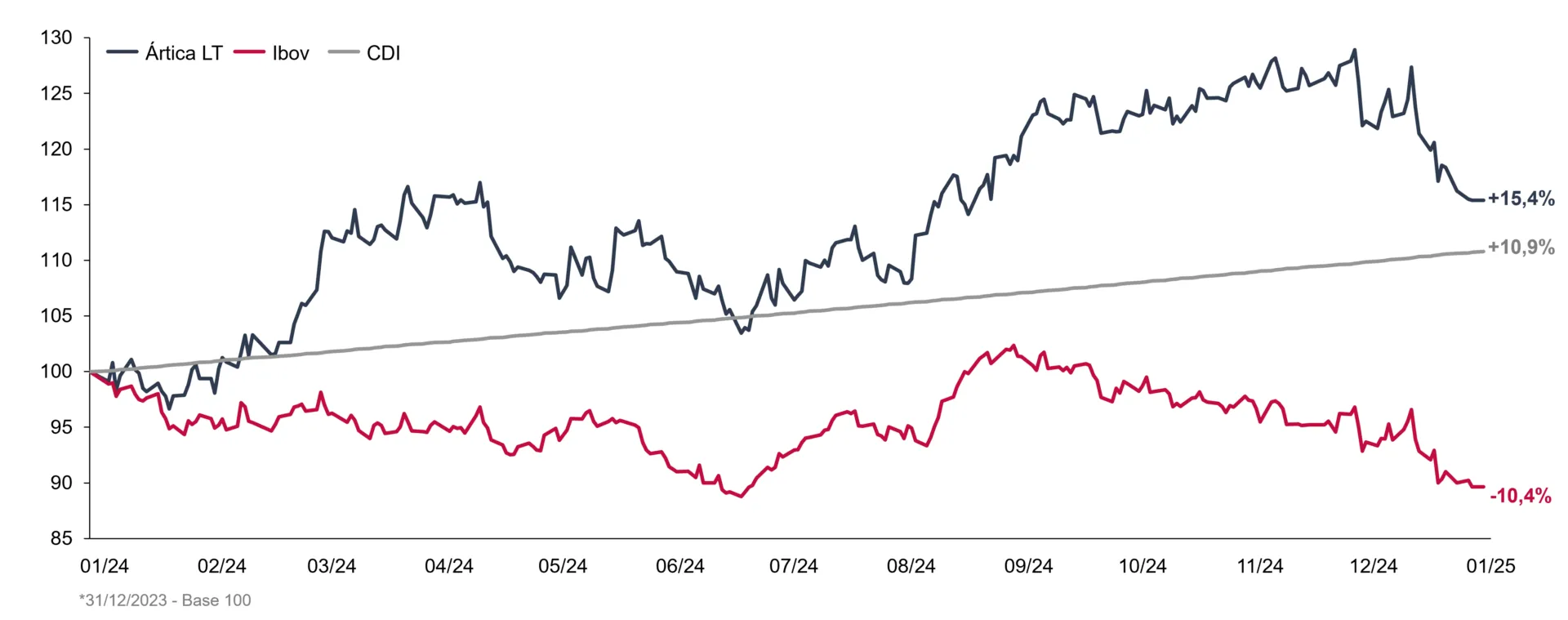
Comparing the real rate of return of the Ártica Long Term and the benchmark indices makes clearer the difference in additional purchasing power generated for our investors:
Return Comparison in 2024

This result raises the concern that the prices of the stocks in our portfolio may have risen more than they should and could now be expensive, but this impression dissolves with a quick look at how the weighted averages of the multiples and profitability of the stocks in our portfolio have evolved in recent years:
Average Multiples of the Ártica Long Term FIA Portfolio

Note: Weighted by portfolio allocation as of end of 2024. For the 2024 calculation, results from the 12 months through Q3 2024 were used (the latest available as of this date). MLAS3 was excluded from the P/E analysis due to losses in the period.
The price appreciation came purely from an increase in our companies’ profitability. In relative terms, prices fell. The 2024 P/E multiple was 27.2% lower than the 2022 figure. So we pose the following question: does investing in companies that have been improving their results, yet still see their share prices falling in relative terms, seem like a good or bad idea? Better or worse than the CDI?
Let us take a step back and analyze the situation in a more conceptual way.
Fixed Income and Equity Prices Move in the Same Direction
There is a strong bias toward paying attention to the data that is most easily available. As a result, we track stock prices and the annual return rates of fixed income securities. This creates confusion because every asset has both a price and an expected return, and these indicators are inversely proportional. If a bond yields BRL 100 per year, that return equals 10% of the invested value if the bond’s price is BRL 1,000, and 20% if the price is BRL 500. In other words, the lower the price of a given asset, the higher its expected rate of return must be, and vice versa.
In fixed-rate bonds, the return rate is set and the bond price fluctuates freely. When the return rates offered in the market are rising, it means that bond prices are falling. The same logic applies to equities: when prices are falling, it means that expected return rates are rising. There is therefore an inconsistency in becoming enthusiastic about fixed income when return rates rise (and prices fall), but becoming discouraged about equities when their prices fall (and expected return rates rise).
Floating-rate bonds, despite also being classified as fixed income, have a fixed price and a variable return rate — analogous to what would be a stock with a fixed price. In this case, it does make sense to be enthusiastic when rates rise, but this type of security carries a reinvestment risk, since high interest rates today do not guarantee good profitability throughout the maturity period. If rates fall, the option would be to sell the floating-rate bonds to buy something else, but it is expected that the prices of equities and fixed-rate bonds will already have risen during the rate decline.
Having clarified the confusion created by the convention of tracking inversely proportional indicators, let us turn to the question of why interest rates are rising in Brazil.
Interest Rates, Inflation and the Impact on the Real Economy
Throughout 2024, we watched the standoff between the government, which suffers from the high interest costs on its public debt, and the Central Bank, which argues that high interest rates are necessary to combat inflation. We wrote about the dynamics between government spending, inflation, and interest rates in our September 2024 letter. For our current purposes, it suffices to recall that the rate hikes projected today are justified by the diagnosis that the Brazilian government is overspending, as this contributes to rising inflation and requires the central bank to raise interest rates as a counterbalance.
Compounding the problem of rising public spending during the fight against inflation, the Brazilian government runs a deficit. Excessive spending causes the public debt to grow ever larger and also increases the risk of government bonds. Governments that hold debt in their own currency do not default on it, but they can instruct the Central Bank to issue more money arbitrarily (print money) to pay the debts, generating inflation.
The practical effect of this process is that the government appropriates a portion of the capital of those who hold assets denominated in the national currency (fixed income securities in reais) and redistributes that capital to the beneficiaries of public spending. This last point has received less attention. Government spending always ends up in the pockets of public servants and companies that provide services to the government, which in turn have their own spending with people and companies not directly related to the government. In other words, the primary impact of financing public spending through inflation is negative for those in fixed income and positive for the real economy.
The side effect that harms the private economy is the rise in interest rates, which increases the cost of corporate debt and reduces the availability of consumer credit, cooling demand. However, these effects are not evenly distributed across companies. Those that are indebted and have no connection to consumption chains warmed by government spending are hurt, while those with no debt that operate in sectors with demand boosted by public spending may actually benefit.
Two conclusions can be drawn immediately. The first is that equities encompass companies from such diverse sectors that any generalization about the category tends to be quite flawed. The second is that it is far from obvious to consider fixed income a safer investment than equities when the problem is a government running a deficit and accelerating public spending.
Another point in favor of equities is that real assets do not have their value eroded by inflation. Fixed-rate bonds will certainly lose value in an inflationary environment, but companies will not, as their value is made up of operations, various assets, intellectual property, and so on, all of which have intrinsic economic value. If the currency loses value, the price of this collection of assets rises so that real economic value is preserved.
This does not mean that the scenario of excessive government spending is desirable for equity investors, because the impact of deficits and inflation in the long run is to reduce confidence in the government, drive away foreign capital, and reduce the country’s productivity, since government capital allocation does not have economic efficiency as its primary goal. Nevertheless, holding equities is better than holding fixed income securities in this scenario. The recent histories of Turkey and Argentina are practical examples of this claim.
In Turkey, inflation due to excessive government spending had already been high for some time (15-20% p.a.), but spun out of control in 2022 (peaking at 85% p.a.) and remains elevated today (~50% p.a.). Nevertheless, the Turkish stock market rose 29% p.a. in dollars from the end of 2021 to the end of 2024. In Argentina, in the five years prior to Milei’s arrival (2019-2023), average inflation was 79% p.a. During that period, the Argentine stock market rose 19% p.a. in dollars.
What Are the Odds That the Currently Projected Macroeconomic Scenario Will Materialize?
Keynes said that economic projections were always made by extrapolating the current scenario into the future, except for specific effects that could be forecast with reasonable confidence, even while knowing that the assumption of continuity of unpredictable factors is highly unlikely to materialize. For lack of an alternative, the practice became a convention, and the process of asset valuation was considered correct if done in this way. The observation appears in the book The General Theory of Employment, Interest and Money, published in 1936, and the same practice remains unchanged to this day.
The convention is old, but it has not become more accurate with the passage of time. Macroeconomic projections are notably unpredictable precisely because of the number of random factors that are implicitly assumed to be constant within them. One only needs to recall how much the narrative of what the near future would look like shifted throughout last year. Looking over a longer timeframe, it becomes clear that it was not an exceptional year. Forecasts change constantly as new facts materialize, and the accuracy rate of any macroeconomic thesis is quite low.
Macroeconomic consensuses end up becoming collective mistakes much of the time. Even so, a large number of investors treat the currently prevailing theses as key factors in making capital allocation decisions, which strikes us as an ill-advised approach because, beyond the track record of errors, nothing that is widely known could be an informational advantage leading to better-than-average market decisions. If it’s in the newspaper, it’s already in the price.
We prefer to maintain the intellectual honesty of admitting that we do not know what will happen to interest rates, inflation, the Lula government’s fiscal policy, or any of the other traditional macroeconomic variables. But this is not a new situation. We have never had good forecasts about things of this nature and have managed to generate good returns regardless. The key point was made long ago by Warren Buffett: there are factors that are both important and possible to predict, and factors that are also important but impossible to predict. The best use of time is to focus on what is foreseeable, rather than wasting effort on what is not.
The Good Old Investment Strategy
When the environment is turbulent and confusing, a good practice is to return to first principles.
Companies have value because they offer a product or service that society wants to consume. That value could be lost if demand declines or is captured by competing companies. A defensive portfolio should therefore concentrate on sectors where demand is stable and on companies whose competitive position is sustainable.
If interest rates are unstable, high debt levels can cause negative surprises in financial expenses and can affect a company’s ability to continue investing and operating at competitive rates. It is therefore prudent to avoid highly leveraged businesses in unstable environments.
The last principle is to buy cheaply, in order to offset the potential negative surprises that turbulent economies can bring. This step should be the most difficult to execute in the case of companies that meet the previous criteria, but it is quite common for stock prices to fall together when market sentiment deteriorates in Brazil. Part of the explanation likely comes from the volume of investments tied to foreign investors, multi-market funds, index funds, and quantitative funds, which typically do not conduct in-depth fundamental analysis of each company and, in aggregate, likely represent more than 70% of the trading flow on the B3 (there are no detailed data to confirm the exact percentage).
We are among a minority of investors who still follow the old strategy of evaluating each opportunity based on its long-term fundamentals. Even fewer are those who genuinely acknowledge ignorance about the macroeconomic future and focus solely on the microeconomic factors of each individual business.
Our current portfolio was built according to these few basic principles. We invest in companies with sustainable competitive advantages, in sectors with stable demand, and that are cheap in the stock market today. Market volatility throughout the year simply led us to rebalance some positions at certain moments, and the sharp market decline in December allowed us to invest in shares of companies we had been eyeing for some time (we will discuss the new positions with Ártica Long Term investors at the next quarterly results presentation meeting).
We share the general concern about the situation of our country, but we remain optimistic about the return potential of our portfolio of companies, hand-picked to navigate Brazil’s uncertain future, and we believe we have good chances of continuing to beat the CDI over the long term.