

How We Find Good Opportunities
Dear investors,
There is a common belief that extraordinary results require extraordinarily complex methods. While this may be true in some cases, it is far from a general rule. Many activities rely on simple and well-known approaches that are nonetheless highly effective. So why doesn’t everyone do what works and achieve outstanding results? At least two reasons stand out. The most obvious is that not everything that is easy to understand is easy to execute. Placing a stone at the top of a mountain is conceptually simple—you just have to carry it up. The second, more subtle reason is that many people simply do not believe that something so straightforward can work. As a result, they either never try or fail to maintain the discipline required for execution—especially in activities where results depend on consistency and take time to materialize. Instead of doing the obvious, they continuously search for a “magic formula.” As you might expect, investing in equities is one of those activities.
The investment philosophy we follow—value investing—is so old, simple, and widely known that it has, in a sense, been trivialized. Many investors claim to follow it and advocate similar principles, yet most deliver mediocre results. This creates the impression that something is missing.
Value investing is not inherently incomplete, but what is often lacking is clarity on how to apply its principles to real-world situations, which rarely fit neatly into generic and abstract definitions. To address this, investors often develop their own typologies of investment theses, incorporating more concrete and recognizable characteristics that help identify great opportunities and quickly interpret those that resemble predefined patterns.
We also make use of this approach by developing mental models to guide our search for great opportunities and to categorize our investments. In what follows, we provide a brief review of the principles that underpin our main investment frameworks and explain each of them.
Traditional Principles
What we seek are opportunities to buy great companies at low prices. When such opportunities are unavailable, we look for great companies at fair prices or acceptable businesses at deeply discounted valuations. The approach is the same as in any purchase—the challenge lies entirely in properly assessing both the asset and the price being paid. The first step, therefore, is to understand what qualifies as a great company.
If our primary objective is to achieve the highest possible return on invested capital, we must focus on businesses capable of doing exactly that—generating high returns on the capital employed in their operations. This is not an easy task due to the very nature of competitive markets, where multiple companies compete to win customers who seek the best product or service at a price they are willing to pay. This competitive “auction” puts pressure on pricing and, under normal conditions, drives returns on invested capital toward the market’s average cost of capital—composed of the risk-free rate plus a risk premium that reflects the perceived risk of the business.
The necessary condition for a company to achieve above-average returns is the presence of competitive advantages that cannot be easily replicated by competitors. The simplest advantage to understand is cost leadership: if a company can produce a similar product at a lower cost than its competitors, it will achieve higher profitability even without differentiation in its offering. For example, Saudi Arabian oil producers are highly profitable even when selling lower-quality oil, as their extraction costs are among the lowest in the world.
There are many other potential sources of competitive advantage, but the topic is extensive and better addressed separately. For now, the key point is that great companies are those with sustainable competitive advantages that consistently generate returns on invested capital above the market’s average cost of capital. The next step is to understand what it means for a company to be “cheap.”
The capital effectively employed in a company’s operations—broadly speaking—corresponds to the book value of equity reported in its financial statements. To capture the intrinsic return of the business, one would ideally purchase shares at a price close to this book value. In practice, this is rarely possible, as stock prices are determined through continuous market auctions. When it is widely recognized that a business generates high and consistent returns, investors compete to acquire its shares, driving prices well above book value—up to a level where the implied return once again converges toward the average cost of capital.
If the general public of investors were always efficient in evaluating investment opportunities, all prices should always converge to values that would result in the same median returns. This is not actually the case, but we can affirm that stock prices always reflect the market's average expectation for the company's future cash flow, discounted to present value using the average cost of capital as the discount rate. Thus, when we state that a stock is cheap, we are saying that our expectations for its future results are higher than the market's expectations. It is important to be clear on this point and to understand why we are projecting performance above what other investors believe. Our mental models for finding good opportunities were defined precisely from the perspective of identifying in which situations we might be interested in going against the general market belief.
Ultrarunners
The ideal businesses are those that deliver strong results consistently over time. The challenge is that, given a long track record of stable and solid performance, projecting future results becomes relatively straightforward for most investors—and the market typically prices these companies accordingly, eliminating the potential for outsized returns.
Shares of such companies tend to decline only when broader sentiment turns negative. Macroeconomic or political issues, for example, may lead part of the market to assume that all businesses will be affected, prompting downward revisions in expectations. When the shares of great companies fall alongside the broader market, attractive opportunities may emerge.
Investing in these situations requires confidence in the continuity of the business despite adverse conditions. For this thesis to be sound, the company must possess clear and meaningful competitive advantages—strong enough to protect the business through the downturn or, at a minimum, allow it to endure until conditions improve.
In simplified terms, the chart below illustrates the gap between our expectations and those implied by market prices in this type of investment thesis.
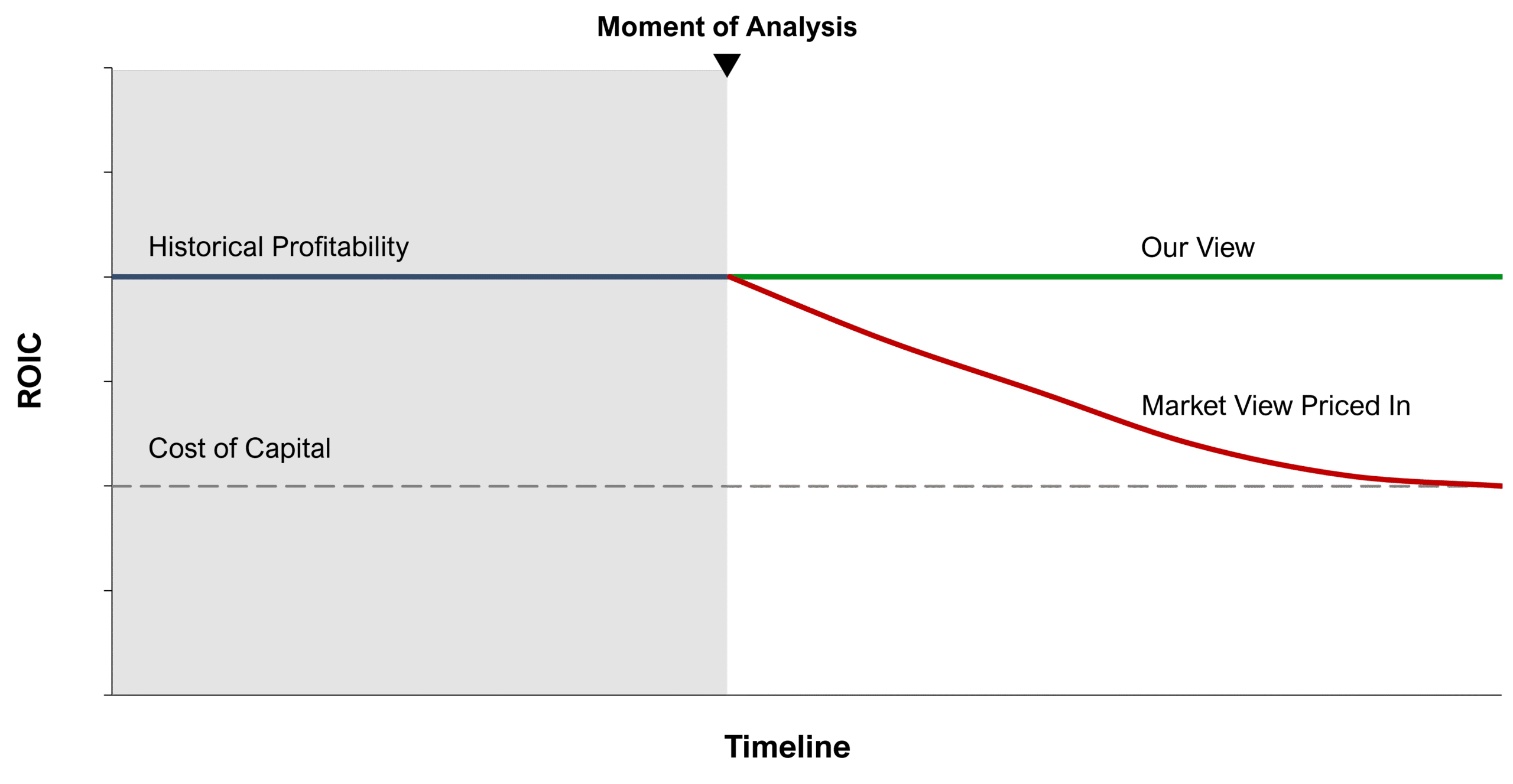
Examples of our investments that fit this category include Fleury (B3:FLRY3) and Caixa Seguridade (B3:CXSE3)—companies with excellent and consistent results that we were able to purchase at attractive prices due to factors unrelated to their underlying businesses.
Challengers
Another type of opportunity arises when a company without a particularly strong historical track record undergoes a change that can meaningfully improve its profitability. This may stem from internal developments—such as the launch of a promising product or entry into a new business segment—or from external factors entirely beyond the company’s control, such as a sudden increase in demand driving up the prices of its products.
Opportunities like these are difficult to identify because they require in-depth analysis of businesses whose historical performance is not especially compelling. Something must capture our attention before we are willing to dedicate time to the company. Sometimes it comes from industry insights about ongoing changes; other times, we encounter an interesting idea while studying unrelated topics.
The advantage of finding such opportunities is that, precisely because they are less visible, the potential improvement in profitability may be entirely overlooked by the market. If we can invest at a price that still offers an acceptable return even if we are wrong about the change, there is a clear asymmetry between upside and downside. It is akin to acquiring a free option on a more optimistic future for the business.
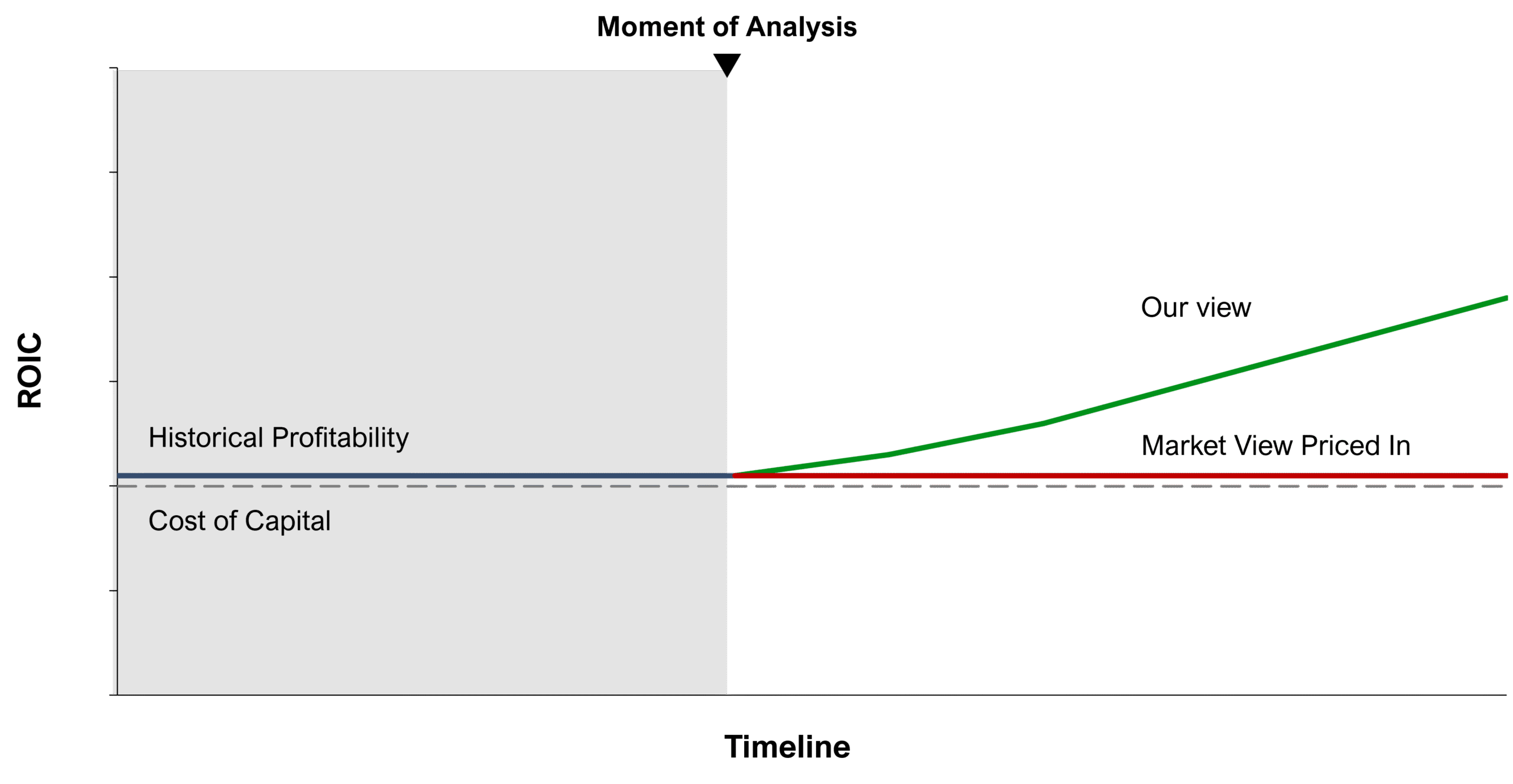
A well-known example is Nvidia, which originally manufactured graphics cards for gaming and later recognized that its technology could be applied to the computational demands of artificial intelligence. Its expansion into this new segment dramatically increased both revenue and profitability. While we did not participate in this thesis, a more modest example is our investment in Marcopolo (B3:POMO4), the leading bus body manufacturer in Brazil. The company experienced a decade of weak sales, but as the Brazilian bus fleet aged, pent-up demand began to emerge—becoming evident in 2023, when domestic production capacity was no longer sufficient. This imbalance between supply and demand led to a doubling of Marcopolo’s profitability and a tripling of its share price. For those interested, we detailed this thesis in our October 2021 letter.
Sprinters
The remaining category is the most traditional among value investors: businesses that are simply very cheap, regardless of their quality. Companies that are out of favor with the market may go through difficult periods and see their shares excessively penalized. Others may be largely ignored by investors—due to low liquidity or the mediocrity of the business—leading to erratic price movements driven more by the decisions of a few participants than by an efficient market auction.
Regardless of what led to the low valuation, the essence of these theses is to buy at a price so depressed that the downside risk is limited. In some cases, opportunities arise to purchase shares below liquidation value—that is, if the company were to shut down, sell all its assets, and settle its liabilities, the residual value would exceed its market capitalization.
For these investments to be highly successful, prices must correct within a relatively short timeframe. The longer it takes, the more returns converge toward the underlying business performance—which, in these cases, is typically below our target. Time works against the investor in such situations, making this a less preferred category for us. We generally only invest in these opportunities when we can identify a clear catalyst that increases the likelihood of repricing in the near term.
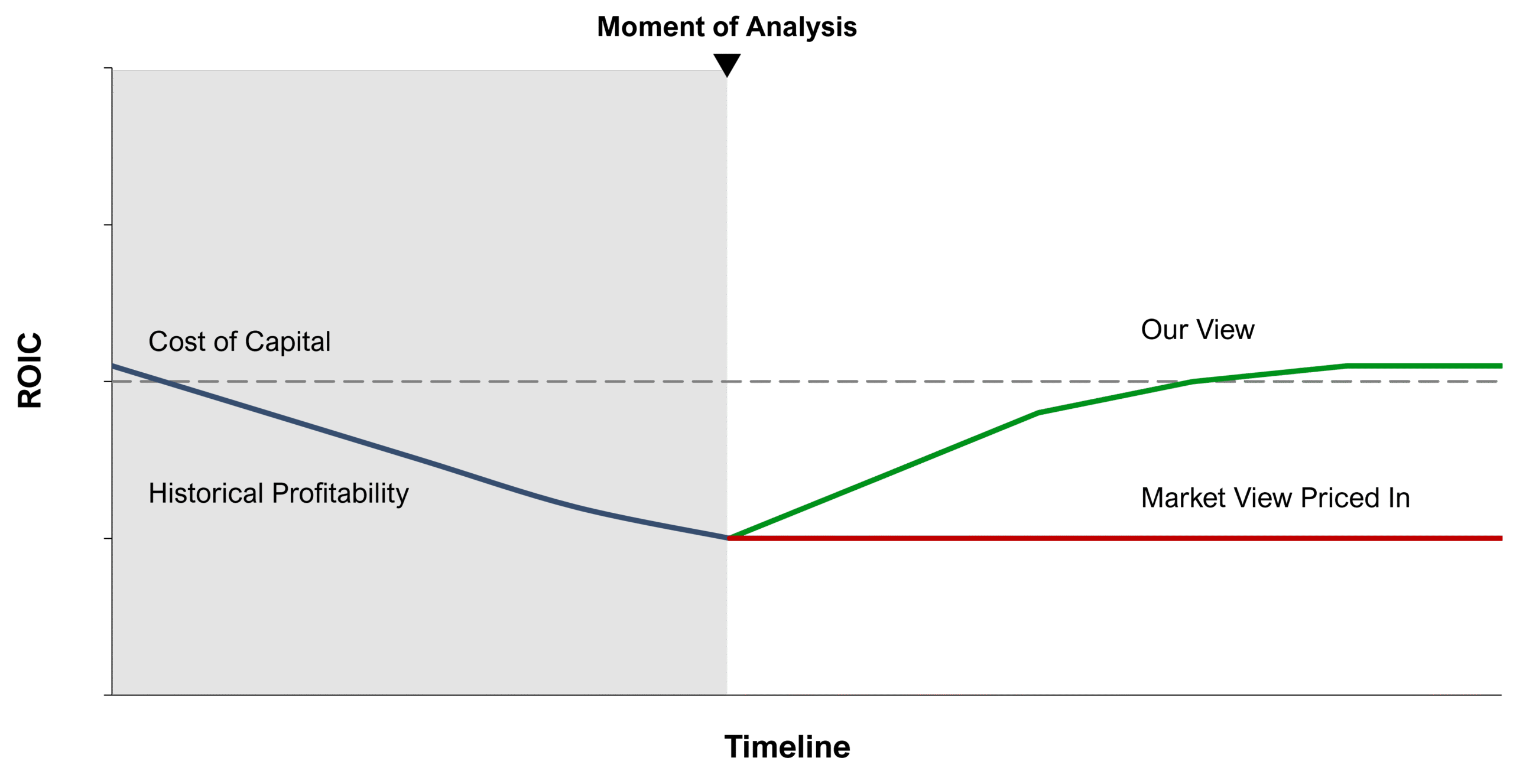
What makes this category so well known—and why it remains part of our mental framework—is the fact that opportunities like these are always present somewhere in the market. Finding them depends primarily on persistence and the number of hours invested in the search.
Our investment in the UK-based company Anexo falls into this category and illustrates the process well. We conducted a quantitative screen to identify companies trading at very low multiples but with an acceptable track record of profitability, which initially yielded a list of just over 300 stocks. After a first manual screening—quickly reviewing the profile of each business—around 25 companies remained. A second, more thorough screening reduced the list to five, among which was Anexo.
More often than not, even after analyzing hundreds of companies, no truly attractive opportunity emerges. However, this process can be repeated multiple times, using different screening criteria, until a suitable opportunity is found.
Comeback players
Finally, our favorite type of opportunity. Even excellent companies go through periods of misfortune and, at times, report disappointing results. Markets tend to be reactive and short-term oriented. When a long track record of consistent earnings is interrupted and analyst expectations are missed, share prices often decline. Despite the company’s history of success, many investors may fear that recent results signal a new, lower level of profitability—or simply sell because they are unwilling to endure a few quarters of weaker performance. When this happens, it is worth investigating. Outside of major economic crises, it is rare to have the opportunity to buy high-quality businesses at attractive prices.
In these situations, the core of the investment thesis is to determine whether the negative event behind the weak results reflects structural damage to the business—which may be irreversible—or whether the impact is temporary. The most concerning structural changes are those that erode the competitive advantages responsible for historically superior returns. If that is the case, the decline in share price may be justified, as the company is unlikely to regain its former position. A clear example is Intel, which dominated the CPU market for decades until its technological edge was overtaken by the AMD–TSMC partnership around 2017. In recent years, Intel has gone from generating approximately $20 billion in annual profits to posting losses of a similar magnitude, and it still struggles to produce CPUs as advanced as those of its competitors.
When weak results are temporary, the opportunity is clearly attractive—but caution is essential before reaching that conclusion. High-quality companies are typically well covered by the market. When their share prices decline in a favorable macroeconomic environment, it usually reflects a consensus view that the issue is not temporary or may persist for longer than expected. The market can be wrong, but we place particular emphasis on thorough analysis before taking a contrarian stance in situations under broad scrutiny.
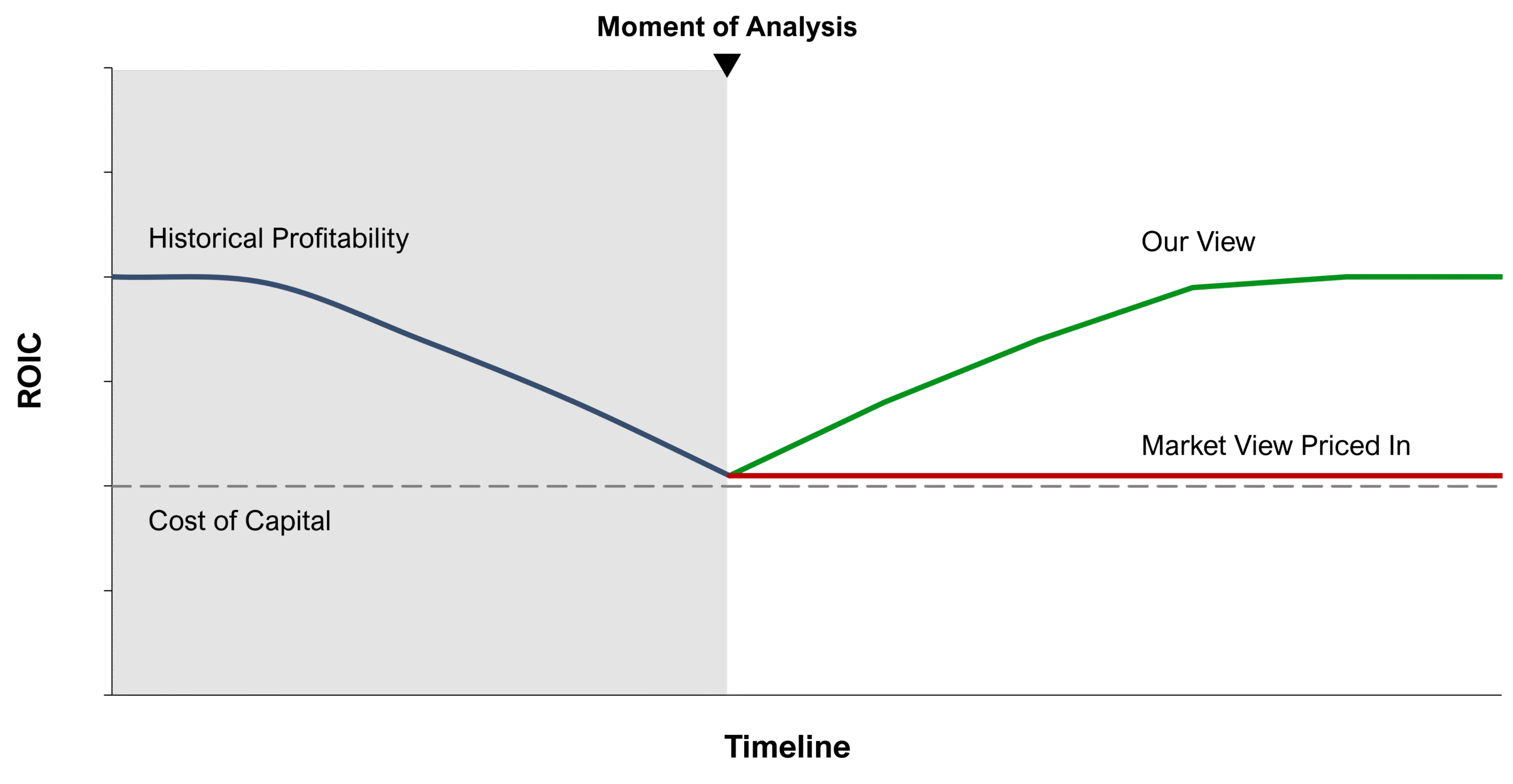
Our investment in Porto (B3:PSSA3), the leading auto insurer in Brazil and now active across multiple segments, is a good example of this category. Its profitability was negatively impacted by shocks that affected the auto insurance sector during the pandemic. In short, for a period of time, insurance policies were priced based on assumptions that later proved overly optimistic. When claims costs came above expectations, Porto’s earnings declined and the market penalized its shares. However, we observed that pricing on new policies was being adjusted while Porto maintained its customer base intact. As a result, it was only a matter of time until the underpriced policies expired and were renewed at higher rates. The recovery unfolded without negative surprises, and the investment has already proven successful. For those interested in further details, we discussed this thesis in our March 2024 letter.
Closing
Other investors have also shared how they categorize their investment theses, and there appears to be a meaningful degree of personal preference in how these categories are defined. The range of opportunities covered tends to overlap significantly, but the way they are grouped—and the nuances in their descriptions—vary from one investor to another. Even so, studying these frameworks has helped us better understand the process of identifying opportunities and develop our own mental models. In recognition of the generosity of those who came before us, we offer our own contribution to the discussion.