

Investment Case – Marcopolo
Dear investors,
In this letter, we would like to share our investment thesis on Marcopolo (POMO4), a position we built between 2019 and 2021 and which today represents a meaningful allocation in our portfolio.
It's not common for managers to share investment theses while they're still in their portfolios, largely due to the risk of making a public error if the future turns out to be contrary to our expectations. However, we believe this transparency will help our shareholders (and potential new shareholders) visualize what we consider a good investment thesis. Therefore, we decided put our mouth where our money is!
Like any investment, this thesis carries risks. What we seek are opportunities where the probability of gain is meaningfully greater than the probability of loss. In this letter, we will outline the key factors that led us to develop conviction that this is the case with Marcopolo.
The Investment Case for Marcopolo
Marcopolo is one of the global leaders in the bus body manufacturing industry. With 12 manufacturing facilities across 8 countries, the company produces approximately 10% of all new bus bodies sold worldwide. In Brazil, Marcopolo accounts for roughly half of the domestic market.
At first glance, this may not appear to be an attractive industry. The product is not highly technological, the market is not experiencing strong structural growth, and bus manufacturing rarely captures media attention. However, what drew our attention was the company’s long-term track record: Marcopolo compounded shareholder capital by 80x (32% per year) over the 16-year period from 1998 to 2013. Following that period, the entire sector entered a prolonged downturn, and Marcopolo delivered a cumulative return of only 0.7x between January 2014 and August 2021 (–5% per year). A long stretch of weak results, indeed. Still, the 80x outcome remained top of mind, raising an important question: could the company experience a new cycle of strong value creation? We decided to study the case more deeply.
In this letter, we focus primarily on Marcopolo’s Brazilian operations. Although export revenues are relevant, they are spread across multiple geographies; as such, Brazil remains by far the company’s most important individual market.
Pre-pandemic History
The downturn for Marcopolo—and the broader bus body manufacturing sector—began during Dilma Rousseff’s second term. From 2015 onward, demand for new bus bodies in Brazil declined sharply. This contraction was largely the consequence of an unsustainable surge in demand between 2008 and 2014, driven by subsidized credit for bus purchases (FINAME).
In 2015, FINAME credit availability for bus purchases was reduced to R$ 6.5 billion (compared to R$ 20 billion in both 2013 and 2014), and new bus sales fell back to levels last seen two decades earlier.
Chart 1 – Domestic Bus Sales in Brazil (thousands)
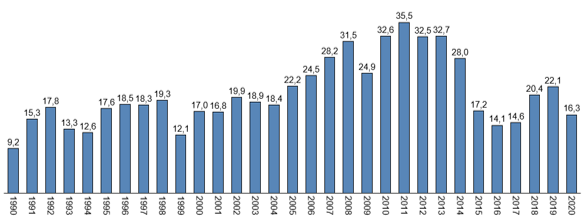
Demand has remained subdued since then. However, while the period of subsidized credit led to a renewal of the bus fleet, this prolonged phase of weak sales has resulted in its aging. Over time, this dynamic tends to create upward pressure on demand for new buses, as maintenance costs eventually exceed the cost of replacement once vehicles reach a certain age. This led us to two key questions: what is the current condition of Brazil’s bus fleet? And what would be the normalized level of annual bus sales required to maintain an adequate fleet for the country?
Current Bus Fleet
In 2020, Brazil had approximately 389 thousand buses in operation—the same level as in 2014. However, the average age of the fleet increased from 8.9 years in 2014 to 10.8 years in 2020. Today, the Brazilian bus fleet is older than it has been at any point in the past 12 years.
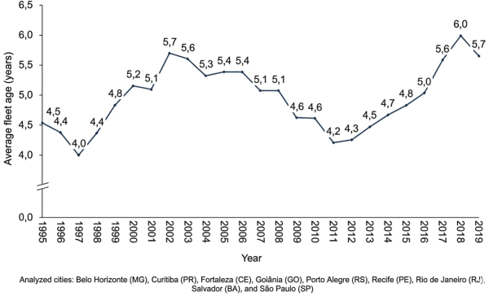
Another data point reinforcing this conclusion comes from the average age of urban bus fleets in major cities, published by the National Association of Urban Transport Companies (NTU). According to this historical series, the current fleet is older than at any point in the past 25 years. Taken together, these indicators give us reasonable confidence that the fleet is indeed aging and that there should be a natural incentive for increased bus purchases to support renewal.
Chart 2 – Bus Fleet in Operation
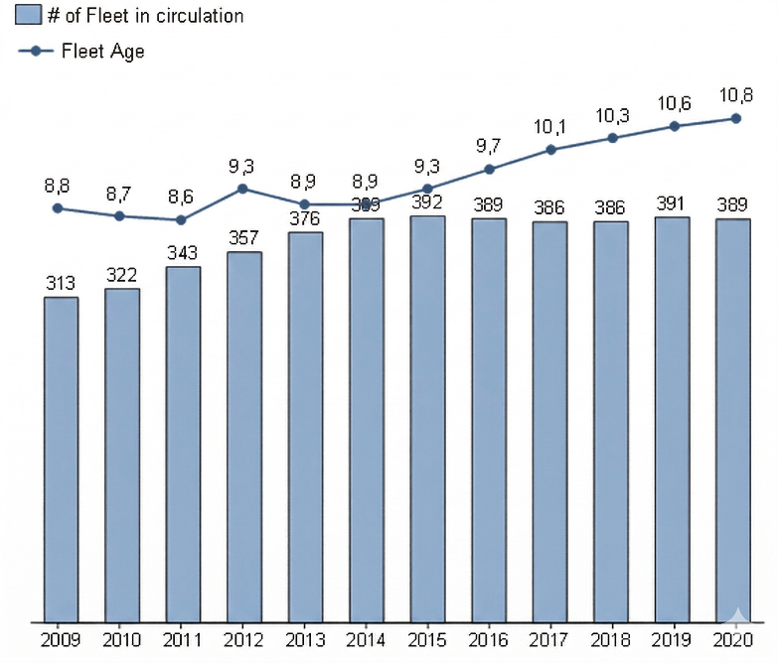
Source: Sindipeças
Chart 3 – Evolution of the Average Age of Urban Bus Fleets (1995–2019)
Normalized Demand Level
This leads to the next question: what level of new bus sales is required to maintain the Brazilian fleet at an adequate size and average age? To estimate this, we analyzed long-term trends in passenger transportation and concluded that bus usage has been gradually declining. Based on this, we project the total fleet to decrease from approximately 387 thousand units in 2020 to 333 thousand over a 25-year period. While this may appear modest, it implies a 20% decline in buses per capita—from 1.82 buses per thousand inhabitants in 2019 to 1.46 by 2045.
Chart 4 – Bus Fleet in Brazil and Buses per Thousand Inhabitants
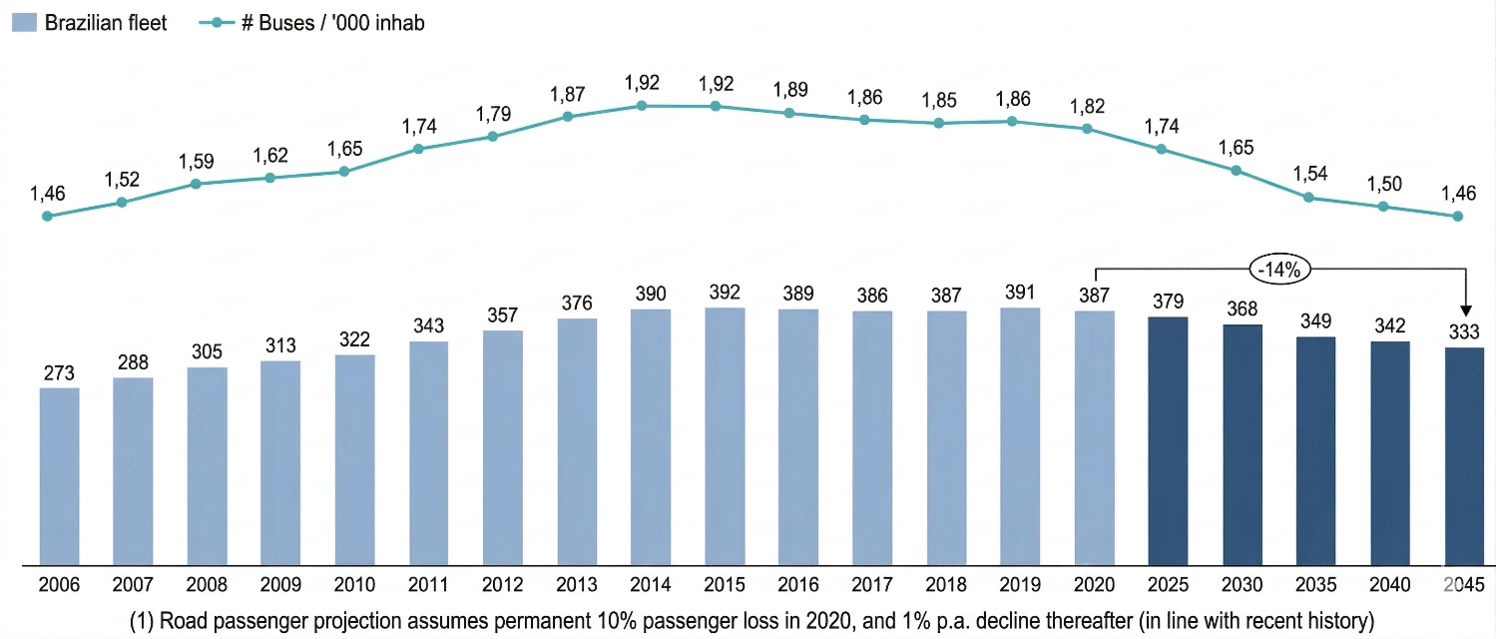
Source: Sindipeças and BIGE; Ártica estimates
With this fleet size projection and considering statistics on the probability of a bus being retired according to its age[1], we estimate that, to maintain the fleet at its current average age (10.8 years), a volume of around 21,000 new buses per year is required. This volume could be higher, considering that the "normal" fleet age appears to be closer to 9 than 11 years, and in this case, sales volume could reach up to 30,000 new buses per year. However, the risk of being conservative in market projections is much less dangerous for an investor than the risk of being optimistic, so we maintained the volume of 21,000 new buses per year as a reference in our analyses.
Initial Share Purchases
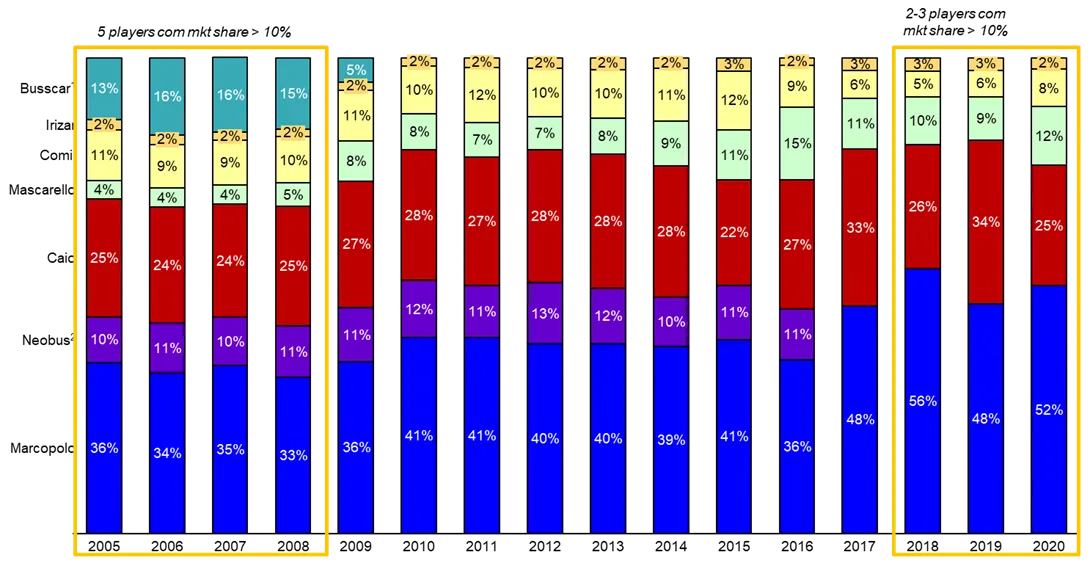
In 2019, our view was that the aging fleet would eventually force a recovery in demand for new buses toward a normalized level—around 21 thousand units per year. At the same time, the bus manufacturing industry was undergoing consolidation, with Marcopolo gaining market share. In 2016, Marcopolo acquired Neobus, bringing its share of the Brazilian market to roughly 50%. Importantly, the second-largest manufacturer, CAIO, is controlled by the same shareholders as a major urban bus operator in São Paulo, with a significant portion of its revenue tied to this captive demand. In the broader market, Marcopolo was the clear leader.
Chart 5 – Market Share
Source: FABUS
Beyond its leadership in volume, Marcopolo is also able to command a 10–20% price premium over competitors. When a company sells at higher prices and still leads in market share, it is usually a strong signal that customers perceive superior value. We spoke with industry participants—particularly those responsible for fleet procurement at urban and intercity bus operators—and their feedback supported our view: Marcopolo’s buses are generally perceived as higher quality, with greater durability and stronger resale value in the secondary market.
Finally, based on the thesis of a rebound in sales volume due to the aging fleet, Marcopolo's sustainable leadership position, and the reasonably low share price, we began investing in August 2019. We certainly didn't anticipate the pandemic, which broke out in March 2020 and caused the stock to plummet, along with the rest of the stock market. Fortunately, our portfolio position wasn't that large, and we had purchased at a price much lower than the average price in February 2020, on the eve of the... lockdown. But yes, it was sad to see our precious profit accumulated until February evaporate in March. In any case, we made the decision to keep the shares in our portfolio, figuring that lockdown would not remain for many years (our base scenario predicted a recovery only in 2023).
Impact of the Pandemic
The effects were straightforward. With mobility restrictions due to COVID-19, passenger volumes dropped sharply, leading to fewer buses in operation and a significant decline in demand for new vehicles. To make matters worse, input costs increased—particularly steel prices—and the company also faced supply chain disruptions, including shortages of semiconductors, further pressuring margins during an already weak demand environment.
Although Marcopolo’s revenues are geographically diversified, the pandemic impacted all regions simultaneously, leaving little room for offsetting effects. The company implemented cost-reduction measures, including temporary shutdowns and collective leave, and used the downturn to improve internal processes. Nevertheless, financial results were materially affected.
Despite the negative impact, the situation was far from catastrophic. Marcopolo maintained a healthy capital structure and its leadership position—arguably strengthened, as smaller and less capitalized competitors were hit harder by the crisis.
Our point is not to be overly optimistic, but rather to recognize that the business remained viable. As long as the company continues operating, it retains the capacity to generate future cash flows—and, therefore, can represent an attractive investment at the right price, even after incorporating the adverse effects of the crisis. POMO4 traded at approximately R$5.00 before March 2020 and fell to around R$2.75 by September 2021—a decline of roughly 45%. In our view, the stock became undervalued even when accounting for the challenging short-term environment.
We took advantage of this price decline to increase our position throughout 2020 and 2021. Notably, members of Marcopolo’s controlling group—including the current CEO—also purchased shares during the pandemic. On January 6, 2021, they disclosed the acquisition of 12 million shares at approximately R$2.86 per share (a transaction of roughly R$34 million). Coincidentally, their purchase price was very close to the prevailing market price of POMO4 at the time.
Outlook
The central question in this investment thesis is the future trajectory of passenger flows (both urban and intercity). If volumes return to normal levels, the number of buses in operation should increase, driving demand for new vehicles to replace aging units—particularly once maintenance costs begin to approach the financing cost of purchasing a new bus. We believe Marcopolo is the best-positioned company to capture this recovery. However, the timing remains uncertain. This is the main risk in the thesis: that passenger volumes take longer than expected to return to pre-pandemic levels. This brings us into more uncertain territory, but we will outline our perspective.
We do not subscribe to the idea of a permanent “new normal.” Over time, we expect pandemic-related concerns to fade, restrictions to be lifted, and COVID-19 to become one of many background risks—similar to others that never prevented people from going about their daily lives.
In work-related transportation, only a small portion of jobs can be performed remotely. Even in these cases, the limitations of remote work are becoming more evident over time: weaker communication, impaired cultural transmission, and gradual declines in engagement. Many companies have already begun bringing employees back to the office—initially on a flexible basis, but likely more broadly as vaccination progresses and legal restrictions are lifted. While some roles may remain permanently remote, we do not believe this will materially impact on passenger volumes overall.
In leisure-related transportation, countries with more advanced vaccination programs are already experiencing a strong rebound in travel demand—sometimes exceeding pre-pandemic levels. This appears to reflect pent-up demand, which aligns with common-sense observation: many people postponed travel plans during the pandemic and intend to resume them once conditions allow. Urban leisure activity has likely recovered even faster. Social interactions inherently require mobility, and not everyone owns a car—making public transportation, including buses, a natural alternative. More broadly, the desire to travel and engage socially is intrinsic to human behavior. Whether the recovery is rapid or gradual, we believe people will eventually return to normal patterns of activity.
Under this scenario, as passenger flows normalize, Marcopolo’s results should recover to healthy levels. Meaningful losses would only occur in a scenario where passenger volumes remain depressed for an extended period, which we view as unlikely. If the recovery is slower than expected, returns may be more modest but should still be positive.
Valuation
At the close of trading on the last day of September, Marcopolo's market value was R$2.6 billion, with an implied P/E (Price/Earnings) multiple of 9.3x, taking into account 2019 net income (R$242 million), in the pre-pandemic scenario. However, of this R$0.7 billion corresponds to Marcopolo's stake in Newflyer.[1]. Without Newflyer, the value would be R$1.9 billion, with the P/E multiple (Price/Earnings) implicit of 9.0x taking into account the 2019 net profit (R$ 215 million, ex-Newflyer). Remembering that in 2019 the number of new buses produced in Brazil was 17.9 thousand, still below the 19 thousand new buses per year that we conservatively estimate to be the equilibrium volume for this market.
If the market converges to this level and Marcopolo is able to maintain its market share, we estimate its net profit to reach around R$1,000,000 million. The company already achieved a net profit of R$1,000,000 million in 2011, which, adjusted for inflation, would be equivalent to approximately R$1,000,000 million today. Since this was the era of subsidized credit for bus purchases, we don't believe the result will return to the same level, but R$1,000,000 million seems feasible. Considering that between 2010 and 2019 (the last 10 years excluding the pandemic period), Marcopolo's average P/E multiple was 20.2x, its market value could reach R$1,000,000 million. This is the earnings potential we see.
Additionally, the operational adjustments implemented by the company—including the closure of underutilized plants and a reduction of more than one-third of its workforce—may lead to operating margins above historical levels, potentially pushing net income beyond our base-case estimates.
Our analysis of valuation are much deeper than this multiples rationale and are based on discounted cash flow models, but the results of both approaches point in the same direction. We always like to cross-check simplified approaches like this to ensure we don't lose reasonability amid the details and complexities of more technically sophisticated analyses.
Final considerations
In summary, we believe Marcopolo will maintain its leadership in the bus body manufacturing industry, with approximately 50% market share in Brazil and meaningful positions in seven other countries. In its core market, Brazil, there are clear signs that demand for new buses should recover once passenger flows return to pre-pandemic levels—a scenario we consider highly likely.
Despite this outlook, Marcopolo is currently facing a “perfect storm”: weak demand, cost pressures, and production disruptions. As a result, the share price has declined to levels we consider highly attractive, creating a favorable risk–return asymmetry for long-term investors. The company maintains a solid capital structure even under adverse conditions, and we believe the probability of further negative surprises is relatively low—given that most of the negative factors have already materialized. On the other hand, Marcopolo is well positioned to benefit from a recovery in demand, with meaningful upside potential in such a scenario.
So we decided to follow Baron de Rothschild's advice: Buy when there's blood in the streets, even if the blood is your own!
1 National Association of Urban Transport Companies
2 Published by Sindipeças
3 Marcopolo holds 9.3% in Newflyer, which is valued at CAD 1.7 billion on the Canadian stock exchange. At the current exchange rate of BRL/CAD = 4.29, Marcopolo's stake is worth R$ 675 million. (Values as of September 30, 2021)
Disclaimer
The information contained in this website/document does not constitute, nor should it be interpreted as, advice, recommendation, offer and/or solicitation for the purchase or sale of shares, bonds, securities and/or any other financial instruments.