

Dark clouds on the horizon
Dear investors,
Last month, the IBOV fell 2%, but the decline was much worse than it appears, as this value is masked by the movement of VALE3, which represents 18% of the index's portfolio and rose 28%, countering the market trend. Excluding VALE3, the IBOV would have fallen 9% in November.
The main reason for the decline is concern about the new government's fiscal policy, which has made clear its intention to increase government spending on social programs but has yet to explain where the additional resources would come from. Thus, the market expects an increase in the government deficit, with a consequent increase in public debt and interest rates. With high interest rates, economic growth is compromised, and stocks lose value. The outlook does seem dire, but it's important to put it in perspective before forming strong opinions about how this impacts investments.
In our October letter, we discussed Brazil's system of government, and in our November letter, we explored Brazil's position in the global economy. Against this backdrop, we will develop our perspective on the most recent developments in the Brazilian market.
The Transition PEC
One of the new administration's first acts was to propose to the National Congress (through agreements with the presidents of the Chamber of Deputies and the Senate) a constitutional amendment (PEC) to allow the executive branch to spend approximately R$198 billion per year, beyond what would be allowed by the spending cap, throughout Lula's term. Of this amount, R$175 billion would be allocated to Bolsa Família, as promised during the campaign, and the remaining R$23 billion could be spent on investments, but only if revenues exceed those forecast in the 2023 budget.
To give these figures their proper proportions, the government's fiscal budget for 2023, excluding amounts related to social security and public debt refinancing, is approximately R$1.9 trillion. Thus, the proposal dubbed the "Transition PEC" would authorize a real increase of approximately R$91 trillion in these government expenditures.
The problem with this constitutional amendment is that the new government is requesting permission to spend more without making it clear where the resources to cover these additional expenses would come from. However, the alternatives are well known. There are three main possible sources: i) increased tax revenue; ii) issuing new currency (printing money); or iii) increasing public debt. Let's consider each of these possibilities.
Increased revenue
There are only two ways to increase tax collection: increase tax rates or rely on real economic growth.
In Brazil, the tax burden hovers around 34% of GDP, an already high level (in the US, for example, it's ~24%). Thus, approving tax increases tends to be a politically taxing process, especially for the new Congress, where most representatives and senators were elected with rhetoric opposing this trend. It's not an impossible path, but the tax burden in Brazil has remained relatively stable over the past 10 years, between 32-34%, even at times when the Executive Branch would certainly like to increase its revenue.
In turn, economic growth would be the ideal alternative and appears to be the new government's hope, but it depends on many factors beyond the state's control, so counting on it carries its risks. The situation is similar to that of a company that decides to increase its expenses in the hope of generating new revenue: the extra spending is always guaranteed, but the extra revenue is not.
Currency issuance
Ultimately, the state could print new money and use it to pay its expenses. Since issuing currency doesn't create real economic value, the practical effect of this move is the state's appropriation of a portion of the value of the money in circulation in the economy. It's as if a company's controlling shareholder were issuing new shares to themselves, without any compensation, diluting minority shareholders and reducing the individual value of each share.
Using this mechanism is always tempting for a government, as the general population understands little about how it works and tends to accept inflation resulting from currency issuance more readily than an explicit tax increase. If the government is free to print money whenever it wants, it tends to abuse this mechanism and cause hyperinflationary crises. Brazil experienced high inflation from the mid-1970s until 1994, when the Plano Real was created and managed to stabilize the country's currency.
The very creation of central banks is linked to the need to control currency issuance so that the economy doesn't enter the downward spiral caused by the practice of issuing currency to finance public spending. The Central Bank of Brazil (BCB) was created in 1965 but underwent a long process of maturation until, very recently, it reached what are considered best practices.
Until 1988, the BCB's role was intertwined with that of the Banco do Brasil, which significantly reduced its influence over the country's monetary policy. Until 2020, the BCB was subordinate to the Ministry of Economy and, consequently, subordinate to the Executive Branch, which could replace the BCB president at any time and dictate the country's monetary policy. Only in February 2021 did our central bank become independent. Now, the BCB president serves four-year terms, beginning at the beginning of the third year of the President's term and extending until the end of the second year of the next President's term. This newly granted autonomy to the BCB was an important step, as it prevents the Executive Branch from engaging in abuses through monetary policy.
Today, Brazil has a mature legislative framework to regulate the BCB's activities and its relationship with the National Treasury (TN), which manages the federal government's finances. The main limitations imposed are:
- O BCB não pode conceder empréstimos ao TN. A dívida do Tesouro com o BCB pode apenas ser refinanciada ao longo do tempo, em valor ajustado pela inflação. Isso impede que o BCB possa emitir moeda e repassá-la ao TN, que poderia levar ao ciclo vicioso de emitir moeda para cobrir déficits fiscais.
- Os juros pagos pelo Tesouro Nacional ao BCB são iguais aos juros de mercado. Não podem ser feitas operações entre as duas instituições em condições especiais.
- O lucro do Banco Central com variações cambiais de suas reservas internacionais é mantido no próprio BCB, para arcar com prejuízos futuros. Esta também foi uma evolução recente, já que antes, o lucro era repassado em dinheiro ao TN e, quando havia prejuízos, o TN emitia ao BCB novos títulos de dívida como pagamento.
Avoiding technicalities, the general message is that the Brazilian Executive Branch does not have the freedom to simply issue currency to cover its expenses. To do so, it would need the support of the BCB president and authorization from Congress. This is the maximum legislative protection we could hope for.
Increase in public debt
If the government's revenues are insufficient and it cannot issue currency to cover its expenses, the National Treasury's only option is to issue new bonds to raise funds from the market. However, this approach is not entirely free, as the Brazilian constitution limits the increase in public debt through the so-called Golden Rule (Art. 167, item III). According to this rule, the government can take on new debt to finance investments, but it is not permitted to increase debt to finance current government expenses (personnel, social benefits, debt interest, and public sector operating expenses), except when authorized by Congress by a simple majority.
This limitation may not be entirely effective because, if Congress approves a budget containing additional spending and the following year's revenue is insufficient to cover the new expenses, there would be little that could be done other than approving that the deficit be covered by new debt. However, again, it is the maximum legislative protection we could hope for, as the Executive and Legislative branches, aligned, can do virtually anything. That's why the market fears this possibility, which would pose two problems:
The first is that resorting to increasing debt to support current expenses signals fiscal irresponsibility on the part of the government, causing the market to attribute greater risk to loans made to the National Treasury (public bonds) and, therefore, demand higher interest rates. This increases government spending on interest on the public debt, worsening the fiscal deficit problem.
The second problem is that by lending money to expand public spending, the government would increase market demand for products and services, which would stimulate higher inflation precisely at a time when our Central Bank is trying to reduce it. The consequence would likely be that the Central Bank would keep interest rates high for longer, thus hindering our economy's growth for a longer period.
Impact on stock market investments
We've repeated several times that interest rates are the gravitational force in the financial market: the higher they are, the more they pull asset prices down. This happens because an increase in the basic interest rate also increases the discount rates used in discounted cash flow calculations, the basic method for estimating the value of assets in general. The higher the discount rate, the lower the resulting value. Furthermore, higher interest rates reduce companies' growth expectations and encourage capital to leave the stock market and flow into fixed income, intensifying the downward trend. This is why the stock market falls when interest rates rise, and rises again when interest rates fall.
What we've described so far summarizes the reason for all the recent market stress. Now, let's take a step back and evaluate this scenario from a broader perspective, encompassing aspects that aren't part of this logical sequence but remain part of the set of factors relevant to our investments.
Tax issue
The trigger for the entire chain of potential fiscal problems Brazil could face in the future would be the Transition Amendment Proposal (PEC), which has not yet been approved in its proposed format. We know that our Congress is not renowned for its agility and pragmatism. The Workers' Party (PT) intends to approve the PEC this year, but controversial issues tend to take time to move through Congress and are significantly watered down throughout the process. The Transition Amendment (PEC) could be approved with more lenient terms (allowing for exceeding the spending cap by a smaller amount or for a shorter period) or it may not even be approved this year, given that we are already approaching the parliamentary recess. If the agenda is postponed until 2023, it will have to be re-discussed with the newly elected Congress, which is less aligned with the PT.
It's not just the practical impact of the Constitutional Amendment Amendment (PEC) that's driving the stock market. Much of the money invested in the stock market is foreign capital, and seeing Brazilians themselves engaged in heated discussions about fiscal responsibility, international fund managers, who generally have a small percentage of their portfolios in Brazil, tend to simply reduce their positions in the Brazilian stock market until the situation stabilizes, rather than spending time trying to understand our political dramas in greater depth. Recently, we've seen international funds selling, at very low prices, shares of companies that may even benefit from the new government's planned social spending, under the pure rationale of reducing exposure to Brazil. In times of turbulence, several market players behave less meticulously and analytically than one might imagine.
Expectations for the yield curve
Another market assumption is that future interest rates will follow the current yield curve, as it reflects the best projections available at the time. It's a reasonable assumption, but "the best projections available" is quite different from "optimal projections." In February 2022, we published a letter discussing the difficulty of forecasting macroeconomic variables and showing the market's accuracy rate for future interest rate forecasts. In short, it's quite poor. In December 2020, the SELIC rate projection for 2022 was 4.5%. This illustrates how quickly the macro environment can change and completely frustrate market expectations.
Our approach is to acknowledge the uncertainty inherent in macro variables and stick to what we know with the highest degree of confidence: the current interest rate is high and is part of a temporary BCB action plan to combat inflation. The medium-term trend is mean reversion. Actions by the new administration could prolong high interest rates, as mentioned, but there is a long process before this materializes, and, as we can see from the reaction to the Constitutional Amendment Proposal (PEC), both the government and Congress would have to overcome several relevant interest groups. It is always possible, but we do not think it is as likely to happen with the catastrophic proportions the market fears.
Between the devil and the deep sea
From another perspective, it's worth considering whether it's better to hold fixed income or stocks in your portfolio if a fiscal crisis materializes. If interest rates rise due to the government's fiscal irresponsibility, this increase reflects the increased risk inherent in government bonds. The stock market may continue to decline, but investing in domestic fixed income doesn't offer as much security in this scenario.
Brazil has most of its debt in local currency, so the risk is not that the National Treasury will default, but that an extraordinary currency issuance will be made to pay off a portion of the public debt that becomes unpayable through normal means (although it requires support from Congress, it is a maneuver that is possible in extreme situations).
On the other hand, stocks may suffer from an economic slowdown, but they have a natural hedge against inflation and high real interest rates for long periods. The important concept to keep in mind is that a company that produces something useful for society will always have real economic value, regardless of the country's currency and interest rates. If the currency loses value, companies raise their prices and continue selling as long as there is market demand for their products. If interest rates rise, the demand for credit will decrease to a point that forces interest rates to fall again. In oversimplified terms, this is the nature of well-known economic cycles.
Investing outside Brazil could be an alternative, but it also has its problems. Current exchange rates are clearly not favorable for taking money out of the country, and the global economy is also not at its best. The United States and Western Europe, markets we generally consider safe havens, are heading for a recession caused by monetary policies to combat inflation very similar to the one Brazil adopted, but we made this move about a year earlier than those countries. In other words, they may take longer than Brazil to return to growth.
Ultimately, there is no perfectly safe investment, with excellent profitability and liquidity.
Focus on the facts
While it's impossible to predict the exact moment the downward cycle will reverse, we know we're far from its peak. The risk remains that we'll face a few more bad years, but we must also consider the foundation we're building from. We've just come through years of severe economic hardship caused by the pandemic. A return to normalcy alone should ensure the coming years aren't as bad as the last.
Furthermore, we're seeing rare stock prices these days. In our time in the market, we've only seen comparable results during the subprime crisis in 2009 and the Dilma Rousseff administration crisis in 2015. With prices at this level, some of our stocks have the potential to double in value in the coming years under a moderate macro scenario. Even if the economy performs poorly, these stocks should still yield returns considerably above the benchmark interest rate. Stock market investments will always involve a risk of loss in catastrophic scenarios, but the current risk-reward ratio seems quite favorable for selected stocks. The chart below makes it clear how cheap the stocks are: the average Price/Earnings multiple on the stock market is 35% below its average level.
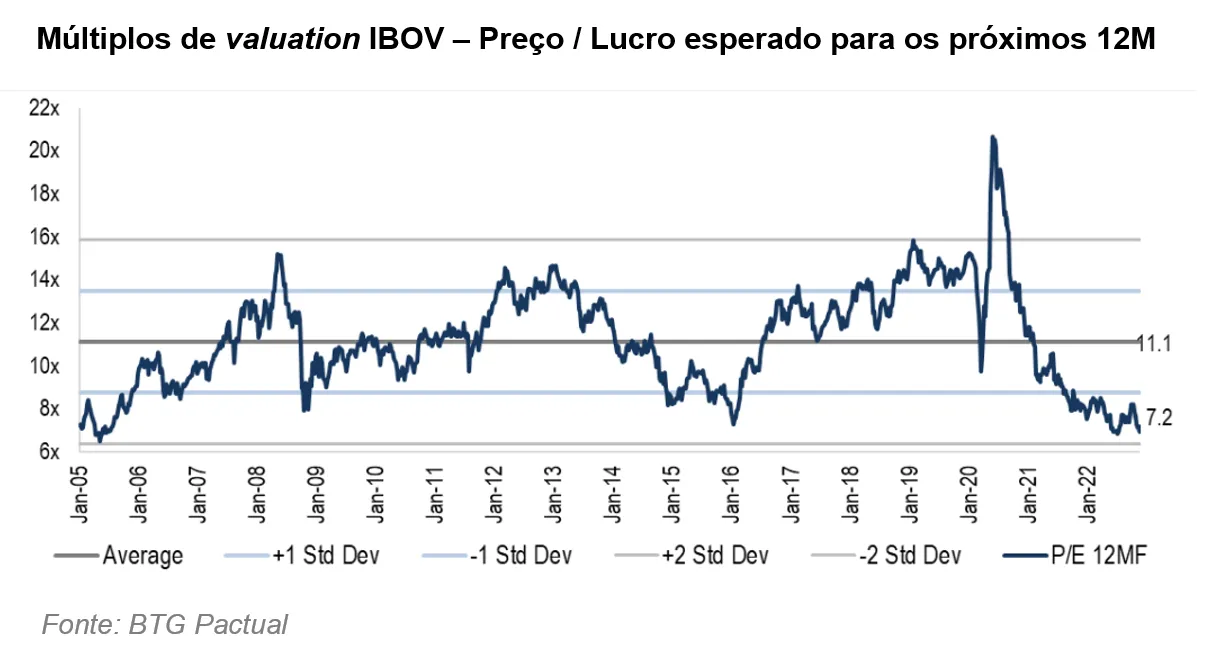
Finally, we leave you with the provocation that large investments are only made if they move against market consensus. This is unsurprising, as stocks are much more expensive when the market is optimistic. Therefore, it's important to remain calm and make sound decisions even amid macroeconomic turbulence, seeking out excellent businesses, investing in them, and waiting for the storm to pass.
“Every decade or so, dark clouds will fill the economic skies, and they will briefly rain gold. When downpours of that sort occur, it's imperative that we rush outdoors carrying washtubs, not teaspoons. And that we will do.” – Warren Buffett