
Investments in times of crisis
Dear investors,
To try to draw parallels and understand potential implications for our investment decisions during this time of the Covid-19 pandemic, we decided to seek a historical perspective on how the capital markets reacted in other periods of major crisis.
It's important to clarify that we are not analyzing, nor comparing, the dire humanitarian consequences of each of these past crises with the current one. What will become clear, however, is our society's enormous capacity to overcome adversity and return to the path of economic growth.
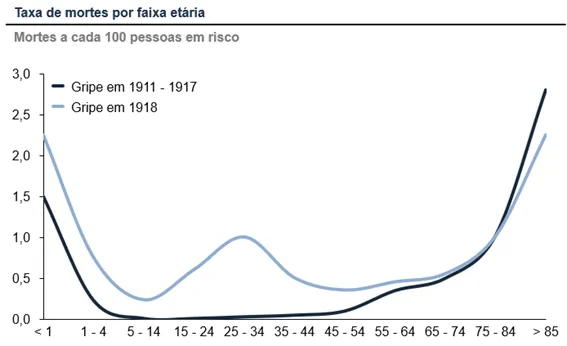
The Spanish flu infected one in four people worldwide and is estimated to have killed about 21,300,000 people worldwide (that would be 160 million in today's numbers). Unlike previous flu waves, the 1918 flu disproportionately affected young people between the ages of 25 and 34.1, the main age group in the workforce:
As if that weren't enough, this pandemic occurred between 1918 and 1920, at the end of the First World War, in which approximately 20 million people, both civilians and military personnel, perished. Entire countries were left in ruins. In terms of the magnitude of the loss of human life, this period is perhaps second only to the Black Death, which peaked in Europe between 1347 and 1351.
The assassination of Archduke Franz Ferdinand in June 1914 triggered a series of events that culminated in the Austro-Hungarian Empire's declaration of war against Serbia on July 28. Germany declared war on Russia on August 1, and within days the European nations were at war.
For nearly a month after the Archduke's assassination, financial markets remained unresponsive. Neither the Dow Jones Industrial Average (DJIA) nor German government bonds seemed to price in the prospect of war. It was only when Austria-Hungary issued an ultimatum to Serbia that markets panicked and began selling.
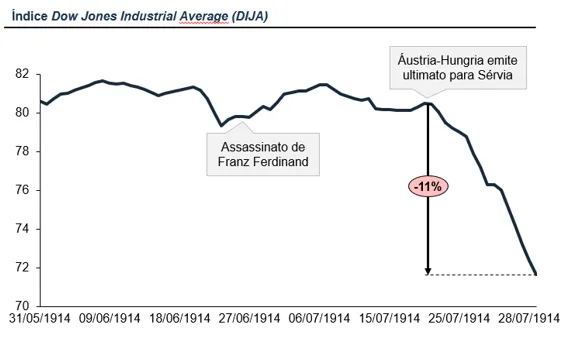
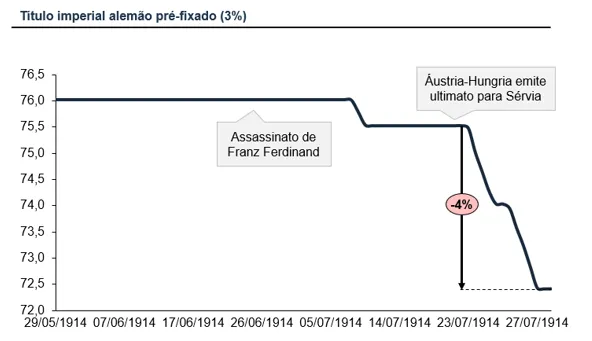
The panic had an immediate impact on global stock markets: all major European exchanges and many non-European exchanges closed, something never before seen. Other crises had led to stock market closures in the United States and other countries, such as the Revolution of 1848 in France or the Panic of 1873 in New York, but never before had all major stock markets around the world closed simultaneously.
The NYSE was closed from July 30 to December 12, 1914.
Across Europe, the problem of catastrophic declines in stock prices was solved by placing a floor on stock prices. Initially, stocks and bonds were not allowed to trade below their price on July 31, 1914. Governments also imposed capital restrictions, limiting or preventing large capital flows out of the continent for the remainder of the war.
The Times of London began printing stock prices in London and Bordeaux on September 19, and in Paris on December 8, 1914. In January 1915, all stocks were allowed to trade on the London Stock Exchange, albeit with price restrictions. The St. Petersburg Stock Exchange reopened in 1917, only to close two months later due to the Russian Revolution. The Berlin Stock Exchange did not reopen until December 1917.
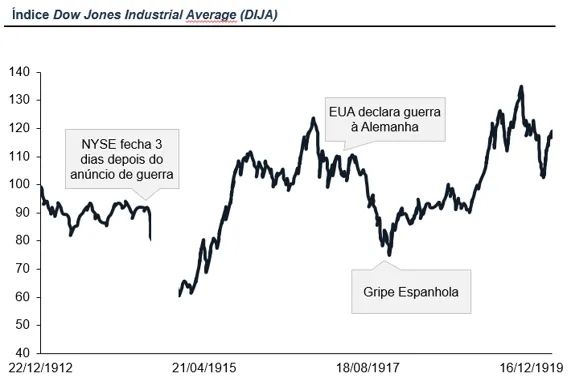
Obviously, it was a period of great volatility, during which the DJIA fell from a level of around 90 points to ~60 at its lowest (a drop of ~33%). Those who remained calm and had capital to invest during this period, and did not make rash decisions to sell, were unlikely to lose money. The chart above does not include any dividends paid. Considering reinvested dividends, an investor's return between January 1914 and January 1920 would have been 11.5% per year.
From a historical perspective, an investment in the DJIA in June 1914, on the eve of the war, maintained until today, in the midst of the Covid-19 pandemic and widespread stock market decline, would have provided a return of 9.8% per year.2 in dollars (reinvested dividends), or almost 20,000 times the invested capital. In real terms, this represents a gain of 6.5% per year above inflation for the period. It's worth remembering that this investment would also weather several other severe crises, such as the 1929 crash, World War II, the Cold War, the oil crisis, Black Monday, the September 11 terrorist attacks, and the 2008 global financial crisis.
World War II was the deadliest conflict in human history. Marked by 70 to 85 million deaths, most of them civilians, it witnessed massacres, genocides (including the Holocaust), mass bombings, premeditated deaths from starvation and disease, and the only instance of nuclear weapons being used in war to date.
Its beginning is considered to be September 1, 1939, with the invasion of Poland by Germany, and its end on August 15, 1945 with the surrender of Japan, after the atomic bombing of Hiroshima and Nagasaki.
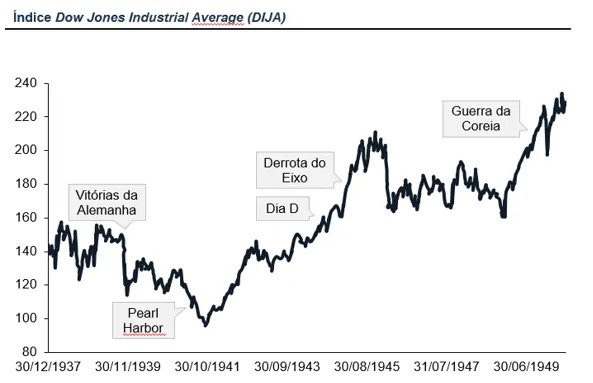
As we can see in the chart above, the DJIA followed the sentiment as the war unfolded: between 1940 and 1941, when everything indicated that the Axis powers would prevail, the unfolding of events caused the index to fall by approximately 33%. When the situation reversed, the index began a rally, more than doubling in a four-year period. A pre-war investment of USD 1,000 in June 1939 would have turned into USD 2,900 in June 1950, an average real return of 4.8% above inflation over the period.
Governments and stock exchanges learned their lessons from World War I. When World War II began, the London Stock Exchange closed for only a week, and the New York Stock Exchange never closed, except on August 15 and 16, 1945, when the NYSE closed to recognize the end of the war. The Berlin Stock Exchange remained open throughout World War II, although minimum price policies and capital restrictions prevented stock prices from falling until the 1948 devaluation.
Finally, we bring a Brazilian perspective, presenting what was, perhaps, the worst period to date for our stock markets.
On the morning of March 16, 1990, one day after assuming the presidency, Fernando Collor de Mello announced a series of provisional measures to try to contain the hyperinflation that in 1989 had reached almost 2,000%.
The most striking aspect of this plan was the confiscation of savings accounts: of all the money deposited, only 50,000 new cruzados could be converted into cruzeiros and withdrawn, while the remainder would be frozen for 18 months. According to the commercial dollar exchange rate on the Monday following the plan's announcement, the 50,000 new cruzados would be equivalent to just over a thousand dollars.
Uncertainty about the future and the need to withdraw funds to cover the amount blocked by the Government led to a series of curious events in the following trading sessions.
Due to the lack of liquidity, on Monday the 19th, the now-defunct Rio de Janeiro Stock Exchange did not register any trades! Similarly, the Bovespa only had 9 trades (interestingly, 8 of them were in Paranapanema shares, whose shares fell by 49.7%). On that day, the Ibovespa fell by 12.1%.
On Tuesday, with a slightly higher number of trades—36—the Ibovespa posted its largest daily drop to date, of 20.9%. But it was the following trading session that went down in history as the index's largest daily decline: a 22.3% drop, with 142 trades and a still very low trading volume of Cr$ 1.76 million. For comparison, the trading session prior to the Collor Plan announcement recorded a trading volume of NCz$ 1.33 billion, with 4,795 trades.
In just 3 days, the Ibovespa fell 46% and, in dollars, it fell an incredible 72.7% in the year (the best reference due to the hyperinflation that was not overcome and accumulated a rise of 1,700% in the year).
GDP fell 4.3% in 1990, according to the IBGE – which at the time used a slightly different methodology to calculate national accounts.
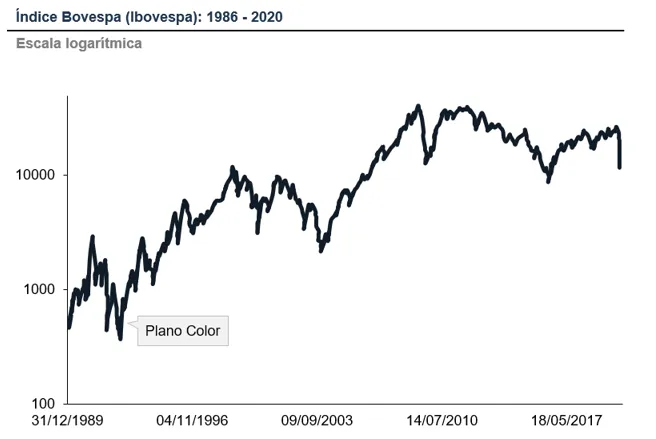
To illustrate, let's consider a very "unlucky" investor who had invested in the Bovespa index before the Collor Plan was announced, buying the index at 1,000 in dollars, and sold it now, in the midst of the Covid-19 pandemic, with the Ibovespa near 12,000, also in dollars. He would have a nominal return of 8.6% per year in hard currency. It's not a return to be proud of, but we're talking about getting in and out at the worst possible times.
By investing in the stock market, we are, in a sense, investing in the human capacity to innovate and generate prosperity for society. The excellent appreciation of stock indices over the last 100 years has been accompanied by a significant improvement in the population's quality of life. Today, a middle-class person lives better than the wealthiest did 100 years ago.
We are fully aware of the unpredictability of the current crisis's developments, and we hope to emerge from it as quickly as possible. But we are quite confident that the future of society and our investments will be better than the scenario we were in even before the Covid-19 crisis emerged, without having to wait 100 years for that to happen.
“The present is the past rolled up for action, and the past is the present unrolled for understanding” – Will & Arial Durant, The Lessons of History, 1968
1Taubenberger JK, Morens DM (January 2006). “1918 Influenza: the mother of all pandemics”. Emerging Infectious Diseases. 12 (1): 15–22.