
Investments in quality companies
Dear investors,
Throughout our conversations and presentations to investors, we always emphasize the importance of investing in quality companies with a long-term vision.
In this letter, we will discuss in a little more detail the reasons that underpin this view.
We begin the letter with a simple example: Let's assume it's 2010 and we have two investment options, both in companies of similar size and operating in the same segment. The companies have the following characteristics:
- Company A (“expensive” and profitable): P/E multiple1 of 36x and return on equity (ROE2) 25% history
- Company B (“cheap” and median profitability): P/E multiple of 23x and historical ROE of 14%
Which company would you invest in?
Company A is costing 50% more than Company B when comparing the multiple based on the previous year's profit. Is this "premium" worth it?
In the following years, both companies managed to maintain ROE levels similar to their historical levels and increase their net income. Due to its higher profitability, Company A managed to grow its profits at a rate of 15% per year, while Company B saw profits grow at a rate of 6% per year.
The net profit and ROE of the two companies are illustrated in the graph below:
Chart 1 – Net profit and ROE of companies A and B
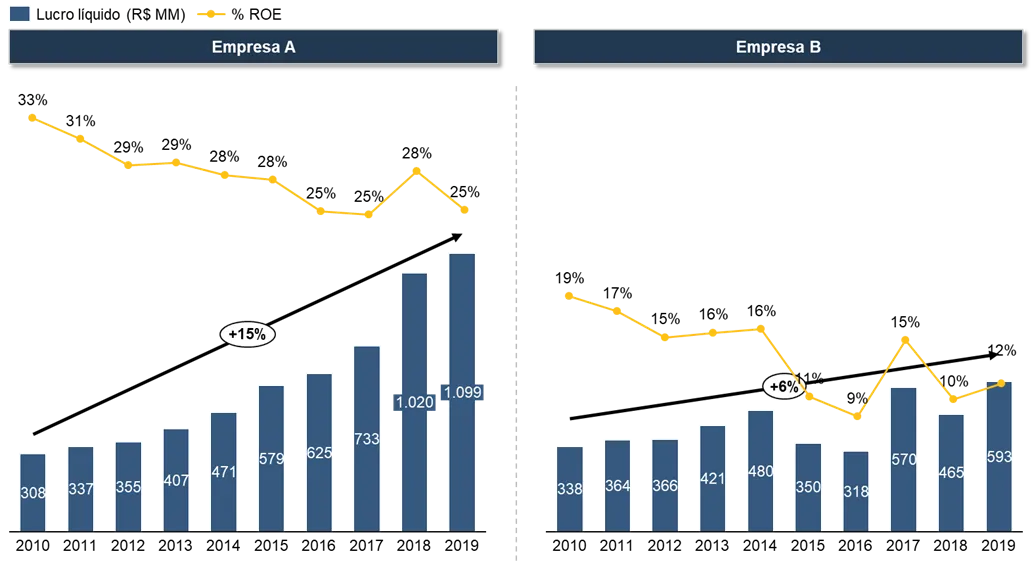
Even starting from a similar level, by the end of the period, Company A's profit was almost double that of Company B. Company A's performance particularly stood out during the 2015-17 crisis. As expected, Company A's stock significantly outperformed Company B's, as can be seen in the chart below:
Chart 2 – Historical returns of companies A and B
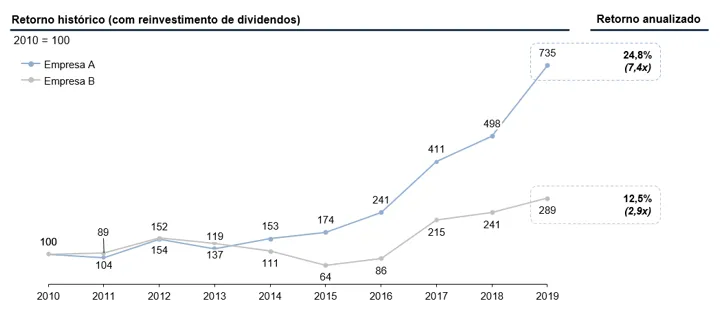
This example comes from a real-life case involving two companies in the same industry. What are they?
- Company A: Renner
- Company B: Guararapes (Riachuelo brand)3
These are solid, well-managed companies. Both outperformed the Ibovespa during the analysis period. However, Renner's performance significantly outperformed Guararapes during the period.
This performance occurred because Renner was able to reinvest capital at a very high rate of return over a long period, a characteristic only the best businesses offer. To clarify the relationship between growth and profitability: in the example above, both companies had net income close to R$ 300 MM in 2010. If both companies used 100% of this profit to reinvest in the operation, Guararapes' R$ 300 MM profit would be profitable at a rate of 14% per year (i.e., the company's ROE) and would increase to R$ 342 MM in one year. In Renner's case, R$ 300 MM profit would be profitable at 25% per year and would increase to R$ 375 MM (a profit 10% higher than Guararapes'). Due to the compounding nature of returns, the profit gap tends to increase over time, and at this rate, Renner's profit would be 130% higher than Guararapes' in 10 years, more than justifying the 50% higher initial price. This growth trend occurs if companies reinvest 100% of their profits back into operations at the same historical rates of return. However, in the real world, not all profits were reinvested (a significant portion was paid as dividends), and the growth rates achieved were slightly lower than the theoretical example suggests.
Growing this way, reinvesting the capital generated by business success, is the healthiest and safest way for a company to grow and generate value for its shareholders. It's not the only way, as there are cases of companies that used external capital to invest in growth, spent years without profitability, only to restore it after assuming a leading position in their market. The problem with these cases is that while some were very successful (like Amazon), others were very unsuccessful (like Netshoes). And while these companies are sacrificing their results to grow, it's difficult to judge, from afar, which will be the winners.
We also focus on profitability because, in the long term, the rate of return on an investment in a company tends toward its ROE. The analysis below illustrates two theoretical scenarios:
- Company C: operates with a ROE of 20% per year, reinvests 100% of its profit at this rate, and trades at a premium of 30% to the industry's average P/E multiple
- Company D: operates with a ROE of 5% per year, reinvests 100% of its profit at this rate, and trades at a discount of 30% to the industry's average P/E multiple
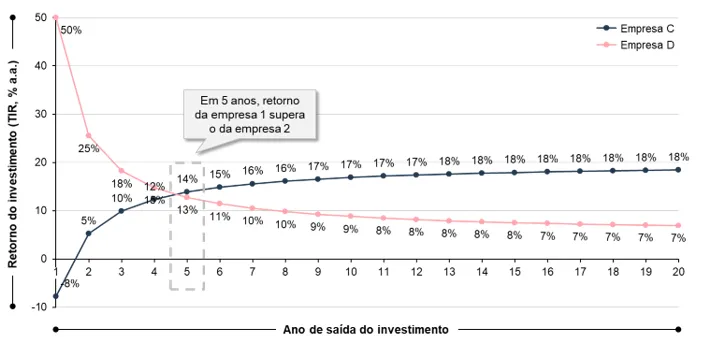
Assuming an investment were made in these companies and the share price soon converged to the sector multiple, what would be the return on this investment over time?
The graph below answers this question. For company D, the return would be excellent in the short term, but it would decline over the years. For company C, the opposite would be observed: the initial return would be low, but it would increase over time, surpassing company 2's return in year 5 and moving toward its natural return level of 20% in the long term.
The graph offers two important lessons: (i) even paying “a lot” for company C, over time, the company is able to generate enough value to compensate for the “mistake” in the price of the initial investment; (ii) the long term is the friend of the excellent company and the enemy of the mediocre one.
“Time is the friend of the wonderful company, the enemy of the mediocre.” – Warren Buffett
Chart 3 – Theoretical return of stock C (high ROE, “expensive”) vs. stock D (low ROE, “cheap”)
An important caveat: it's not enough to simply evaluate a company's track record and assume that its historical ROE will continue in the future. When a company starts making significant profits in a particular segment or product, competitors quickly spot the opportunity and seek to enter the market. As competition increases, prices and margins tend to fall, leading to a convergence toward the industry's average cost of capital. Companies that lack a strong and sustainable competitive position will see their returns decline, and their stock performance will follow suit.
Cielo is a recent case that illustrates this point. Until 2016, the company was growing at a strong pace, consistently maintaining excellent ROE levels, and was one of the stock market's darlings. For a long time, the payment methods sector was dominated by Cielo and Rede, which together held approximately 90% of the market. The companies held a monopoly on the operation of the main card brands: Visa, Amex, and Elo were exclusive to Cielo, while Mastercard and Hiper were exclusive to Rede. Many merchants were required to maintain terminals from both companies in their establishments, which allowed them to charge high fees. However, with the deregulation of the sector (initiated in 2010 and accentuated in 2016), this monopoly was eliminated, allowing the entry of new players into the sector and harming the competitive position of incumbents.
The result was a sharp drop in Cielo's profit and ROE, which was accompanied by a drop in its stock market performance. The chart below shows Cielo's historical results:
Chart 4 – Cielo’s historical net income and share return
To sustain shareholder value generation in the long term, companies must be able to maintain their competitive advantages, which will translate into differentiated profitability.
Predicting who will achieve this goal is quite a difficult task. Therefore, we delve deeply into understanding companies' competitive advantages, the risks of disruption they face, and whether the management team is strong enough to keep the company ahead of the competition.
Identifying good companies is only part of the job. The other part is having the patience and discipline to invest in them at the right price. Good companies are available for purchase every day, usually at a price well above what we'd like to pay.
1 P/E (Price/Earnings) is a widely used multiple in the financial market. It measures a company's market value relative to its annual net profit. As a rule, the higher the multiple, the more expensive the company tends to be.
2 ROE (Return on Equity) is calculated by dividing a company's net income by its equity. ROE is a measure of a company's financial performance because it indicates how well the company uses its resources to generate profit for shareholders. The higher the profit for a given amount of equity, the higher the company's ROE.
3 In the analysis above, Guararapes' net income and ROE in 2018 were adjusted to disregard non-recurring tax gains.