
Investment Case: Wilson Sons
Dear investors,
Wilson Sons is an investment we've had in our portfolio since late 2018 and is currently a very significant position within the fund. We decided to share it because it's a good example of our investment philosophy: for over two years, the share price "floated sideways," while the company delivered good operational results, even during the crisis.
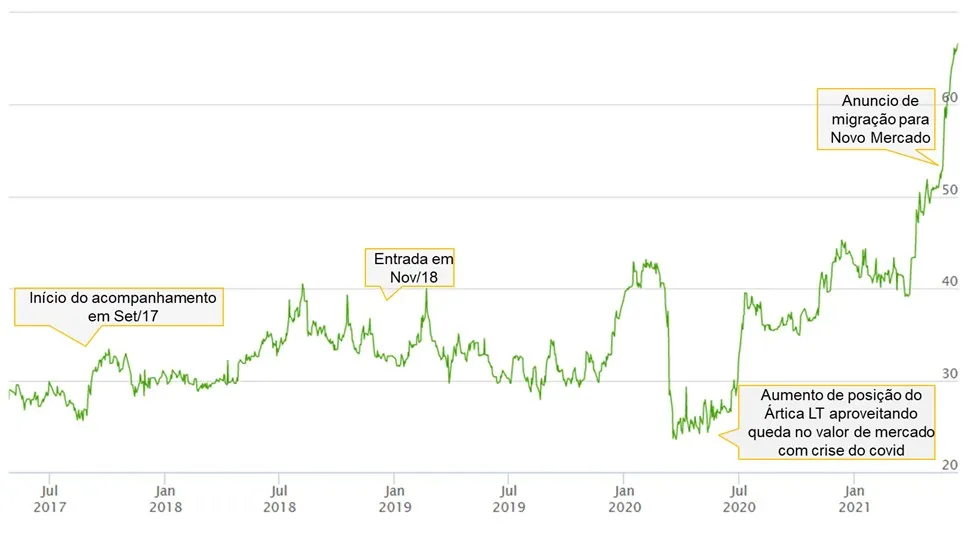
The company is traded in the form of BDR1 on the stock exchange and, for this reason, ends up being under-invested by a large portion of investors. This situation changed in May 2021, when the company announced its intention to convert its BDRs into shares and become listed on the B3 Novo Mercado segment. This simple move drew attention to the stock, contributing to a 24.8% appreciation since the announcement.2.
Below, we detail our investment process in the company, from entering the position to our current view on the investment.
Nosso investimento
Our relationship with Wilson Sons goes back a long way. We began analyzing the company in mid-2017 and had a very positive initial impression, but we had some doubts about the thesis, so we decided to only follow it initially.
The main concerns at the time concerned the potentially challenging competitive environment in its tugboat segment, and the potential discontinuation of its tecons business if its concessions were not renewed.
After more than a year of monitoring, we became increasingly comfortable with the risk factors that initially concerned us, and we decided to initiate the investment in November 2018. There were factors that could benefit the company in the medium term (economic recovery; expected lower capex levels in the following years, allowing for greater cash distribution; gains from operational improvements), but what most caught our attention at Wilson Sons was that we saw the investment as low risk. Both from the perspective of the business, which has stable and recurring results and no risk of disruption, and also from the perspective of valuation, which seemed quite discounted to us (in particular, it was noteworthy that the company had invested more than USD 1.0 billion in its operations in the previous 10 years, an amount that was higher than its market value at the time).
For two years after the initial purchase, the investment in Wilson Sons was average, with the stock trading sideways, even though the company delivered good operating results. We took advantage of this period to continually increase our investment position.
Em 2021, a disciplina e paciência foram recompensadas. Desde que iniciamos o investimento em Wilson Sons, a ação já apresentou uma valorização de 100%, o que gerou uma TIR3 anualizada de 37% para o nosso fundo.
Chart 1 – Price per share of WSON33 and main companies milestones of the investment
As we've said in other letters, finding good companies isn't enough; the challenge is investing in them at the right price. And at Wilson Sons, we believe we've found a great combination of both.
Visão geral sobre a empresa
Wilson Sons is a company with over 180 years of experience operating in the port and maritime services sector. Interestingly, it is the oldest publicly traded company (even older than Banco do Brasil)! The company operates in seven different segments: (1) maritime towage, (2) container terminal (TECON), (3) offshore support vessels, (4) offshore support bases, (5) logistics centers, (6) shipping agencies, and (7) shipyards.
The first three are the most important segments for the company, as evidenced by the graph below:
Chart 2 – Net revenue and EBITDA by business unit (%, in 2020)
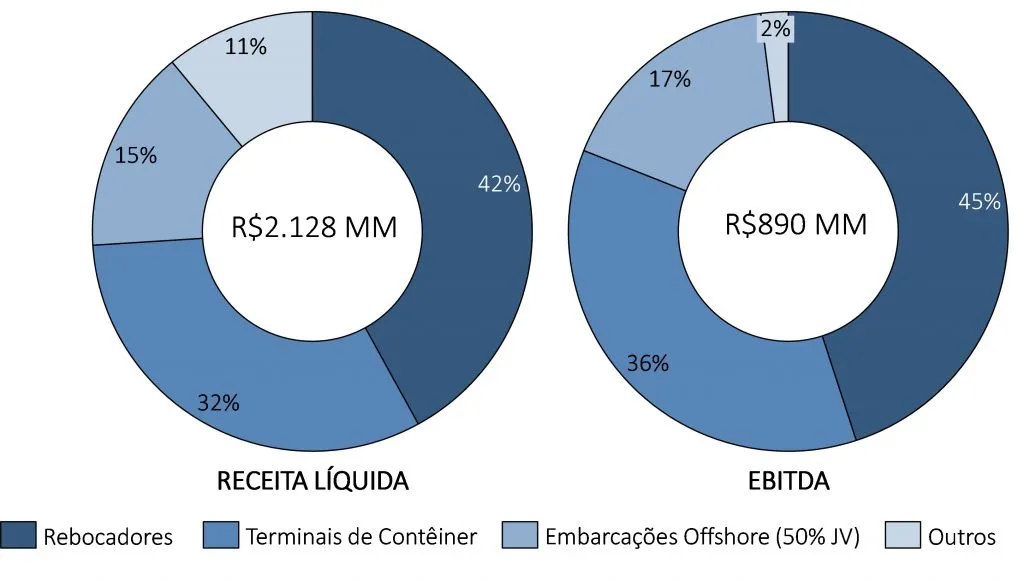
Tugboats (42% of 2020 revenue, and 45% of EBITDA):
Tugboats are small vessels with high static traction power used to assist in the docking and undocking of large vessels at port terminals. Tugboats are required by the companies responsible for docking (shipowners), and the service is monitored and regulated by the Brazilian Navy.
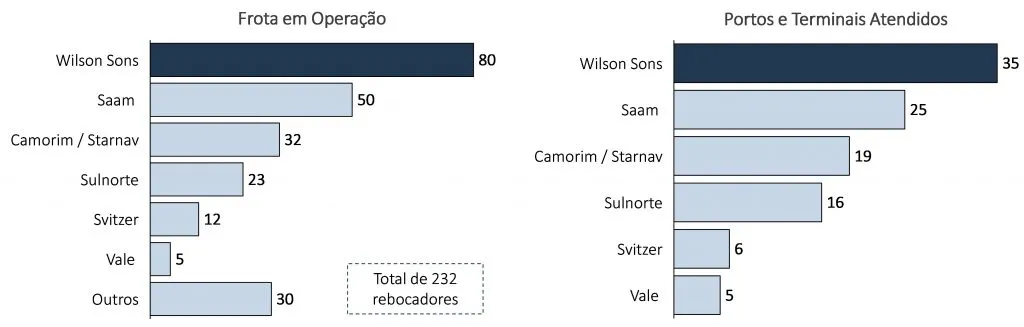
Wilson Sons is the Brazilian leader in this market, with 80 vessels in operation and operating in all major Brazilian ports (35 ports). In terms of number of maneuvers, market share of the company is around 40-50%.
Chart 3 – Towing market in Brazil (#, in Mar/2021)
Tecon (32% of 2020 revenue, and 36% of EBITDA):
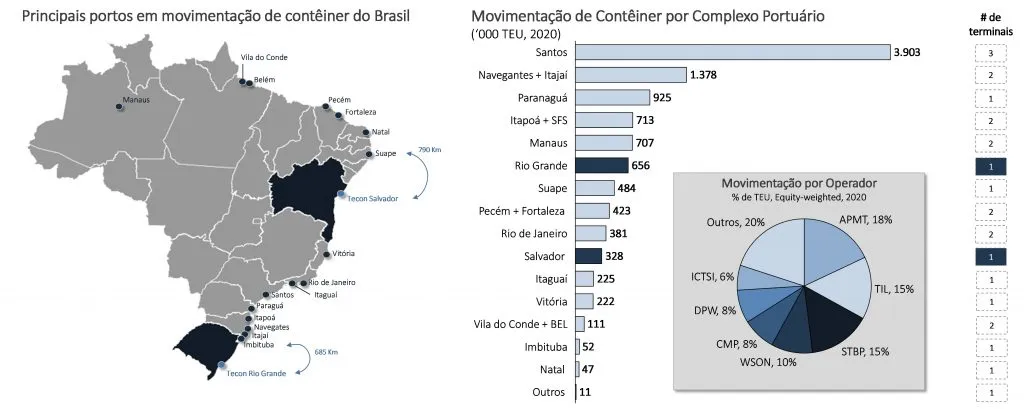
Wilson Sons operates two container terminals (Tecons) in Brazil: Rio Grande (Rio Grande do Sul) and Salvador (Bahia). Containers are widely used to transport goods such as plastics and resins, agricultural products, pulp and paper, and other materials.
Both Wilson Sons terminals are among the most important in the country:
Chart 4 – Main container ports in the country, and movement by port
Offshore vessels (15% of 2020 revenue, and 17% of EBITDA):
Wilson Sons owns 23 offshore support vessels through its subsidiary WSUT (a joint venture with 50% of Wilson Sons and 50% of the Chilean group Ultramar). These vessels are used to support oil exploration and production operations, particularly those of Petrobras.
The hiring of such vessels is carried out through contracts lasting approximately 2 years.
Tese de Investimento
Our investment thesis for the company is based on 3 pillars:
Posicionamento de mercado privilegiado nos principais segmentos de atuação (rebocadores e tecons)
As mentioned previously, Wilson Sons is the Brazilian leader in the tugboat market, with a market share of 40-501 TP3T. This leading position confers significant competitive advantages on the company, such as: greater port coverage, allowing shipowners to rely on a single supplier for all port calls in the country; an operations center that monitors all the company's tugboats 24/7, enabling greater safety and operational efficiency (fuel savings); and its own shipyard, which is used for the construction and maintenance of its own vessels.
The result of these differences is that the company has a higher level of profitability than its competitors:
Chart 5 – Wilson Sons (tugboats) EBIT margin comparison with competitors
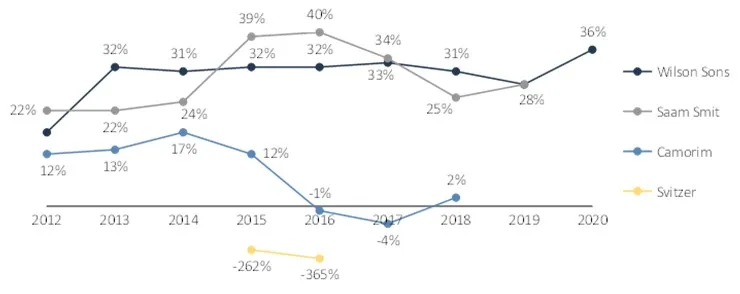
In this segment, benefiting from high margins and access to cheap financing, Wilson Sons has consistently achieved an average ROE above 20%.
In the Tecons segment, the company operates the only container terminals in its states (Rio Grande do Sul and Bahia). In both cases, the nearest terminals are at least 700 km away, giving the operation a captive market and a geographic monopoly. The result is very high profitability, with a ROE close to 30% in this segment.
There is additional comfort with the operation due to the following facts: (1) concessions are long-term (Rio Grande expires in 2047, Salvador in 2050), and (2) there is no competing terminal project announced (even if there were, new terminal projects take years to build).
Company well-positioned to capture expansion in foreign trade, which should accelerate with economic recovery
Even with the crisis we've experienced in the last decade, trade flows continued to grow, albeit at a much slower pace than in the previous decade, which benefited from a better economic climate. In both periods, containerized transport grew at a faster rate than overall trade flows:
Chart 6 – Growth in trade flows in Brazil vs. GDP growth
| % Annual growth | Period 1 (2002-2010) | Period 2 (2010-2020) |
|---|---|---|
| GDP | 4,0% | 0,2% |
| Goods transported in ports (MM ton) | 6,0% | 3,2% |
| Goods transported in ports via container (MM TEU) | 11,5% | 3,7% |
The above data highlight two facts: (1) even with a decade of zero economic growth, trade flows proved their resilience by growing at a reasonable pace of 3.2% per year (3.7% for containers); (2) with stronger economic growth, an even more significant growth level for trade flows is expected.
Also contributing to this trend is the growth of cabotage, the maritime transportation of cargo within the country. This mode has been growing at a rate of 11% per year over the last decade and is expected to accelerate with BR do Mar, a project by the Ministry of Infrastructure that aims to stimulate cabotage in the country.
This increased trade flow should benefit both Wilson Sons' tecon and tugboat operations.
In addition, the company has made significant investments over the last decade. These investments have focused primarily on renewing and expanding its tugboat fleet and increasing cargo handling capacity at the tecons. These investments position the company to capture another industry trend: the increase in the average size of vessels docking on the Brazilian coast. To support larger vessels, Wilson Sons stands out for its powerful tugboats and terminals with adequate infrastructure (especially the port's draft).
Finally, it's worth mentioning that the company's offshore operations support segment has been significantly impacted since 2015 by the crisis in the O&G sector in Brazil, which led to a drastic reduction in vessel utilization levels, impacting both the volume and price of contracts. With the advancement of pre-salt development (up to 18 new platforms are expected by 2024), expectations for the sector are once again positive, which should benefit the company's performance in this segment in the medium term.
Menor nível de investimentos (após um longo período de investimentos elevados) vai permitir maior geração de caixa nos próximos anos
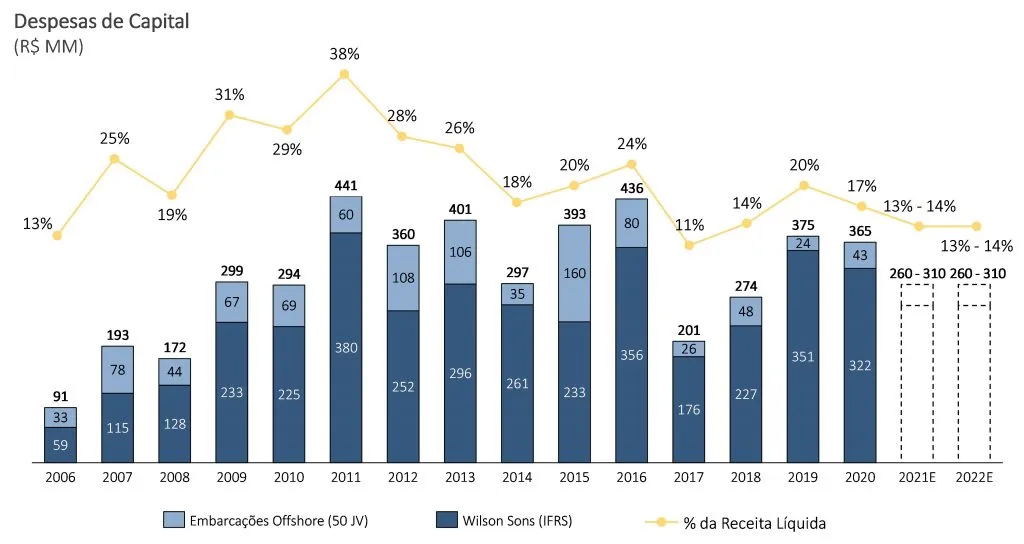
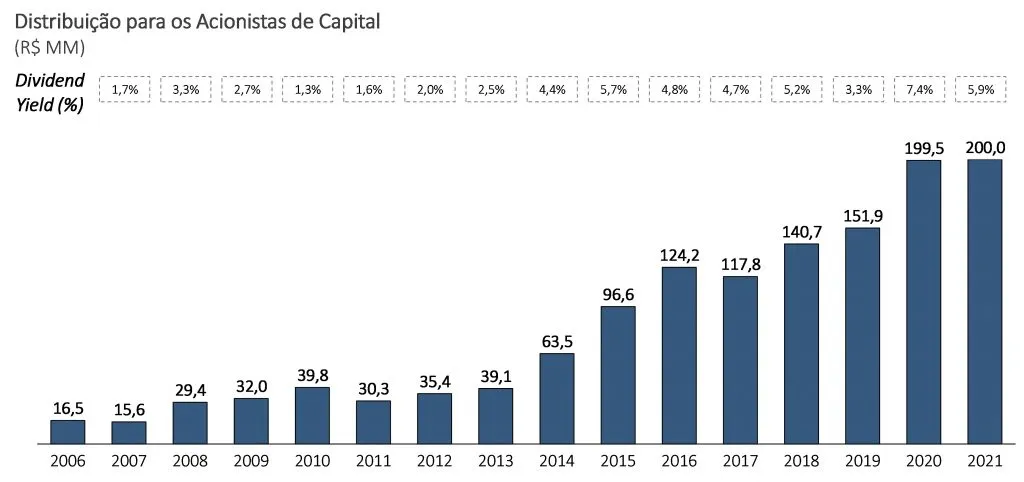
As mentioned previously, Wilson Sons has made significant investments over the past decade. A highlight is the expansion of the Tecon plant in Salvador, which was completed in March 2021 and resulted in a capacity increase of 110%. Now, especially in the Tecon operation, the company has significant room to grow without the need for new investments for several years and could allow for an increase in dividends.
Chart 7 – Historical Capex and Dividends
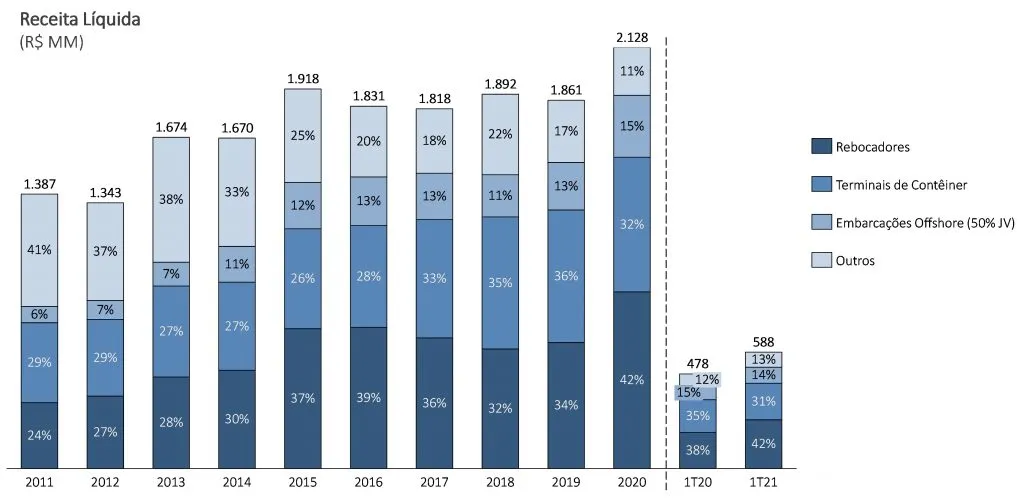
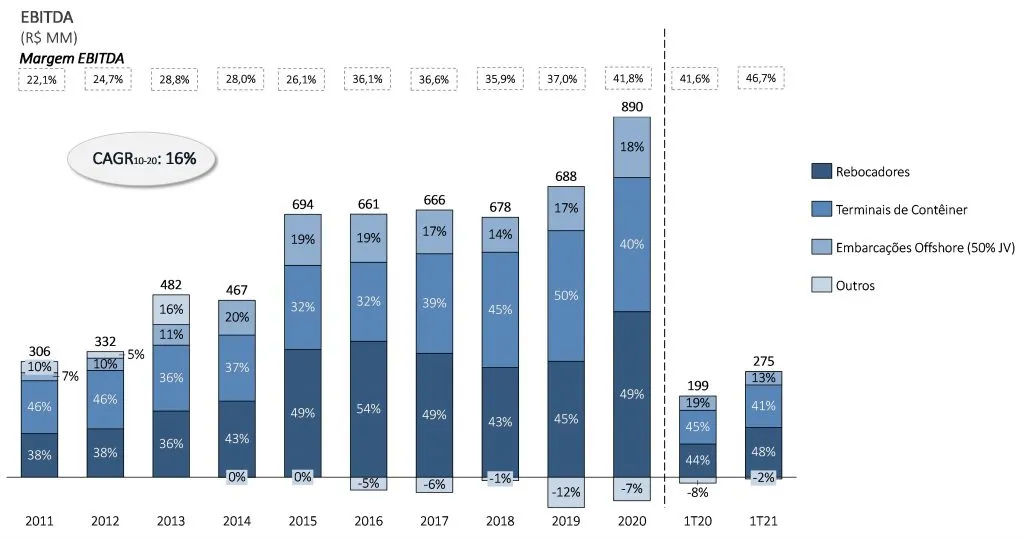
It's worth noting that, even with the crisis we've been through over the last decade, Wilson Sons has proven to be quite resilient, growing its results at a rate of 16% per year from 2011 to 2020. During this period, the company implemented operational improvements and benefited from an increase in the dollar (many of the company's operating segments have dollar-denominated revenue):
Chart 8 – Historical Net Revenue and EBITDA
Valuation
Quanto ao valuation, nossas estimativas são que, em cenários conservadores, a empresa parece bastante descontada, mesmo considerando a subida recente no preço das ações. Estimamos que a empresa esteja negociada a cerca de 12-14x seu patamar de geração de caixa, o que parece bastante atrativo. Combinando com as boas perspectivas de crescimento que poderão ocorrer sem a necessidade de grandes investimentos, acreditamos ser uma ótima oportunidade.
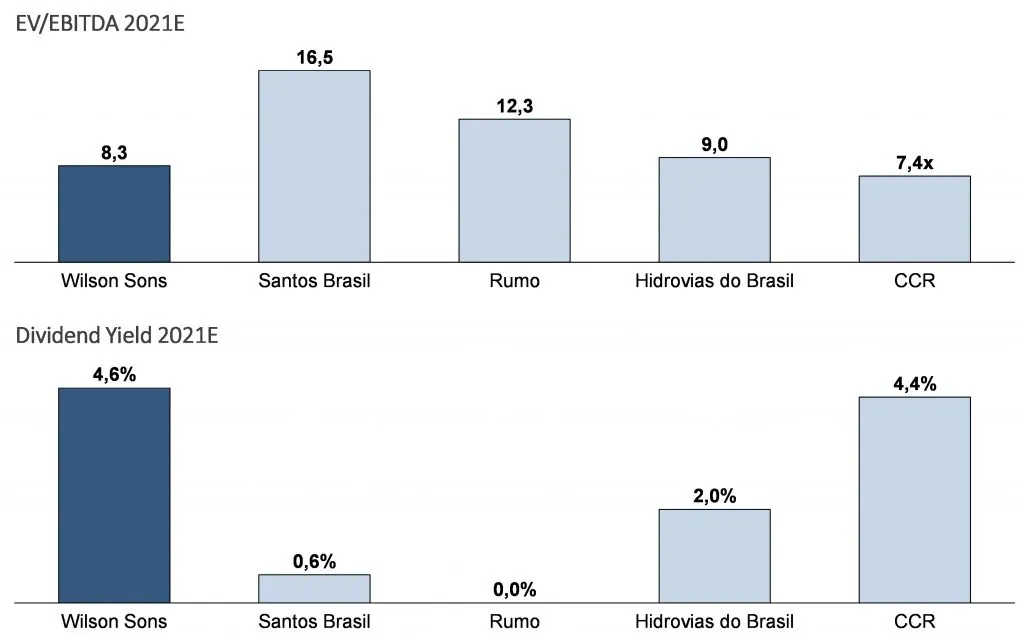
In comparative terms, the table below shows that Wilson Sons is still the cheapest company in the sector:
Chart 9 – Comparison of multiples4
1 BDRs (Brazilian Depositary Receipts) are share certificates for companies headquartered abroad. They operate similarly to common shares.
2 From the announcement on 05/23/21 to the closing price on 06/14/21
3 IRR: Internal rate of return. This metric represents the fund's annualized return.
4 Reference date 06/11/2021