

The turning of the tide in the stock market
Dear investors,
Over the past 4 months, the IBOV has risen around 20%. It is therefore natural to ask whether there are still good investment opportunities in the stock market, or whether the market has already adjusted to something close to what should be a normal price level.
Before addressing this question, let us revisit the stock market's history over recent years — from the pandemic to the present — which forms the necessary backdrop for reflecting on what the future may hold.
The Pandemic Shock
In 2019 and early 2020, interest rates were quite low (4.5% at end-2019 and 2.0% at end-2020), and finding cheap stocks was an arduous prospecting exercise. When the pandemic began to take on major proportions in late February 2020, the IBOV fell around 40% within the space of a month, reflecting the fear and uncertainty that surrounded global markets in the face of an atypical threat whose consequences were very difficult to quantify.
Surprisingly, following that decline, the stock market rose more than 75% by the end of 2020, surpassed its pre-pandemic peak, and continued rising until June 2021, when the IBOV reached 130,000 points — nearly double the low of 67,000 points reached in March 2020.
This rapid recovery was partly driven by the world's demonstrated ability to adapt to the health restrictions imposed by the pandemic and to maintain a reasonably productive economy. However, two other factors also played an important role in this upward cycle.
The first — and most impactful — was massive government action to stimulate the economy, both in Brazil and around the world, through the distribution of subsidies and expansionary monetary policies. This is how the SELIC rate fell to 2%, and this is how the seeds of the inflation problem of the following years were sown.
The second factor was a wave of market enthusiasm for this low-interest-rate environment, and for certain sectors that were boosted by the sudden shift in consumption patterns caused by restrictions (e.g., technology and e-commerce), along with a narrative that a “new normal” had arrived in which interest rates would remain low and these businesses would continue to flourish. The theory did not take long to collapse.
Amid all the enthusiasm of the time, it was ignored that no expansionary monetary policy is sustainable for long, and that the restrictions imposed during the pandemic period could only have caused a negative economic impact. Production stoppages, changes in production methods, and additional health protection measures came at enormous costs, with no positive offset. From July 2021 onward, these factors began to weigh on the market and the stock market's upward cycle was interrupted.
The Hangover and the War
In the second half of 2021, reality came knocking. Inflation rose — driven by the monetary policy adopted during the pandemic — and to combat it, the Central Bank began raising interest rates. Over a year and a half (Mar/21 to Aug/22), rates rose from 2.0% to 13.75%. At the same time, the thesis of the “new normal” lost traction as the world gravitated back to the “old normal” after health restrictions were lifted.
As if that were not enough, in February 2022 the war between Russia and Ukraine began, in which much of the Western world ended up becoming politically involved and acting through economic sanctions. The main impact was felt in commodity markets where Russia was an important supplier. The sanctions caused a negative supply shock and drove prices up rapidly, worsening the global inflation problem.
Brazil did not suffer as much from the Russia-Ukraine war, given its distance from the center of the conflict — both geographically and politically — and because it is a commodity-exporting economy that benefited from the commodity price upswing. However, we were significantly impacted by the Central Bank's monetary tightening policy employed to combat inflation. High interest rates, maintained over an extended period, had a strong contractionary effect on our economy, suppressing consumption and weighing on the balance sheets of several companies that had leveraged up during the low-interest-rate period.
Beyond this effect on the real economy, high interest rates caused a massive reallocation of capital between asset classes. With the opportunity to invest at 13.75% per year “risk-free” and a macroeconomic environment full of uncertainty, a large portion of Brazilian investors redeemed their capital from equity funds and multi-strategy funds, transferring it to fixed income. This movement naturally weighed heavily on the prices of listed shares.
This is the very brief summary of the bear market cycle we went through between June 2021 and March 2023, a period in which the IBOV fell from 130,000 to around 100,000 points (-23%). Let us now turn to the more recent developments that drove the stock market's upward move from April of this year onward.
Stock Market Recovery
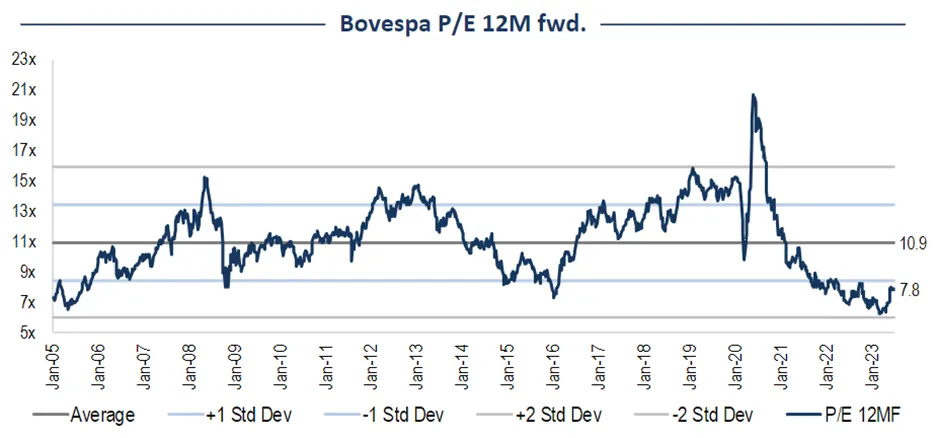
The rate cut itself had long been anticipated, but the exact timing of its start and the pace of the decline were still uncertain. As the Central Bank began signaling that it would initiate the rate reduction process, the market began to react by reallocating capital back to equities. Greater clarity about the Central Bank’s intentions was the trigger for the recent stock market rally, but it was undoubtedly helped by the fact that the market was very cheap at the time, with valuation multiples close to 2 standard deviations below the average.
Source: BTG Pactual
Note that, even after the recent rally, valuation multiples remain 1 standard deviation below the average. While this is a broad metric, it makes clear that we are far from an overheated market. There are two other factors that support the view that we are likely at the beginning of a new, longer upward cycle in the stock market.
The first is that the effect of rate cuts on the real economy only materializes some time after the rate is already lower, since it is the genuinely lower cost of credit that will rekindle demand, and only after months of stronger demand will the resulting financial performance show up in companies' financial statements. We are therefore still looking at weak financial results today, pressured by the contractionary monetary policy, and no matter how much the market tries to anticipate the improvement based on the expectation of rate cuts, recent history always exerts a strong anchoring effect on projections. As the economy reheats, several businesses will likely deliver results better than those currently assumed.
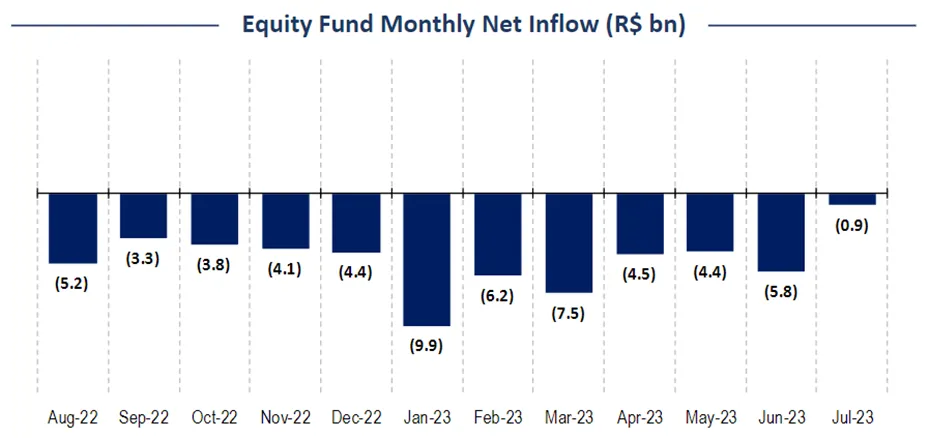
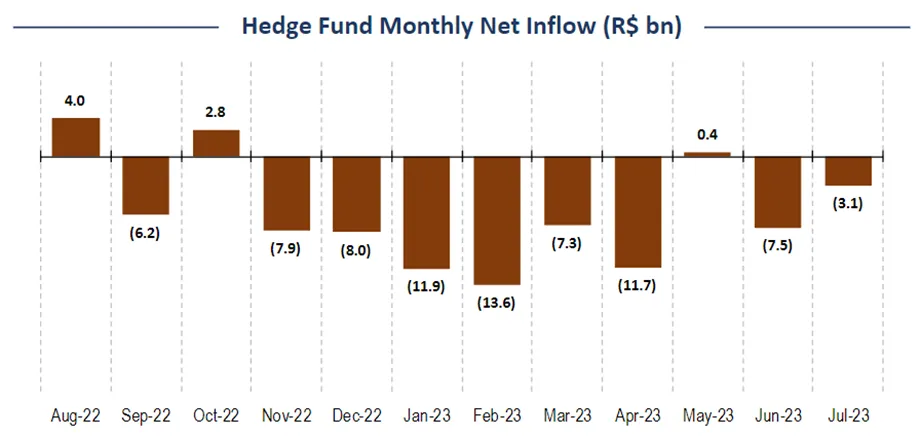
The second factor is related to the reallocation of capital back to equities, which should occur over the coming semesters and reverse the massive wave of redemptions from equity funds and multi-strategy funds that we saw in 2022 and the first half of 2023. This movement has not yet even begun, as the funds still recorded negative flows in recent months.
Source: BTG Pactual
Some investors are certainly already anticipating and reallocating capital back to equities, but most of the market will probably maintain its fixed income investments while interest rates remain high, only seeking to reallocate after the effective rate cut. That is, there are still many potential stock buyers to drive a new upward price cycle.
Positive Optionalities
Beyond the already anticipated rate cuts and the positive capital flow to equities that they should generate, there are other more uncertain elements that could be sources of future positive surprises.
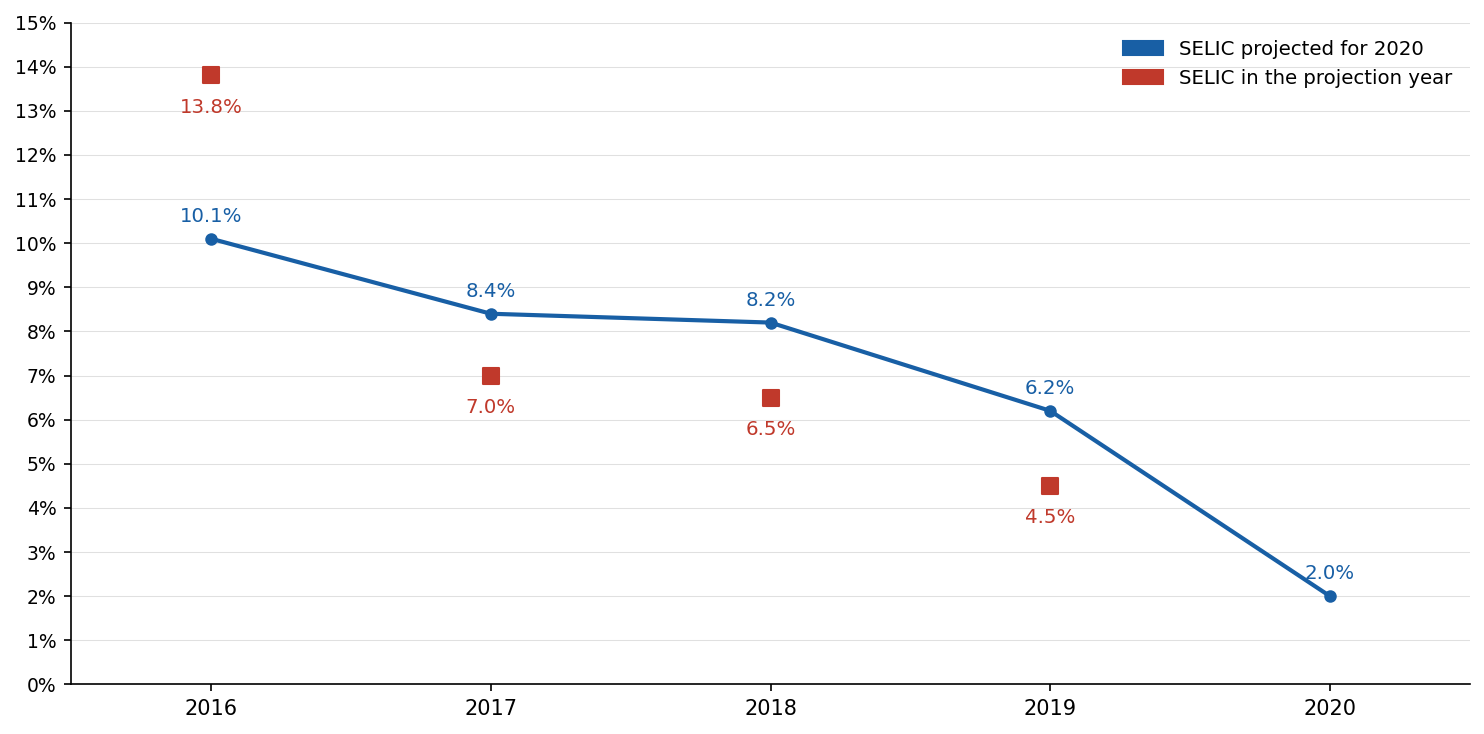
One of them is the fact that market interest rate projections are generally subject to an anchoring effect based on the level of the interest rate at the time the projection is made, as can be observed in the evolution of projections compiled in the Central Bank's Market Expectations System. Below we present the history of projections for two years in which the SELIC rate was at its extremes: 2020 and 2023.
Historical projections for the SELIC Rate in 2020
Historical projections for the SELIC rate in 2023
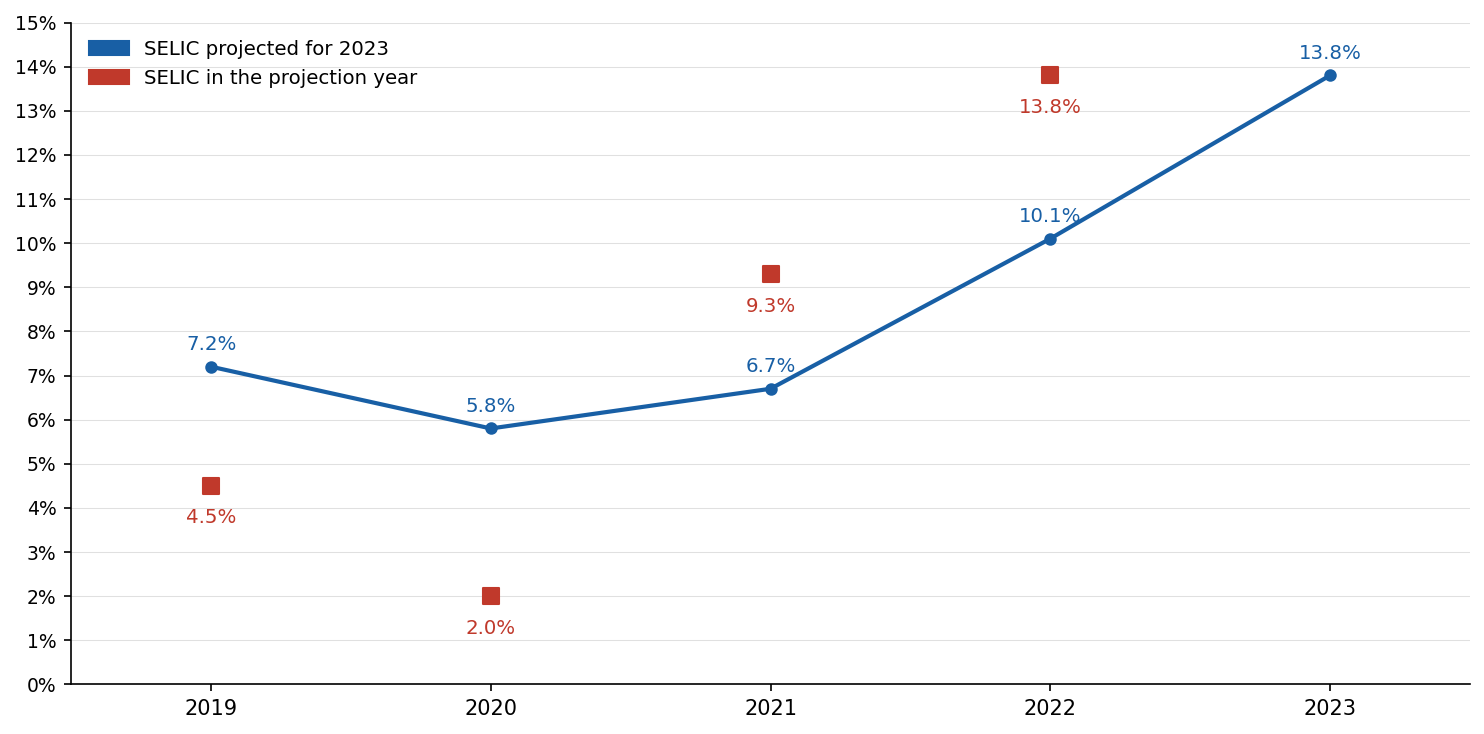
Source: BACEN – Market Expectations System
There is therefore some chance that the long-term interest rate currently projected by the market is overestimated, having been forecast while the rate is elevated. If realized interest rates prove lower than projected, there will be a positive impact on share prices.
We also anticipate the approval of the tax reform, which would bring major simplification to the Brazilian tax system, standardize the rates paid by different economic activities, and could thus bring productivity gains to the national economy. While it is difficult to quantify the impact of the potential reform, it is very likely to be positive. In May 2023 we wrote about this reform. Although some of the proposal’s terms have changed since then, the main concepts we explored still hold.
Brazil may also benefit from the trend toward decentralization of supply chains, which are currently heavily concentrated in Asia — a topic that gained prominence following supply disruption problems during the lockdowns and the Russia-Ukraine war — and from global efforts to decarbonize the economy, leveraging the clean energy matrix we have in our country. We spoke about these trends in greater detail in our November 2022 letter.
Stock Market Outlook
Even after the recent rally — which started from a price base resulting from difficult years for the stock market — the market still looks cheap to us, with interesting opportunities in well-selected companies. Added to this, the less contractionary monetary policy that the Central Bank announced it will adopt going forward will also contribute to the recovery of Brazilian companies and, consequently, to the share prices of listed companies. Finally, we see more positive factors than major threats to the Brazilian economy today, and we believe we are likely at the beginning of a new upward trend in the stock market. There will certainly be periods of price decline, as is natural in equity markets, but we are optimistic about the long term.
In any case, there is always the work of separating the wheat from the chaff. Not every listed company is cheap, and it is important to maintain the discipline of identifying high-quality businesses and only buying shares at prices that offer a comfortable margin of safety. In the current environment, we have been able to identify excellent opportunities, and the capital under our management is almost fully invested in companies we believe have excellent prospects for the coming years.